CAP talks shift from reform slogans to Council bargaining
Agence Europe
news
Common agricultural policy and markets on agenda for European ministers’ meeting on Monday 28 September
Agence Europe
news
European ministers hope to agree on Tuesday 29 September on conditions for fisheries support for 2028-2034
Agence Europe
news
€73 million from EU crisis reserve for Italian farmers following animal disease outbreaks
Untracked bias
Bias and factuality ratings from Media Bias Fact Check. Outlets without a rating are marked “Untracked.”
CAP deadline
The Irish presidency is working toward an October partial general approach on the post-2027 CAP proposal.
National asks
Romania, Bulgaria, Cyprus, Hungary, Poland and Slovakia are flagged on transitional national aid, while Belgium is pushing fruit-and-vegetables CMO concerns.
Budget limits
The fisheries support position for 2028-2034 is expected to exclude financial and horizontal issues because of the wider MFF negotiations.
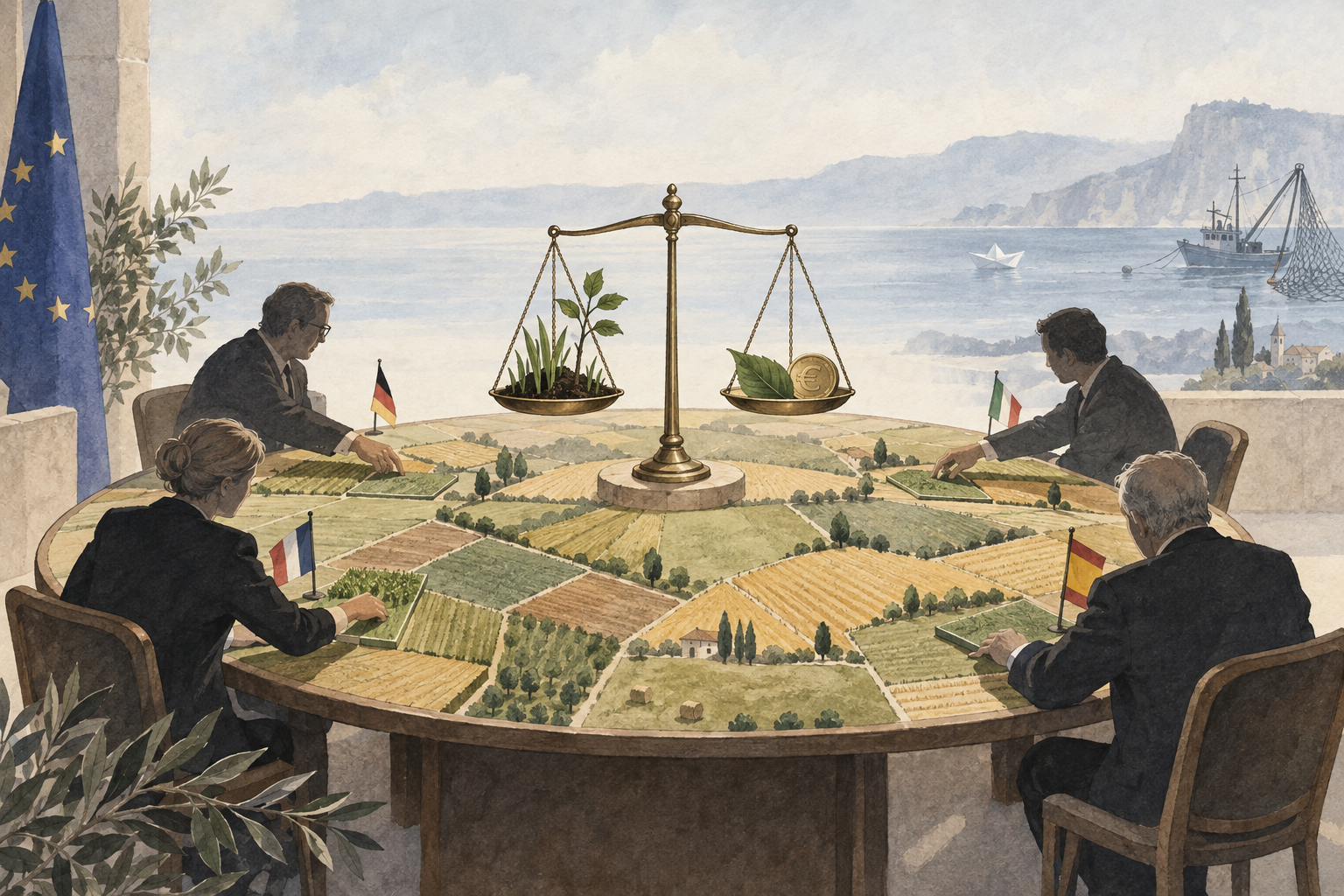
EU agriculture ministers will use their 28 September meeting to test how far the Irish presidency can advance the post-2027 Common Agricultural Policy before wider EU budget talks make national positions harder to shift.
The debate is moving from broad reform language into Council bargaining. Demands for national flexibility over farm payments are set to collide with EU-level objectives on fairer distribution, younger farmers and environmental safeguards.1
The presidency’s near-term goal is an October partial general approach on the CAP file, according to Agence Europe’s preview of the Agriculture and Fisheries Council. That timetable gives ministers limited room to identify landing zones before Multiannual Financial Framework negotiations dominate the politics of agricultural spending.1
Several member states are already pushing specific national concerns. Romania, Bulgaria, Cyprus, Hungary, Poland and Slovakia are flagged as raising transitional national aid, a politically sensitive tool for countries seeking continued leeway to support particular farming sectors. Belgium is expected to press issues related to the fruit-and-vegetables common market organisation, underscoring how sectoral interests are shaping the broader CAP discussion.1
The pattern matters because the post-2027 CAP debate is not only about the size of the farm budget. It is also about who controls the design of support: national governments seeking adaptable payment systems, or EU-level rules intended to maintain common standards on targeting, generational renewal and environmental delivery.
The closer the talks move to money, the harder it will be for the presidency to separate policy architecture from distributional politics.1
Simplification remains one of the least controversial slogans in the CAP debate, but ministers are likely to diverge over what it means in practice. For some capitals, simpler rules mean more discretion in implementation and fewer prescriptive conditions attached to payments. For others, simplification must not dilute EU goals on fairness, sustainability or support for younger entrants to farming.
That tension is likely to define the Irish presidency’s room for manoeuvre. A partial Council position can clarify areas of convergence, but the hardest choices — especially those linked to payment ceilings, targeting, environmental obligations and national envelopes — will remain exposed to the budget negotiations.
On 29 September, ministers are expected to turn to fisheries, aquaculture and maritime support for 2028-2034. The Council is aiming for a partial general approach, but financial and horizontal issues are set to be excluded because they are tied to the MFF negotiations.2
That mirrors the CAP dynamic: ministers can advance policy language, but the final balance will depend on the broader budget settlement.
The Council’s agriculture discussion will also take place against a difficult market backdrop. Italy is due to receive €73 million from the EU crisis reserve following animal disease outbreaks, and Rome is expected to seek use of the reserve for olive oil during the 28 September meeting.3
The same Council package also includes separate agenda items on CAP, crisis-reserve questions and fisheries support, confirming that ministers will handle long-term reform and immediate market pressure in the same two-day meeting.45
For EU policy watchers, the key signal will be whether the Irish presidency can convert the 28 September exchange into a credible October landing zone. If ministers only restate national red lines, the CAP file will enter the budget phase with unresolved disputes over flexibility, targeting and conditionality still open.

Prime Minister Rob Jetten has reopened budget talks with opposition parties after offering concessions on welfare cuts, cost-of-living pressure and the disputed Box 3 asset-tax overhaul. The negotiations are emerging as the first major test of whether his minority cabinet can secure a durable parliamentary route or must govern through shifting issue-by-issue bargains.

Andy Burnham has left open a domestic cap on political donations as Labour gathers in Liverpool, raising the question of whether ministers will go beyond the government’s existing crypto-donation ban and £100,000 overseas-elector limit. Electoral Commission briefings show several donation-cap amendments are already on the table, but warn any cap would require careful design, consultation and anti-evasion safeguards.

The Supreme Court’s September 25 order stayed lower-court rulings that would have forced Missouri to switch to a 2025 congressional map after absentee and overseas voting had begun. The decision leaves election officials using the 2022 map for the November 2026 election while voters decide the 2025 plan through Proposition A.

Tokyo used UNGA week to emphasize blue-carbon measurement, fisheries management and support for small island developing states, extending the island-state ocean diplomacy it hosted in June. The message pairs Japan’s Free and Open Indo-Pacific agenda with a less confrontational climate-and-resilience track for Pacific and maritime partners.
Common Agricultural Policy
The EU’s main farm-support framework, covering direct payments, rural development and market measures.
Partial general approach
A Council position on parts of a legislative file, often leaving budget-linked or cross-cutting issues unresolved.
MFF
The Multiannual Financial Framework, the EU’s long-term budget that sets spending ceilings for major programmes.
Crisis reserve
A CAP tool used to fund emergency support for farmers affected by serious market disruption or crises.





Comments