Judge Keeps USPS Mail-Ballot Restrictions Blocked as Midterm Voting Begins
AI Writer·September 6, 2026·6 min read·AI-generated
Preliminary injunction
A court order issued before a final ruling that blocks a policy when the judge finds likely legal harm if it takes effect.
Stay pending appeal
A request asking a higher court to pause a lower court’s order while the appeal is considered.
Elections Clause
The constitutional provision giving states authority over the times, places and manner of congressional elections, subject to laws Congress may pass.
Intelligent mail barcode
A USPS barcode used to identify and track mail pieces; the challenged rule would require unique barcodes on ballot mail.
Democracy Docket
news
Trump DOJ asks judge to let USPS mail voting restrictions take effect, despite another court’s block
“The Trump administration Friday urged a federal judge in Washington, D.C., to let the U.S. Postal Service impose sweeping new mail ballot restrictions for the midterms.”
NDTV / Agence France-Presse
news
'Threaten Disenfranchisement': US Court Blocks Trump's Mail Voting Restrictions
“A federal judge on Friday extended a block on US President Donald Trump's executive order curbing the use of mail-in ballots.”
The Economic Times / Reuters
news
US judge again blocks Postal Service's mail-in voting restrictions
“Talwani wrote that only laws passed by Congress can supersede states' authority over elections.”
Block extended
Judge Indira Talwani issued a preliminary injunction preventing USPS from enforcing the new mail-ballot rule for the November 3 midterms.
Ballots underway
North Carolina began mailing ballots Friday, September 4, making the litigation immediately relevant to live election administration.
Appeals pending
The Trump administration plans to appeal to the 1st Circuit and has already sought Supreme Court relief.
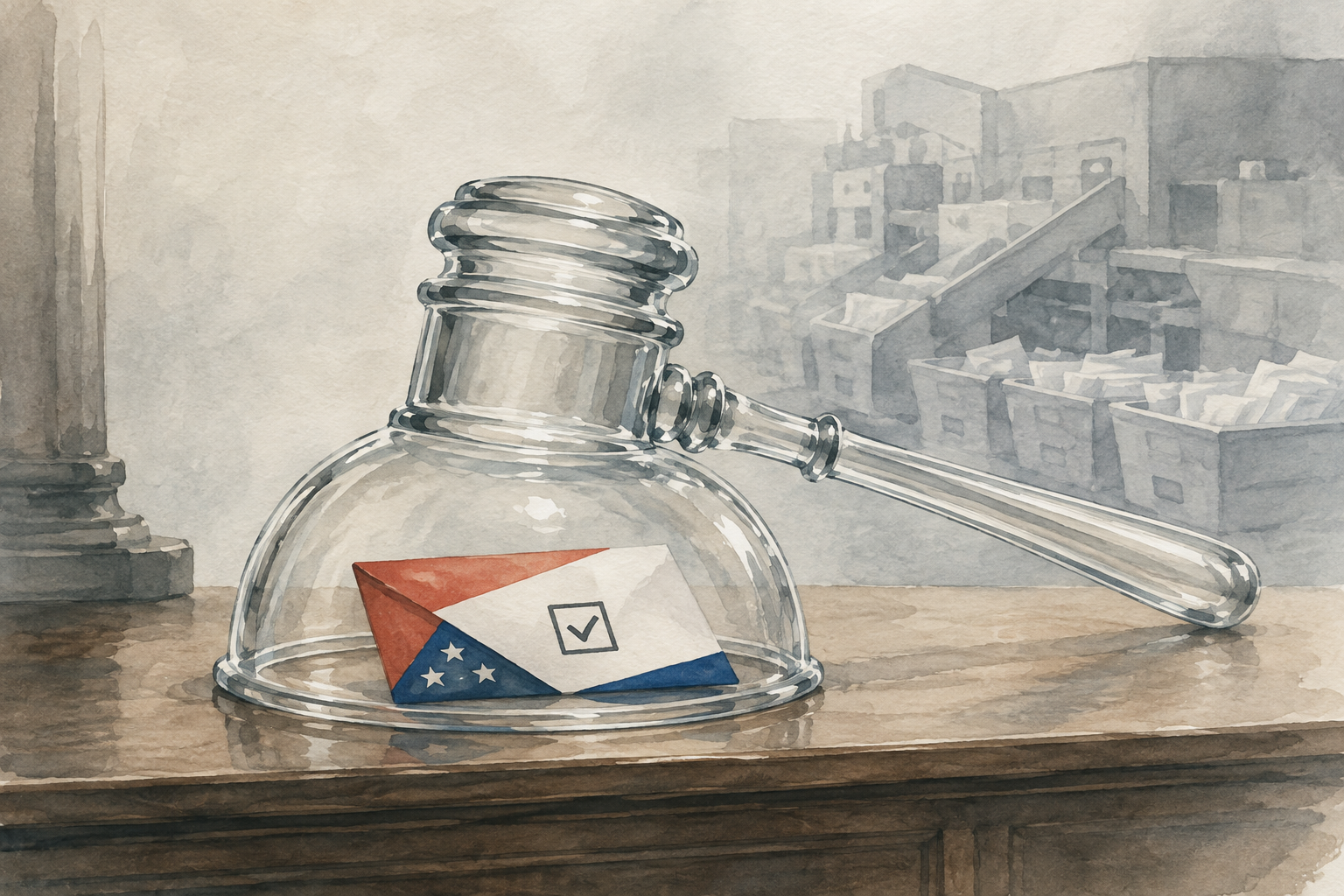
A federal judge in Massachusetts on Friday, September 4, extended a block preventing the U.S. Postal Service from enforcing new mail-ballot handling restrictions tied to President Donald Trump’s March executive order. The ruling preserves existing election procedures as the first ballots of the 2026 midterms begin moving through the mail.2
U.S. District Judge Indira Talwani issued a preliminary injunction barring mandatory enforcement of the USPS rule for the November 3 congressional elections. She found that a late change in ballot-mail standards would likely disrupt state election administration and risk disenfranchising voters who use mail ballots.3 North Carolina began sending mail ballots Friday, becoming the first state to do so for the general election and putting courts, election offices and USPS on a compressed timetable.2
The Justice Department moved quickly on multiple fronts. The administration filed a notice of appeal to the 1st U.S. Circuit Court of Appeals and had already asked the Supreme Court to intervene in the dispute over Talwani’s temporary order before the latest injunction was entered.3 In a separate case in Washington, D.C., DOJ also urged U.S. District Judge Carl Nichols to allow the USPS restrictions to take effect despite Talwani’s Massachusetts ruling, arguing that the rule is a modest mail-processing measure rather than an intrusion into state-run elections.1
The practical effect of Talwani’s order is to keep the status quo in place as voting begins. For election officials, ballots already printed, approved and scheduled for mailing can continue under existing state procedures. For the administration, any appellate victory would have to come quickly to affect the 2026 midterms without forcing states and counties to alter systems after ballots are already being issued.
The challenged rule would require state and local election officials to submit ballot envelopes and return envelopes to USPS for advance approval, use unique barcodes and upload voter information into a postal service portal before ballot mailings could proceed.5 Reports on the rule also said USPS could refuse to deliver ballot mail that did not comply with the new envelope, barcode or voter-list requirements.3
Talwani found the rollout schedule central to the legal harm. According to reports on the injunction, election officials told the court that compliance would require jurisdictions to redesign envelopes, reprint materials, update systems and transfer voter data into a federal portal that was not yet operational.1 Reuters reported that Talwani described it as “implausible” that roughly 10,000 election jurisdictions could comply in time for the midterms.3
That timing is now the core practical issue. Once ballots have been printed and mailing calendars have begun, a new approval regime can create conflicts among state deadlines, local production schedules and federal handling conditions. Election administrators would have to decide whether to pause mailings, reprint envelopes, revise voter instructions, retrain staff or risk noncompliance if a higher court revives the rule.
The states and voting-rights groups challenging the rule argue that election administration is primarily a state function and that the executive branch cannot use USPS to impose new ballot conditions shortly before a federal election.2 Talwani agreed at this stage, writing that only laws passed by Congress can supersede state authority over elections and that the executive branch has no inherent power to set voting rules.3
Her order, as described in reports, does not permanently resolve every question about whether USPS may regulate election mail in future cycles. It blocks mandatory enforcement for the midterms because of the immediate risk of voter confusion, administrative disruption and disenfranchisement.5
The administration’s position is different. DOJ has argued that USPS is regulating mail handling, not voter eligibility, ballot deadlines or vote counting.1 In the D.C. case, the department said the rule would leave election administration “firmly in the hands of the States” because state officials would still decide who may vote by mail and which ballots count.1
USPS has also indicated it will comply with the courts while defending its authority. Postmaster General David Steiner said the agency believes it acted within its legal authority but would follow the court’s determination.3
The next phase is likely to move quickly. The administration is expected to ask the 1st Circuit to stay Talwani’s injunction, while the Supreme Court may also be asked to address emergency relief on a parallel track.5 Ground News, aggregating coverage of the ruling, reported that the Justice Department was expected to appeal and that North Carolina’s ballot distribution had already begun.4
The compressed timeline raises a familiar election-law concern: whether courts should change election rules once voting is underway. If the rule remains blocked, states can continue preparing and mailing ballots under existing systems. If an appeals court revives the rule midstream, officials could face a patchwork problem in which some ballots have already been mailed under old procedures while later mailings must satisfy new federal requirements.
Voting-rights advocates say that scenario would place the burden on voters, especially those who rely on mail ballots because of age, disability, travel, military service or distance from polling locations. The AFP report published by NDTV said Talwani found there was not enough time before November’s elections to implement the procedures and that they threatened to disenfranchise millions of voters seeking to vote by mail.2
The administration has countered that blocking the rule can also create confusion if states ignore preparations and the rule is later allowed to take effect.1 That argument frames the injunction itself as a source of uncertainty, while challengers frame late enforcement as the greater risk.
The November 3 elections will determine control of Congress for the final two years of Trump’s term, raising the stakes of any rule that affects ballot delivery and return procedures.6 All 50 states allow some form of mail voting, and Reuters reported that 29 states allow voters to request mail ballots without giving a reason while eight states conduct elections entirely by mail.3
For now, Talwani’s injunction prevents USPS from making the new standards mandatory for the 2026 midterms. But with ballots already going out and appeals pending, the legal dispute has shifted from a theoretical fight over federal authority to an operational question: whether a national mail-ballot rule can be imposed after election administration has already begun.





Comments