Moldova spillover turns Russia’s Odesa campaign into broader European risk
Untracked bias
100% of tracked sources are High factuality
The Kyiv Independent
Russian strike on Liberian-flagged cargo ship in Black Sea kills 1, injures 3
The Kyiv Independent
5 Russian missiles and drones exploded over Moldova's airspace, Sandu says
Bias and factuality ratings from Media Bias Fact Check. Outlets without a rating are marked “Untracked.”
Six flights
Moldova said it detected six unauthorized aerial flights on Oct. 3, including five objects that impacted Moldovan territory.
Port strike
A Russian strike hit a Liberian-flagged cargo ship in an Odesa-region port, killing one crew member and injuring three.
European risk
The incursions show how attacks on southern Ukraine can spill into Moldova and widen the security burden beyond the battlefield.
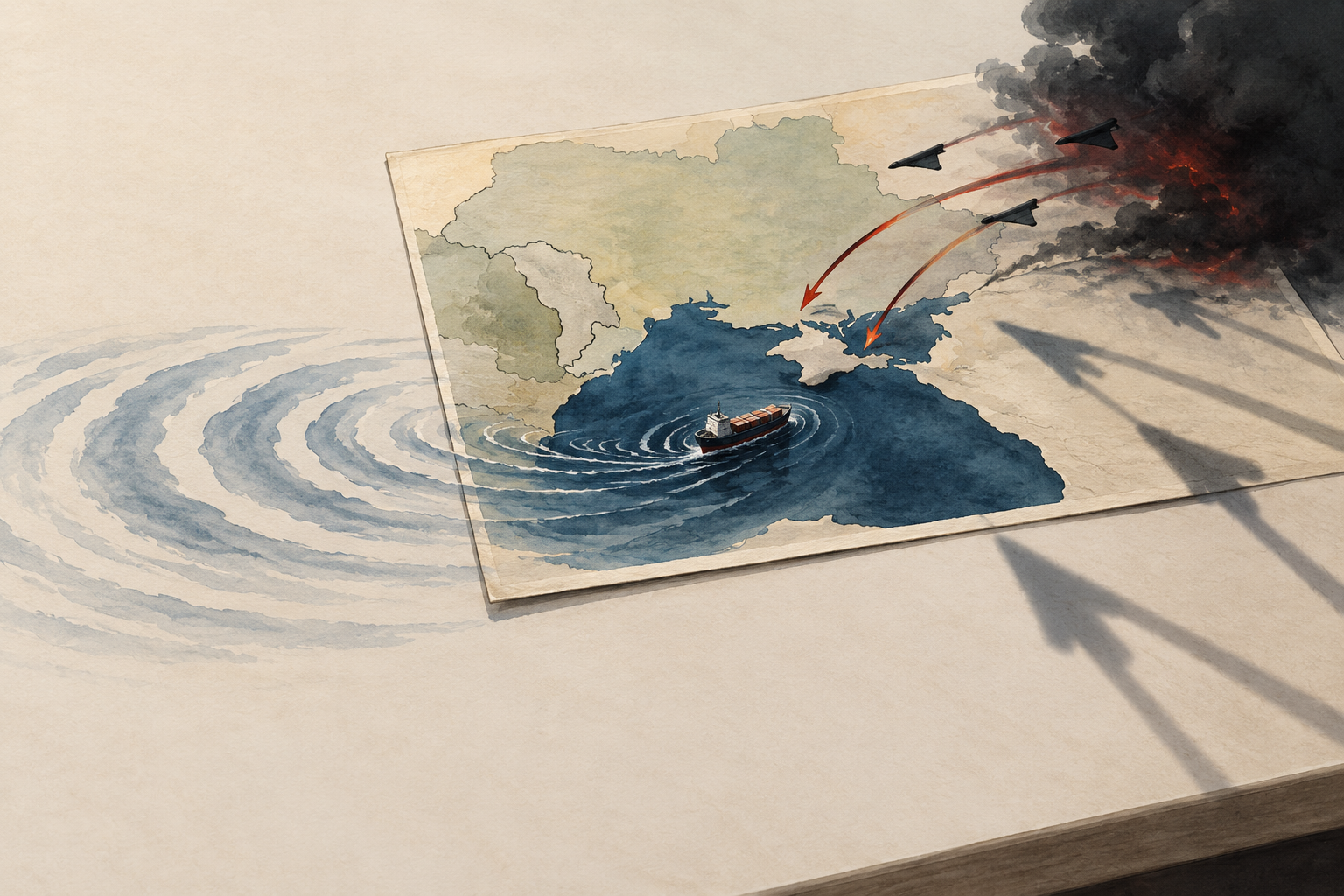
Russian air attacks on Ukraine’s Odesa region on Oct. 3 spilled into Moldova, where authorities said five aerial objects — three missiles and two drones — struck Moldovan territory. A sixth unauthorized flight briefly crossed from Ukraine’s Odesa region toward Palanca before returning to Ukraine.1 The incursions, along with a strike on a Liberian-flagged cargo ship at an Odesa-region port, suggest Russia’s southern air campaign is creating a broader European security risk around the Black Sea trade corridor and Moldova’s vulnerable border region, even without a formal battlefield breakthrough.35
Moldovan President Maia Sandu said five Russian air-attack weapons, including Banderol missiles and drones, violated Moldovan airspace and exploded on Moldovan soil during Russia’s latest attack on Ukraine.34 Moldova’s Defense Ministry later said its surveillance systems detected six unauthorized flights on Oct. 3. That total included an additional object that entered Moldovan airspace at 8:04 a.m. from the direction of Udobnoe in Ukraine’s Odesa region, flew toward Palanca, and exited one minute later toward Bilyaivka, Ukraine.1
The immediate damage in Moldova appears to have been limited. Authorities reported explosions near several localities and sent police and army teams to investigate, while warning residents not to touch unidentified objects or fragments.2 But the operational signal is more significant than the physical damage. The objects did not fall in isolation; they landed across districts adjacent to the same air and maritime battlespace Russia is using to pressure Odesa, Ukraine’s southern export gateway and a long frontier with Moldova.410
The latest Moldovan incursions occurred as Russia attacked the Odesa region, home to multiple Black Sea ports. The Ukrainian Sea Ports Authority said Russian forces struck a civilian cargo vessel under the Liberian flag in an Odesa-region port, killing a motorman and injuring three other crew members.5 Reuters reported that 13 other crew members were evacuated and that Russia has renewed pressure on Ukrainian Black Sea ports since the summer, disrupting trade routes and weighing on grain and steel exports.6
That makes the Oct. 3 events more than an airspace violation. They connect three sensitive systems: Ukraine’s port economy, international merchant shipping and the airspace of a small European state bordering the strike zone. AP reported that Odesa, toward which the Banderol cruise missiles were launched, shares a long land border with Moldova, underscoring why attacks on southern Ukraine carry built-in spillover risk.3
The pattern also complicates threat assessment. If Russian systems are routed near Moldova to approach Odesa targets, or if loitering munitions, decoys and missiles fail or are diverted by Ukrainian defenses, Moldova can become an unintended impact zone. If Russian planners instead tolerate or deliberately use flight paths that violate Moldovan airspace, the risk becomes more coercive: Moldova is exposed to the consequences of strikes without being a battlefield actor.
The Oct. 3-4 air campaign fits a broader Russian tactic of disrupting infrastructure through repeated, overlapping attacks. In Kyiv, Russian strikes damaged the Northern Bridge over the Dnipro River, halting traffic and damaging trolleybus lines, after previous strikes forced closures or restrictions on other bridges in the capital.37 The Kyiv Independent cited an aviation expert who said the bridge attacks appeared less likely to destroy major spans than to interrupt traffic, logistics and civilian routines.7
That logic applies to southern Ukraine and Moldova. Russia does not need to capture Odesa or advance toward Moldova to alter the operating environment. Repeated air attacks can raise insurance, shipping and port-operation risks; force Ukrainian air defenses to cover wider corridors; and pressure Moldova to monitor, investigate and politically respond to incidents on its soil.
Ukraine’s Air Force said Russia used massed drones and Banderol/Dan-T missiles in the following overnight attack, with Ukrainian air defenses neutralizing 123 of 135 drones and two Banderol/Dan-T missiles.9 AP described Banderol cruise missiles as low-cost, jet-powered loitering munitions used by Russia to overwhelm Ukrainian air defenses.3 Saturation matters because the more objects Russia launches near the Odesa-Moldova border, the greater the chance that failures, misroutes or intercepted debris will cross into Moldovan territory.
Moldova’s Defense Ministry initially reported multiple explosions near Moldovan localities including Crocmaz, Ștefan Vodă, Delacău, Puhăceni, Anenii Noi, Bozieni, Hîncești, Dubovca, Constantinovca and Căușeni. It also said national airspace had been overflown near Anenii Noi, Ștefan Vodă, Tudora and Căușeni.2 Its later clarification identified the five impacted aerial objects and the sixth one-minute crossing near Palanca.1
Open-source reconstructions indicate the blast sites were spread across four Moldovan districts within a short time window. AirVeto logged five blasts between 7:50 a.m. and 8:24 a.m. local time and noted that the Crocmaz and Dubovca sites were more than 110 kilometers apart, supporting the Moldovan account that multiple aerial objects were involved rather than one malfunctioning craft.10 GlobalMilitary.net’s incident log similarly summarized the event as three missiles and two drones exploding across four districts, with fragments reportedly resembling the Russian S-8000 Banderol and Moldova’s foreign ministry summoning Russia’s representative.11
For Moldova, the problem is structural. The country is not the main target of Russia’s Odesa strikes, but it is geographically tied to the southern air corridor and politically exposed when Russian weapons cross its airspace. Sandu’s statement that the war is “dangerously reaching” Moldova framed the incidents not as isolated debris events but as a cross-border security threat.34
The strike on the Liberian-flagged ship sharpens the maritime risk. Civilian vessels in Odesa-region ports are part of Ukraine’s export lifeline and international trade networks. When a crew member is killed and others are wounded aboard a foreign-flagged ship, the security implications extend beyond Ukraine’s coastline to insurers, shipowners, port operators and governments whose nationals or registries are involved.56
That does not mean Russia has opened a new front against Moldova or achieved a breakthrough in southern Ukraine. The available evidence instead points to a widening operational hazard: air-defense saturation, imprecise or risky routing, and repeated attacks on infrastructure and ports are pushing the effects of the war across borders.
Moldova’s exposure is therefore less about invasion scenarios than about cumulative pressure — recurring airspace violations, explosive impacts on its territory, emergency responses, diplomatic protests and the risk of casualties if future objects fall in populated areas.
European leaders are already framing Russia’s intensified air campaign as a continent-wide security issue. During German Chancellor Friedrich Merz’s Oct. 4 visit to Kyiv, AP reported that Ukrainian and German officials discussed support for Ukraine in terms of shared European security, while Russia continued strikes on Kyiv’s Northern Bridge.8 The Moldovan incidents give that framing a concrete geographic edge: a non-belligerent European state is absorbing physical spillover from Russia’s attacks on Ukraine’s south.
The latest incursions therefore mark a widening operational risk around Odesa, Black Sea ports and Moldova, even if front lines remain largely static. Russia’s campaign can internationalize danger without crossing the threshold of a declared attack on another state. Each missile or drone that crosses into Moldova tests airspace monitoring, crisis communication and political restraint — and turns the fight for southern Ukraine into a recurring European security problem.1310

Defense Secretary Pete Hegseth’s warning that President Donald Trump will keep military options available comes as U.S. naval movements signal a larger deterrent posture around Iran and the Strait of Hormuz. The buildup raises pressure on Tehran while leaving open whether Washington is seeking leverage for talks or preparing for renewed strikes.

German Chancellor Friedrich Merz arrived in Kyiv as Russia said it would intensify strikes on the Ukrainian capital and other regions. The visit underscored Berlin’s shift from arms donor to a direct stakeholder in Ukraine’s air-defense capacity, energy resilience and defense-industrial survival.

Bosnia and Herzegovina is voting in general elections that could determine whether its stalled EU accession path can move beyond promises of reform. The central test is whether the next governing configuration can deliver judicial oversight and anti-corruption changes despite entity-based veto politics and nationalist pressure.

After the Council’s 1 October approval of new EU returns rules, the focus has shifted to how governments will enforce removals, negotiate readmission with non-EU states and test return hubs outside the bloc. Spain’s lone opposition underscored unresolved legal, diplomatic and operational concerns as the asylum pact moves from legislation to delivery.
Banderol missile
A Russian jet-powered loitering weapon described in reports as a low-cost system used to pressure or overwhelm Ukrainian air defenses.
Loitering munition
A weapon that can fly or wait in an area before diving into a target and detonating.
Odesa region
Ukraine’s southwestern Black Sea region, home to major ports and a long border with Moldova.
Operational spillover
The spread of military effects, such as drones, missiles, debris or airspace violations, into territory outside the main battlefield.





Comments