Trump PSA Defense Draws Congressional Scrutiny Over Taxpayer-Funded Ads
Associated Press
news
Taxpayers have funded nearly $1.5M in pro-Trump ads. Criticism is mounting, including from the GOP
NBC News via AOL
news
White House releases new taxpayer-funded ad describing ‘final battle’
Washington Examiner
news
Thune bucks Trump’s campaign-style ‘PSA’ ads for using taxpayer money
Untracked bias
100% of tracked sources are High factuality
CNN
White House airs another government-funded ad, this time with Trump warning of ‘final battle’
Bias and factuality ratings from Media Bias Fact Check. Outlets without a rating are marked “Untracked.”
Ad spending
Taxpayer-funded ads promoting Trump have neared at least $1.5 million, with one ad-tracking estimate placing the buy above $1.7 million.
GOP concern
Senate Majority Leader John Thune and other Republicans have questioned the use of taxpayer money for campaign-style presidential ads.
Funding gap
Public reporting has not yet established which agency funds or appropriations account paid for the advertisements.
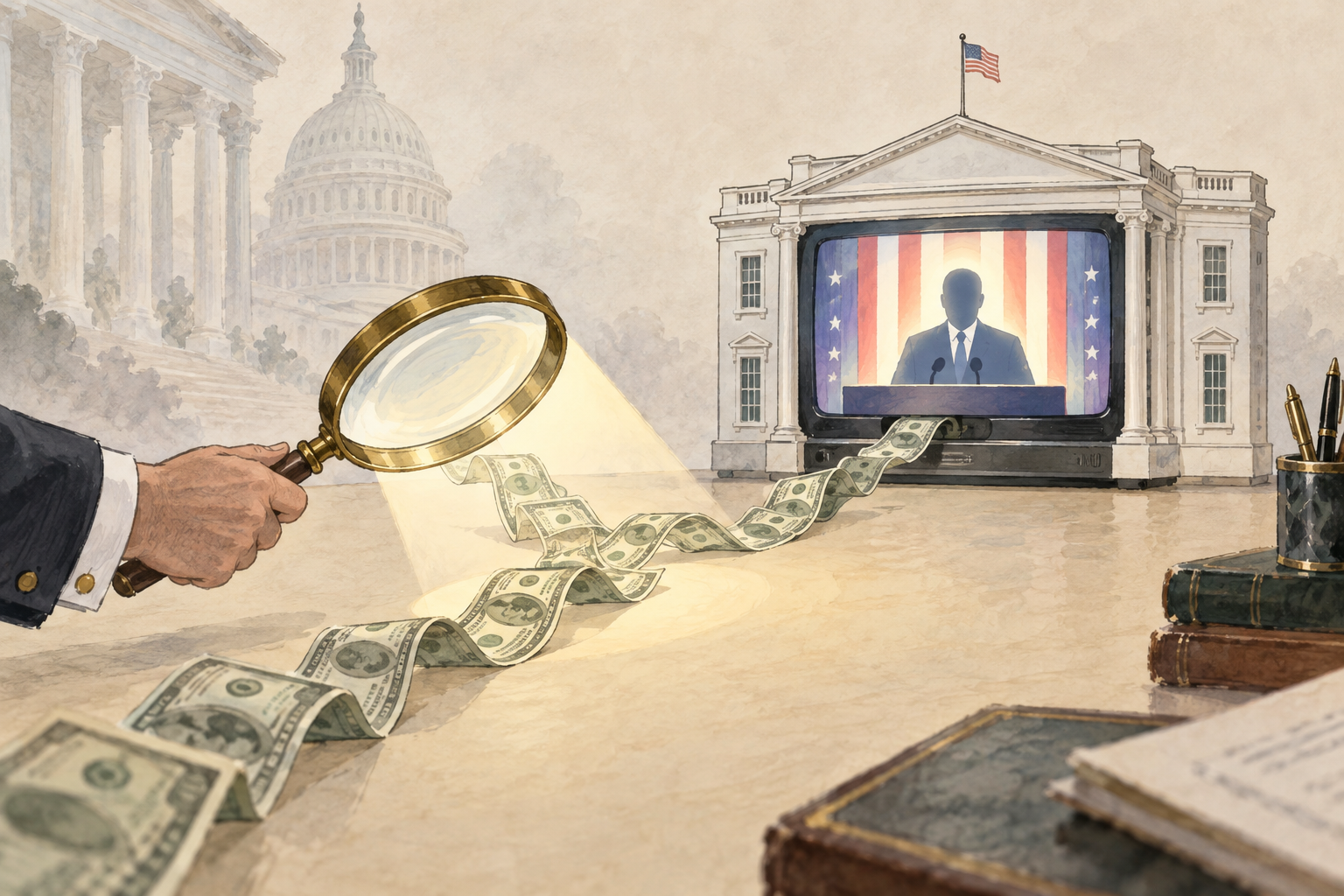
The White House is defending three taxpayer-funded television ads promoting President Donald Trump as public service announcements. But the campaign-style spots have become a separation-of-powers test for a Republican-led Congress that must decide whether to scrutinize the spending before November.1
The central questions are less about messaging than authority: which government account is paying for the ads, whether Congress appropriated money for that purpose, and whether federal publicity-or-propaganda restrictions apply.1 The spending has approached at least $1.5 million, according to Associated Press reporting. Ad-tracking firm AdImpact estimated the campaign at more than $1.7 million in placements, according to NBC News via AOL.12
The political problem for the White House is that criticism is no longer limited to Democrats or outside ethics specialists. Senate Majority Leader John Thune has publicly questioned the use of taxpayer money for the ads. Other Republicans, including Rep. Thomas Massie and Sen. John Kennedy, have also raised concerns or expressed discomfort with the optics.35 Their response could determine whether the issue remains a brief media controversy or becomes a formal oversight matter for committees that control appropriations and agency accountability.
The newest ad, the third in the series, reportedly features Trump and language resembling campaign messaging, including a “final battle” framing that critics say is difficult to separate from electoral politics.27 Multiple outlets reported that the spot overlaps with or resembles material used in Trump’s 2024 campaign advertising, intensifying questions about whether a government-funded communication is serving a public purpose or promoting a political figure.26
The White House says the ads are educational public service announcements, not campaign ads, and has argued that Trump is not on the ballot in 2026.4 That distinction may matter politically, but it does not resolve the appropriations issue. Federal agencies generally may communicate with the public, but they must spend money for authorized purposes and may not use appropriated funds for certain forms of covert or self-aggrandizing propaganda.17
The ads also carry a government-paid disclaimer, making the funding source explicit even as the underlying agency account remains unclear in public reporting.6 That gap is likely to be the first target of any serious congressional inquiry. Before lawmakers can assess legality or propriety, they need to know which department, office or program budget absorbed the cost.
For Congress watchers, the most important development is not the ad buy itself but the Republican reaction. Thune’s criticism matters because Senate leadership can decide whether discomfort becomes action: letters to the administration, appropriations riders, inspector general referrals or hearings.3
Massie’s criticism adds pressure from the House, particularly because he has often framed spending disputes as institutional and fiscal questions rather than purely partisan ones.5 Kennedy’s comments, meanwhile, underscore the awkward position of Republicans who support Trump’s agenda but are wary of taxpayer-funded messaging that looks like campaign promotion.56
That puts GOP lawmakers in a familiar bind. Ignoring the ads risks appearing to tolerate the executive branch’s use of appropriated funds for personality-driven promotion. Pursuing the issue risks antagonizing the White House weeks before November, when party unity and turnout messaging are central campaign concerns.
The key legal and oversight question is whether the ads fit within a valid government communications purpose. Agencies can run public information campaigns when Congress has provided authority and money for that outreach. But appropriations law also restricts publicity or propaganda, and watchdogs such as the Government Accountability Office have historically examined whether federally funded communications cross that line.17
Legal experts cited in coverage have pointed to two possible concerns: whether the ads are an authorized use of the funds involved, and whether they amount to promotional propaganda for the president rather than neutral public information.1 Ethics critics have also argued that the spots blur the line between official communication and political advertising, especially because of their tone, timing and resemblance to campaign materials.48
The White House’s strongest defense is that the ads are official PSAs intended to inform the public, not electioneering. Its vulnerability is that the ads appear to center Trump personally, use campaign-style themes and are airing in a politically charged pre-November environment.24
If Republican leaders pursue oversight, the first step would likely be a demand for documents: the agency sponsor, appropriations account, production contract, placement invoices, legal review and any White House communications guidance. Appropriators could also ask whether funds were transferred, reprogrammed or obligated under a general communications authority.
A second step would be to request a GAO opinion or inspector general review. That path would let lawmakers frame the issue as institutional oversight rather than direct political confrontation with Trump. It would also produce a record that could shape future limits on executive advertising.
The third option is legislative. Congress could add narrower restrictions to appropriations language barring taxpayer-funded ads that feature elected officials, candidates or campaign slogans. That route would be more confrontational and harder to complete quickly, but even the threat of it could pressure the administration to disclose funding details.
The immediate test is whether Thune and other Republicans follow criticism with oversight. If they do, the first public answers should identify the paying agency and the statutory basis for the expenditure. If they do not, the White House may succeed in normalizing a broader model of president-centered government advertising.
Either way, the controversy has already shifted from an ad-buy story to an institutional one. A communications push the White House calls public service has become a live question about Congress’s power of the purse, executive messaging and the boundary between governing and campaigning.

The government will use Commons amendments to the Lords-started Social Housing Bill to give councils new referral powers, extend social home disposal notices to eight weeks and create a Duty to Collaborate across public services. The move links protection of existing stock with homelessness prevention, while raising questions over whether councils and providers are being given new duties without a dedicated funding settlement.

A federal judge in Washington vacated DHS and FEMA conditions that would have withheld 20% of certain counterterrorism grants unless jurisdictions adopted election-administration changes. The ruling came weeks before the November 3 midterms and sets up a potential appeal over how far the executive branch can go in using public-safety money to shape local election policy.

Japan says an IAEA-led interlaboratory comparison involving laboratories from China, South Korea and Switzerland supports the reliability of monitoring around ALPS-treated water releases from Fukushima Daiichi. The finding gives Tokyo new technical evidence in a long-running regional dispute, but its diplomatic value depends on whether verification can ease seafood restrictions and political mistrust.

Japan said its UN affairs ambassador joined the inaugural ministerial meeting of the Group of Friends on Safety and Security of Shipping and Seafarers, a new India- and Liberia-backed platform responding to attacks on merchant vessels. Tokyo used the forum to reaffirm freedom of navigation, UNCLOS and safe passage through Hormuz and Bab el-Mandeb as India seeks to frame seafarer safety as a wider diplomatic issue.
Public service announcement
A government or nonprofit-style message intended to inform the public, often about policy, safety or benefits, rather than to promote a candidate.
Appropriations
Money Congress authorizes federal agencies to spend for specific purposes; agencies generally cannot spend outside those purposes.
Publicity-or-propaganda restriction
A federal spending limitation that can bar certain government-funded communications that are covert, self-promotional or designed to influence public opinion beyond authorized purposes.
GAO
The Government Accountability Office is a congressional watchdog that can review whether federal spending complies with appropriations law.




Comments