UK blames IRGC for alleged RAF Fairford plot as Iran war pressures Europe’s bases
GOV.UK / Prime Minister's Office
government
PM statement to the House of Commons: 12 October 2026
GOV.UK / Foreign, Commonwealth & Development Office
government
Joint Statement on Iran, 12 October
Parallel Parliament / UK House of Commons transcript
government
Debate: National Security - 12th Oct 2026
Untracked bias
83% of tracked sources are High factuality
BBC News
Britain won't tolerate threats on our soil, Miliband says as he summons Iran ambassador
Stars and Stripes
British PM says incident at US-run base ‘almost certainly’ directed by Iran
Breitbart
Britain Blames Iran’s IRGC for Attempted Terror Plot That Forced U.S. Bombers Out of the UK
Jewish News
Burnham accuses Iran’s IRGC of directing RAF Fairford plot as new sanctions announced
India Today
UK PM says Iran's Revolutionary Guards 'certainly' behind RAF Fairford incident
The Economic Times
Iran likely behind security incident at RAF Fairford, says UK PM Burnham
The Epoch Times
Terror Plot at UK Airbase ‘Almost Certainly’ Directed by Iran, British PM Says
Eastern Eye
Iran’s Revolutionary Guards ‘almost certainly directed’ RAF Fairford plot, says Burnham
Bias and factuality ratings from Media Bias Fact Check. Outlets without a rating are marked “Untracked.”
IRGC blamed
Britain says the suspected RAF Fairford plot was highly likely coordinated in Iran and almost certainly directed by the IRGC.
Seven arrested
Seven men have been arrested in the investigation, released on bail and not charged.
Allied concern
European and NATO allies framed the incident as a threat to military infrastructure that supports collective defense.
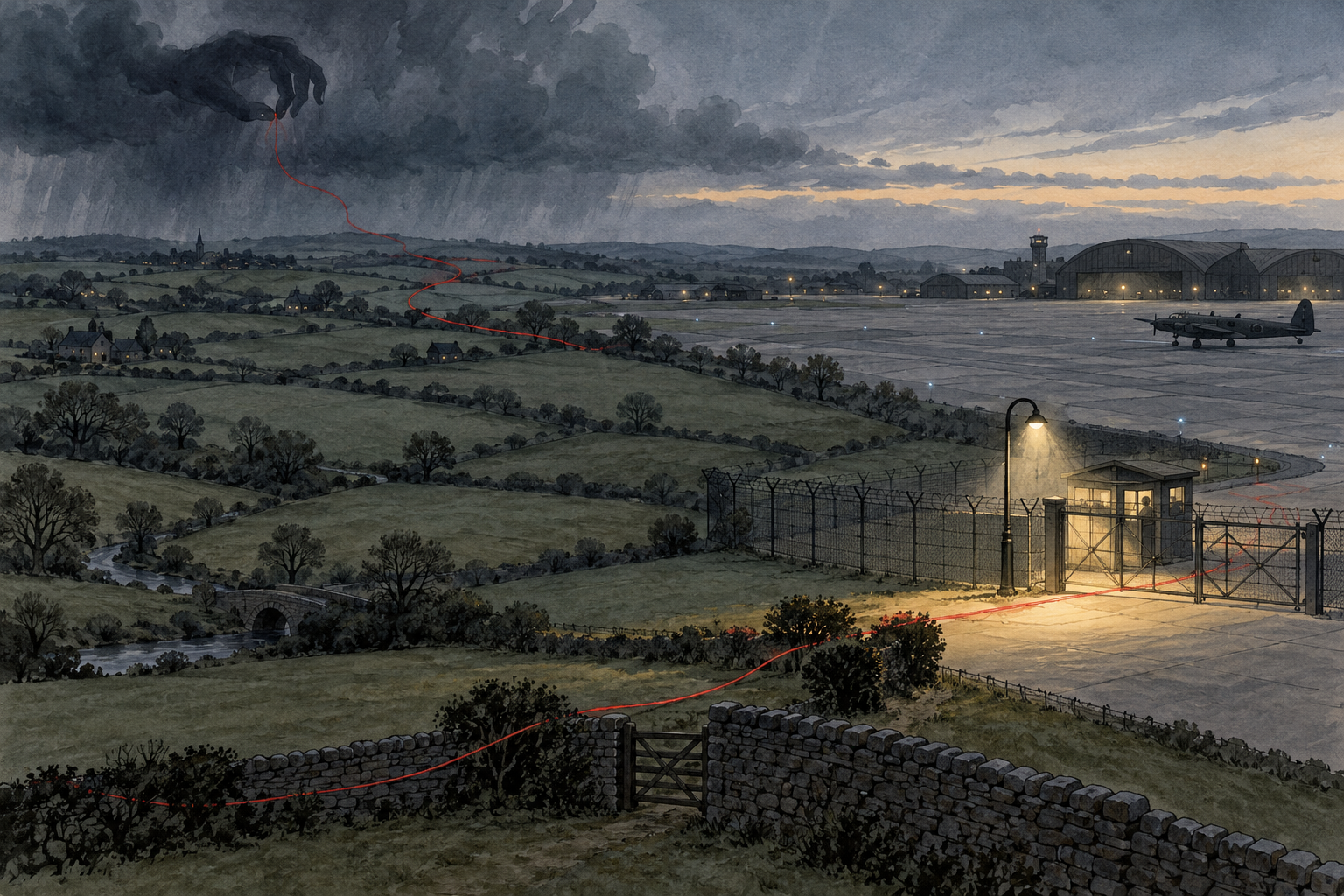
LONDON — Britain has attributed a suspected plot against RAF Fairford, a U.S.-run air base in southwest England used by American bombers in the Iran war, to Tehran’s Islamic Revolutionary Guard Corps. The assessment marks one of the clearest signs yet that the conflict is widening into European domestic security.
Prime Minister Andy Burnham told the House of Commons on Monday that Britain assessed the Sept. 27 incident as “highly likely” coordinated in Iran and “almost certainly” directed by the IRGC.1 Police have arrested seven men in the investigation, all of whom have been released on bail. No one has been charged.4 Iran has denied involvement and called on Britain to provide evidence.10
The attribution turns RAF Fairford from a local counterterrorism case into a test of European resilience against Iranian state threats. The base, about 100 miles west of London, has been used by U.S. bombers to strike Iran during the ongoing war, making it a politically and militarily sensitive node in the U.S. and NATO posture in Europe.4
Burnham said Britain would not tolerate such threats on its soil and pledged further sanctions and closer cooperation with the United States on protective security at shared bases.1 The immediate policy response included new Iran-related sanctions against Ruhollah Bazghandi and Shahram Ali Reza Tamarzadeh Jakki, according to official sanctions notices.9
The alleged plot centers on one of the most important U.S.-linked airfields in Britain. RAF Fairford has long hosted deployments of American long-range bombers, giving Washington a European platform for operations extending into the Middle East. During the current Iran war, the base’s role has become more visible and more exposed.
Authorities said the Sept. 27 incident prompted a major security response near the rural Gloucestershire base. Residents were evacuated as armed police and bomb-disposal personnel responded. Police later said they found gasoline in three vans linked to the first five suspects arrested at the scene, but no explosives.4
All seven suspects arrested are in their 20s. Six are British nationals, and one is a dual U.K.-Iranian citizen, according to police information reported by the Associated Press.4 Their release on bail has drawn scrutiny in Parliament, where opposition lawmakers pressed ministers on whether the suspects still posed a risk and whether the government had advance warning of the threat.3
The military implications were immediate. The United States pulled its bombers from RAF Fairford after the incident, and the aircraft were redeployed to their home bases, the Pentagon said.4 The Guardian reported that 12 B-1 bombers were withdrawn a week after the incident, amid concern over the security of U.S.-linked bases in Europe.6
Reuters, cited by the South China Morning Post, reported that U.S. officials believed the suspected plot involved a possible Iranian drone attack. The report said President Donald Trump linked the bomber withdrawal to a threat associated with Iran.7 British authorities have not publicly detailed the alleged operational plan.
The strongest signal that Britain sees Fairford as part of a wider pattern came from MI5 Director General Ken McCallum. He said Tuesday that Iran is trying to hit military sites in the United Kingdom and that the suspected plot at RAF Fairford was “not unique.”5
McCallum said Tehran has moved beyond more familiar targets, such as Iranian dissidents and Jewish sites, toward “harder targets” including military facilities.5 That assessment broadens the case from a single alleged plot to a counterintelligence challenge. European security agencies now have to protect not only communities and dissidents, but also bases, logistics hubs and U.S.-linked military infrastructure.
Home Secretary Shabana Mahmood told lawmakers that the Fairford incident was highly likely coordinated by a known individual based in Iran and almost certainly directed by the IRGC.3 She also linked the case to a broader pattern in which Iran uses proxies, criminal networks and volunteers to create plausible deniability while conducting hostile activity inside Britain.3
That model is difficult for European authorities to counter. It blurs the boundary between terrorism, organized crime, espionage and state-directed sabotage. It also allows a government to deny formal involvement while exploiting local actors or transnational networks that may be only loosely connected to state services.
Britain’s attribution quickly drew allied support. In a joint statement, foreign ministers from the United Kingdom, the United States, many European governments and the European Union recognized the U.K. assessment and condemned Iranian violent plots, arson, sabotage, cyberattacks and other hybrid activity.2
The statement said the incident showed the IRGC’s willingness to project hostile activity beyond Iran’s borders through covert networks and proxy actors.2 It also linked Fairford to a recent campaign of attacks across Europe targeting Jewish communities, Iranian journalists and U.S. interests.2
Estonia’s Foreign Ministry put the allied concern in NATO terms. Foreign Minister Margus Tsahkna said RAF Fairford’s security matters beyond Britain because NATO collective defense depends on allied military infrastructure remaining operational and on troops and equipment being able to move quickly across Europe in a crisis.8
That framing is significant. If Iranian-linked activity threatens U.S. airfields in Britain, it could also affect European air bases, ports, fuel depots, munitions sites and transit routes that underpin U.S. reinforcement of NATO. The issue is therefore not only counterterrorism, but also force protection and wartime mobility.
Iran has rejected the British allegations. Iran’s ambassador in London, Seyed Ali Mousavi, denied Tehran’s role during a diplomatic meeting and urged Britain not to take positions without evidence, according to Anadolu Agency, citing Iranian state media.10 Mousavi also said Iran was prepared to cooperate in examining the incident.10
The denial leaves Britain and its allies balancing public attribution against evidentiary limits. London has released its intelligence judgment, but not the underlying intelligence. That is common in state-threat cases, where governments often avoid disclosing sources and methods, but it also gives Tehran room to challenge the claim.
The legal picture remains unresolved. No suspect has been charged, and the discovery of gasoline but not explosives has left unanswered questions about whether the alleged plot was intended as an attack, reconnaissance, intimidation or a signal.4 The Guardian cited expert speculation that the episode may have been a demonstration of capability rather than a fully developed strike plan.6
For defense planners, the Fairford case illustrates how a Middle East conflict can generate security effects far from the battlefield. U.S. bomber operations from European bases create strategic reach, but they also create potential targets for hostile states seeking to impose costs below the threshold of open war.
Iran has previously signaled that it views bases used to attack its territory as legitimate targets, while Britain says threats on its soil are unacceptable.4 That divergence raises the risk that Tehran and Western governments will define the battlespace differently: Iran may see overseas military infrastructure as part of the war, while European governments treat attacks or plots on their territory as domestic security violations and hostile state activity.
The alleged Fairford plot also lands amid a wider European focus on hybrid threats, including sabotage, cyberattacks and proxy violence. Burnham’s Commons statement placed Iran alongside broader warnings about Russia’s sabotage campaign in Europe, underscoring that European governments increasingly view domestic security, military readiness and foreign policy as a single threat environment.1
Britain’s next steps are likely to include more sanctions, tighter base security, deeper U.S.-U.K. coordination and greater scrutiny of suspected Iranian networks. The more difficult task will be detecting low-signature plots before they reach military infrastructure.
Fairford suggests that, as the Iran war continues, European territory is not a rear area insulated from the conflict, but part of the strategic contest around U.S. power projection.

UN agencies said Israeli authorities suspended cargo entry into Gaza on Monday and announced another suspension for Wednesday, adding uncertainty to an aid system already constrained by closed crossings, damaged shelter and winter needs.

President Volodymyr Zelenskyy said Ukraine received no partner warning before five Russian ballistic missiles hit Kyiv, exposing a dangerous gap in a system designed to turn launch detection into minutes of civilian warning. The wider overnight attack, spanning Kharkiv, Rivne and Lviv Oblast, suggests Moscow is testing Ukraine’s air-defense capacity and public resilience as winter approaches.

EU leaders will discuss enlargement and internal reforms on October 15-16, with Montenegro emerging as the near-term test of whether the bloc can match accession rhetoric with treaty work and a political timetable. The debate will show whether member states are ready to pair Western Balkans entry with governance and budget preparations for a wider Union.

Raphaël Glucksmann’s emphatic center-left primary victory gives the Socialist-Place Publique bloc a clear candidate for 2027, but not yet a winning coalition. His refusal to ally with Jean-Luc Mélenchon’s La France Insoumise sharpens the split on the left just as Parliament opens a budget fight that will test the new balance of power.
RAF Fairford
A Royal Air Force base in Gloucestershire used by the U.S. Air Force, including for deployments of long-range bombers.
IRGC
Iran’s Islamic Revolutionary Guard Corps, a powerful military and security organization that Western governments accuse of directing covert activity abroad.
Hybrid activity
Hostile actions below the level of conventional war, including sabotage, cyberattacks, proxy violence and covert influence operations.
Protective security
Measures to protect people, bases, infrastructure and equipment from attack, espionage, sabotage or disruption.





Comments