Andersson’s withdrawal leaves Sweden with a majority for change, but no government
Untracked bias
Kvartal
Ny talmansrunda på onsdag
Syre
Norlén återvald till talman
Bias and factuality ratings from Media Bias Fact Check. Outlets without a rating are marked “Untracked.”
Narrow edge
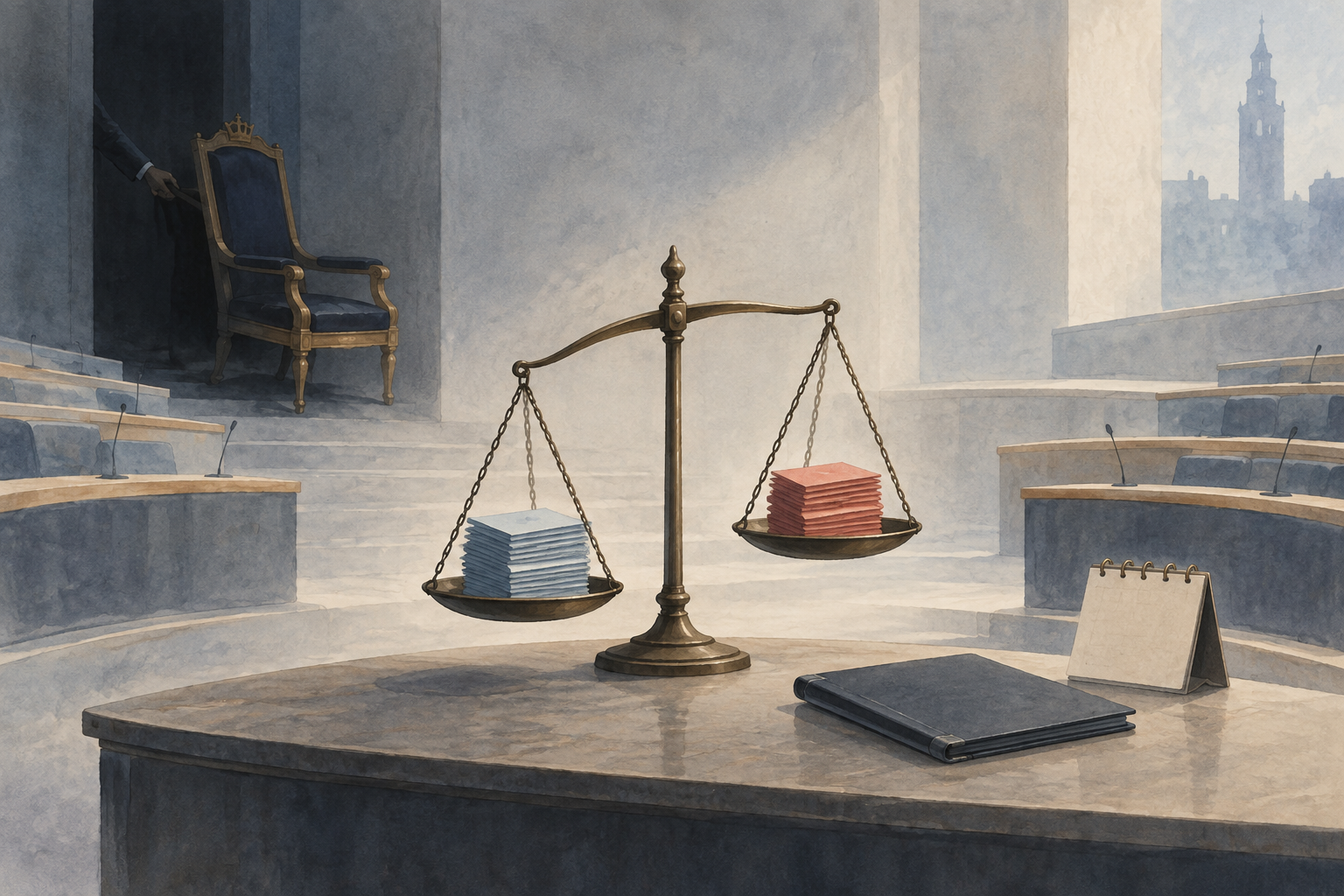
The centre-left bloc won 176 seats against 173 for the centre-right, but Andersson still could not assemble a government.
Speaker’s move
Andreas Norlén will consult party representatives on 30 September before deciding who gets the next mandate.
Four attempts
The speaker can put forward four prime-ministerial candidates before a new election must be called.
Magdalena Andersson’s decision to return her exploratory mandate has turned Sweden’s narrow election result into a governing deadlock. The centre-left bloc holds 176 seats to the centre-right’s 173, but still lacks a workable majority for a cabinet.3
The Social Democratic leader said on 28 September that there was “currently no possibility” for her to form a government, after talks with potential partners stalled over the Left Party’s role, the Centre Party’s red lines and a dispute over parliamentary leadership.3 Speaker Andreas Norlén will now consult party representatives on 30 September as he restarts the search for a prime minister who can pass the Riksdag’s negative-parliamentarism test.1
The immediate result is that Sweden has produced a nominal majority for change, but not a governing majority. For European politics watchers, the episode shows how bloc politics is fragmenting even in a country long associated with disciplined coalition bargaining.
Norlén’s next formal step is a new round of consultations with party representatives on Wednesday, 30 September. The Riksdag said he will meet representatives of all parliamentary parties except the Social Democrats, because he had already met Andersson when she ended her mandate.1
The speaker can then give another party leader the task of exploring a government. Reuters reported that Norlén is now likely to turn to outgoing prime minister Ulf Kristersson, whose Moderate Party is the second-largest party after the Social Democrats.3 Euronews also reported that Kristersson is expected to be asked to try, while noting that he resigned after his bloc’s election loss and is serving in an outgoing capacity.5
If Kristersson is nominated, his path will also be difficult. His right-wing bloc has 173 seats, short of a majority, and would need defections, abstentions or some form of cross-bloc tolerance. One possible route would involve the Centre Party, but its leader, Elisabeth Thand Ringqvist, has pledged to resist governments dependent on parties at the political edges, complicating any arrangement involving the Sweden Democrats.5
Sweden’s rules give the speaker four chances to present a prime ministerial candidate to parliament. If all four are rejected, a new election must be held.3 Because Andersson was never put to a vote, The Local reported that those four formal attempts remain unused.4
The centre-left arithmetic looked straightforward after the 13 September election: the Social Democrats, Greens, Centre Party and Left Party together held 176 of the Riksdag’s 349 seats, a three-seat advantage over the centre-right.5 The problem was political rather than mathematical.
The Left Party was essential to Andersson’s majority, but it wanted stronger influence, including ministerial positions. The Centre Party, meanwhile, resisted talks with the Left unless it dropped that demand. That created incompatible starting positions before a government programme could be settled.4
The dispute escalated around the speakership. Andersson linked her withdrawal to the Left Party’s decision to support Andreas Norlén, a Moderate, as speaker rather than the Social Democrats’ candidate.3 The Riksdag later confirmed that Norlén was elected speaker for the 2026-2030 electoral period by 200 votes to 146, with one invalid vote.2
That vote mattered less because of the office itself than because it revealed the bargaining leverage of smaller parties. The Left Party’s support for Norlén signalled that the centre-left bloc could not be treated as a single negotiating unit, even after winning more seats than the right.
The Left Party’s 30 seats make it indispensable to an Andersson-led government. Its leader, Nooshi Dadgostar, rejected the idea that backing Norlén meant joining a new bloc with the Moderates, arguing instead that the speaker should be experienced and impartial.4
But the move had an immediate strategic effect. Andersson said she would not have ended her exploratory mission that day if the Left Party had not backed Norlén.4 In practice, the Left showed that Andersson could not rely on its support while excluding it from meaningful power.
That creates a familiar dilemma for centre-left parties across Europe: whether to govern from the centre with liberal partners, or accommodate the left flank enough to secure a parliamentary majority. In Sweden, the dilemma is sharpened by the Centre Party’s reluctance to share space with the Left and by its opposition to right-wing arrangements shaped by the Sweden Democrats.
The longer the process lasts, the greater the risk that Sweden remains under a caretaker administration while EU-level bargaining continues. Kristersson has already resigned after the election defeat, and Euronews described him as outgoing as the speaker weighs the next mandate.5
A caretaker government can keep the state functioning, but it carries less political authority for major trade-offs. That matters in Brussels, where national governments are expected to negotiate on budget priorities, security policy, migration and energy. A Swedish government without a durable mandate may still attend the table, but its room to commit politically could be narrower.
The precedent for a drawn-out process is recent. Reuters noted that after Sweden’s 2018 election, Social Democrat Stefan Löfven needed 134 days to form a government.3 The current impasse is not yet comparable in duration, but the ingredients are similar: tight numbers, incompatible partner demands and a speaker-led process that can move only as fast as party leaders are willing to compromise.
Sweden’s 2026 result showed voter appetite for change, especially after the centre-left won a slim majority and the Sweden Democrats lost ground compared with the right’s previous position.3 But it also showed that the old bloc labels do not automatically produce governing coalitions.
The centre-left can block the right, but not yet govern together. The centre-right may get the next chance, but lacks seats and faces its own dependency problem. The speaker’s consultations will therefore test not just which leader can assemble a cabinet, but whether Sweden’s bloc system can still translate electoral majorities into stable executive power.

Russia’s latest missile-and-drone attacks on Kyiv point to a larger operational problem for Ukraine: jet-powered Shahed-type drones and ballistic missiles are compressing response times while Patriot interceptor stocks remain tight. The pressure is rising before winter, when Russia has repeatedly intensified strikes on Ukraine’s power grid and other civilian infrastructure.

EU ministers adopted the pharmaceutical package on 28 September, advancing a sweeping rewrite of medicines rules that links patient access, supply security and faster generic entry with protections for innovators. The package still needs European Parliament adoption before it can enter into force.

The government will use Commons amendments to the Lords-started Social Housing Bill to give councils new referral powers, extend social home disposal notices to eight weeks and create a Duty to Collaborate across public services. The move links protection of existing stock with homelessness prevention, while raising questions over whether councils and providers are being given new duties without a dedicated funding settlement.

A White House advertising push promoting President Trump has become a campaign-adjacent spending fight as costs near at least $1.5 million and Republicans including Senate Majority Leader John Thune question the use of taxpayer money. The unresolved issue for Congress is which agency funds are paying for the ads and whether appropriations or anti-propaganda limits apply.
Negative parliamentarism
Sweden does not require a prime minister to win an absolute majority in favour; a candidate can take office unless a majority of MPs votes against them.
Caretaker government
An outgoing administration that keeps day-to-day government running while a new cabinet is negotiated, but usually avoids major new political commitments.
Riksdag speaker
The speaker leads parliamentary work and, after an election or resignation, manages the process of proposing a prime minister.
Bloc politics
The traditional division of Swedish parties into centre-left and centre-right camps, which is increasingly strained by party-specific red lines.



Comments