India’s voter-roll dispute tests electoral legitimacy and protest rights
Associated Press
news
'Cockroach' protest leaders detained on plane as SIR anger spreads in India
Associated Press
news
Leaders of India's 'Cockroach' protests released from detention
India Today
news
Full clampdown in Delhi, no signs of protest as cops detain 3,000 including CJP leaders
Untracked bias
100% of tracked sources are High factuality
Los Angeles Times
India cracks down on youth protests as anger grows against Modi and election chief
CBS News
India's "Cockroach Party" leaders released from detention, demand resignation of country's election chief
Reuters via ThePrint
India detains hundreds, locks down Delhi to foil election chief protest
Reuters via ThePrint
India’s ‘cockroach’ movement leader released from detention, lawyer says
CNA
Protesters seeking India election chief's ouster detained, as 'cockroach' leaders released
The Indian Express
CJP leaders Abhijeet Dipke, Ranka and Saurav Das released from detention
India Today
Dipke leaves Delhi for grandmother's funeral; cops deny sitting on news of death
South China Morning Post
India’s cockroach party leaders freed as election chief protests mount
Khaleej Times
India's Cockroach Party leaders Abhijeet, Saurav, Ashutosh released from detention
Bias and factuality ratings from Media Bias Fact Check. Outlets without a rating are marked “Untracked.”
Leaders freed
Three Cockroach Janata Party leaders were released on October 11 after being detained in New Delhi.
Mass removals
The voter-list revision has removed more than 130 million names since last year.
Protest curbs
Authorities imposed sweeping restrictions in New Delhi and detained protesters during the October 10 crackdown.
NEW DELHI — Indian protest leaders freed from detention on October 11 vowed to keep mobilizing against a sweeping voter-list revision, escalating a dispute that has moved beyond election administration into a confrontation over democratic legitimacy, state power and the right to protest in the world’s largest democracy.2
The immediate trigger was the detention of Abhijeet Dipke, Saurav Das and Ashutosh Ranka, leaders of the youth-led Cockroach Janata Party, after police boarded their flight from Mumbai when it landed in New Delhi on October 10. They had been preparing to lead demonstrations demanding the resignation of Chief Election Commissioner Gyanesh Kumar over the Election Commission’s Special Intensive Revision, a voter-roll exercise that has removed more than 130 million names since last year.12
Police restrictions in the capital — including bans on gatherings, heavy deployment, curtailed transport links and renewed detentions — turned the dispute into a visible test of whether dissent over election management can be expressed in the capital without being treated as a security threat.12 Delhi Police and local authorities cited public-order grounds for denying or restricting protest activity. Movement leaders and opposition politicians framed the response as an effort to suppress scrutiny of the Election Commission.56
The Election Commission and Modi’s Bharatiya Janata Party say the revision is needed to remove duplicate, dead, shifted or otherwise ineligible entries from voter lists. The government and the commission deny opposition allegations that the process is being used to manipulate the electorate.12 But the scale of removals, the political geography of India’s coming state contests and the identity of those leading the protests have turned the exercise into a national political flashpoint rather than a bureaucratic update.
Voter-list maintenance is a routine function of election administration. In India, where population mobility is high and voter rolls can include duplicate or outdated entries, periodic revision is important to preserving election integrity. The commission says the Special Intensive Revision is meant to improve accuracy by eliminating entries that should not remain on the rolls.1
The opposition’s charge is that the removals are not politically neutral. Congress leader Rahul Gandhi and other opposition figures have alleged that voters more likely to support non-BJP parties are being disproportionately affected, while BJP-aligned voters are allegedly protected or added.110 The commission and the BJP reject those allegations, but the opposition has seized on the scale of the purge — more than 130 million names — to argue that the process needs far greater transparency, auditability and judicial scrutiny.210
That is why the controversy has become a question of legitimacy. If the commission’s explanation is accepted, the revision is a necessary correction to protect the franchise from fraud and duplication. If the opposition’s allegations gain traction, the same exercise becomes a mechanism of disenfranchisement before future elections. The political risk for the government is that the public argument is no longer about whether voter rolls need updating, but whether voters can trust the referee.
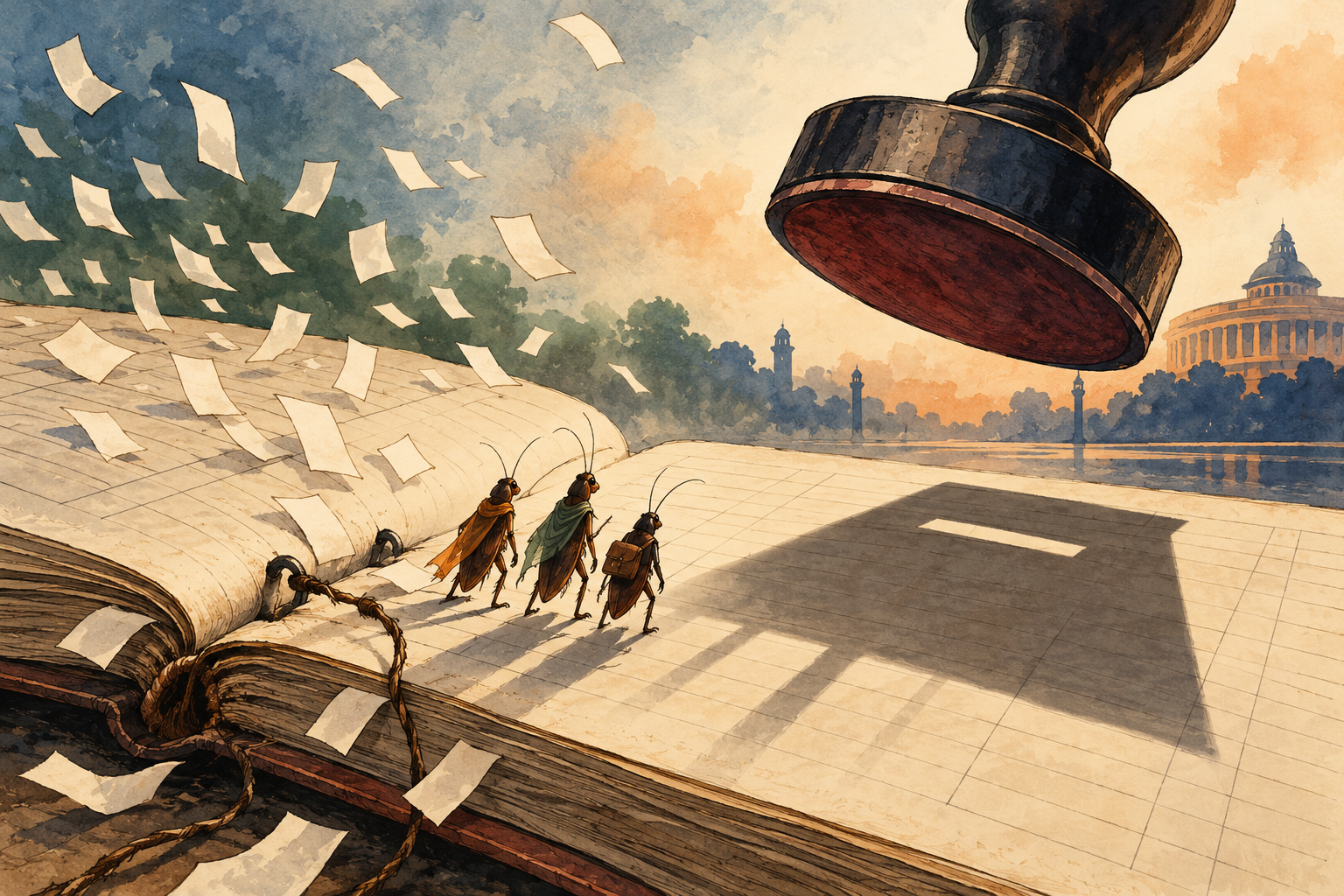
The Cockroach movement has changed the political texture of the dispute. The group began as an online youth campaign and gained prominence through protests over alleged exam-paper leaks, unemployment and institutional accountability. Its adoption of the cockroach as a symbol of resilience helped turn a derogatory reference into an organizing identity for young Indians frustrated with corruption and state institutions.2
That history matters because the movement is not a conventional opposition party, even as opposition parties align with its demands. Its leaders have shown they can mobilize young people through social media, street actions, hunger strikes and symbolic confrontation. AP reported that earlier protests led by the group culminated in the resignation of Modi’s education minister in July, a rare political setback for a prime minister who has dominated national politics for more than 12 years.12
The voter-roll dispute gives the movement a broader platform. Exam leaks and youth unemployment speak to generational grievance; voter-list removals speak to the foundation of representative politics. By placing the Election Commission at the center of its campaign, the movement has shifted from issue-based protest to institutional challenge.
The state response on October 10 and October 11 has become inseparable from the voter-roll controversy. Authorities detained more than 2,000 protesters after the October 10 crackdown, according to AP, including opposition lawmakers. Train services to the capital were canceled, metro stations were closed and mobile internet was suspended in parts of the city.2 Indian outlets reported broader security curbs around planned protest sites, with Delhi Police warning that groups of five or more could be detained in restricted areas.56
Most detainees were released late on October 10, police said. The three Cockroach leaders were freed on October 11 on a condition that they commit no breach of peace for one year, according to the movement’s legal director.2 The ambiguity of that condition added another layer to the dispute: whether release terms could chill participation in future demonstrations.
Small groups returned to the streets after the leaders’ release, and police broke up some demonstrations.26 Movement leaders said they would seek a lawful route to continue protesting, while opposition parties discussed institutional responses, including appeals to the judiciary.710
For the government, the policing calculus is delicate. Allowing large protests in the capital risks giving the movement momentum and creating a televised national spectacle. Restricting protests too aggressively, however, supports the opposition’s argument that the government is using public-order powers to shield election authorities from accountability.
The dispute lands at a sensitive point in Modi’s third term. National elections are not due until 2029, but state elections next year in BJP-ruled Uttar Pradesh and Gujarat will test the party’s strength in electorally significant terrain.1 Uttar Pradesh is India’s most populous state and central to the BJP’s national coalition math; Gujarat is Modi’s home state and a symbolic stronghold.
The controversy also gives the opposition a unifying issue. The INDIA bloc has struggled to convert anti-BJP sentiment into sustained national pressure, but the voter-roll dispute offers a theme that can link institutional independence, federal competition, youth frustration and civil liberties.10 It allows opposition parties to argue not only that the BJP should be defeated, but that the rules of electoral competition are under strain.
For Modi, the danger is not only electoral. It is institutional. The Election Commission has historically derived authority from its perceived independence. If a large segment of voters comes to believe the commission is aligned with the ruling party, every subsequent election result risks being litigated in the public sphere before it is accepted politically. That would be a serious challenge for a government whose legitimacy rests on repeated electoral mandates.
The next phase will likely turn on three questions.
First, whether the Election Commission provides more granular data on the removals: where names were deleted, why they were deleted, how appeals work and whether demographic or partisan patterns can be independently assessed. Transparency could reduce suspicion; opacity could deepen it.
Second, whether courts become a central venue. Opposition leaders are already looking toward judicial intervention, and any order requiring disclosure, review or procedural safeguards could reshape the dispute.10
Third, whether the Cockroach movement can sustain pressure beyond flash protests. The release of its leaders has given it a new rallying point, but durable political impact will depend on whether it can connect urban youth anger with voters directly affected by roll deletions.
For now, a voter-list revision has become a confrontation over who gets to vote, who gets to protest and who gets trusted to administer democracy. In a country of India’s size, that makes the dispute more than a technical quarrel. It is a test of institutional confidence midway through Modi’s third term.

U.S. Secretary of State Marco Rubio promised cooperation with Japanese authorities after allegations that a U.S. Marine robbed and killed a woman in Okinawa, a case that has renewed local demands for stronger accountability over American forces. The issue places Prime Minister Sanae Takaichi’s drive for closer U.S.-Japan security coordination alongside Okinawa’s long-running grievances over base burdens.

Taiwan President Lai Ching-te said Taiwan would not give up its freedom and urged Indo-Pacific democracies to protect regional stability, drawing swift condemnation from Beijing. Initial military tracking showed continued Chinese activity around Taiwan, but not an immediate surge above the previous day’s baseline.

Explosive drones near Erbil suggest Tehran may be folding Iranian Kurdish opposition groups in Iraq into the wider battlefield opened by the Iran war. The timing, days after the U.S.-led coalition ended its Iraq mission, raises questions about deterrence, air-defense gaps and Baghdad-Erbil coordination.

One year after a U.S.-brokered ceasefire halted major fighting in Gaza and secured the return of remaining Israeli hostages, the agreement’s next phase remains stalled. Disputes over sequencing — Hamas disarmament, Israeli withdrawal, governance, security forces and reconstruction — have left Gaza in limbo as strikes, casualties and aid restrictions continue.
Special Intensive Revision
The Election Commission’s voter-roll review process, which authorities say is meant to remove duplicate and ineligible entries.
Cockroach Janata Party
A youth-led protest movement that began online and has used satire and street mobilization to challenge Indian institutions.
Election Commission of India
India’s constitutional election authority, responsible for administering elections and maintaining voter rolls.
INDIA bloc
A coalition of opposition parties seeking to challenge Prime Minister Narendra Modi’s Bharatiya Janata Party.


Comments