Jaishankar frames India’s post-Trump-Xi diplomacy as a calculated hedge
Strategic autonomy
India’s practice of retaining freedom of action across competing power centers instead of formally aligning with one bloc.
De-risking
Reducing exposure to a single country, market or supply chain without necessarily cutting ties altogether.
G2 frame
The idea that the United States and China could jointly shape global outcomes as the two dominant powers, a model India resists.
Section 301
A U.S. trade law tool used to investigate and respond to foreign trade practices deemed unfair.
The Indian Express
news
US, China in competitive mode, India & others need to de-risk, diversify to secure interests: S Jaishankar
The Indian Express
news
Jaishankar on Trump-Xi Meet: ‘Limits to what two of them can agree upon’
India Today
news
India-China ties better now as border normalcy returns, says S Jaishankar
Untracked bias
The Indian Express
‘Limits to what two of them can agree upon’: Jaishankar after Trump-Xi meet
India Today
Jaishankar says India-China ties improve as border situation moves towards normalcy
Business Standard
India-China ties 'better' today than a couple of years ago: EAM Jaishankar
Business Standard
Trade agreement can contribute to 'better' India-US ties, says Jaishankar
Bias and factuality ratings from Media Bias Fact Check. Outlets without a rating are marked “Untracked.”
Structured hedge
Jaishankar framed India’s response to U.S.-China competition as de-risking and diversification rather than alignment with one camp.
China channel
India is keeping engagement with Beijing open as border normalcy improves, while maintaining that the boundary situation remains central.
Terror concern
Jaishankar warned that inadequate U.S. empathy for India’s Pakistan-linked terrorism concerns can affect bilateral ties.
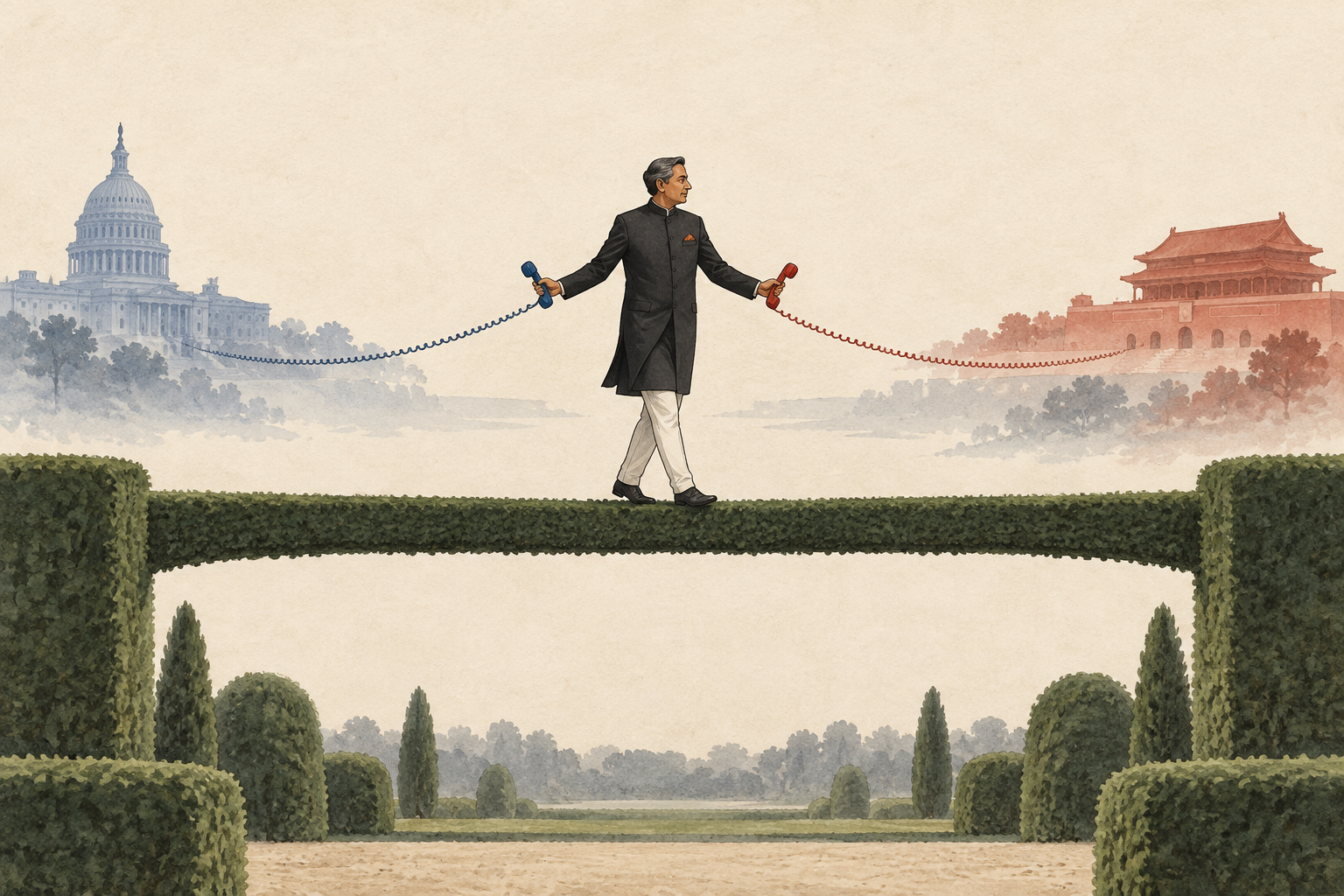
External Affairs Minister S. Jaishankar has placed India’s post-Trump-Xi diplomacy in a familiar but sharper frame: the United States and China may stabilize parts of their relationship, but they remain competitors, leaving countries such as India to de-risk, diversify and protect their own interests.1
Speaking in New York on September 28-29, Jaishankar argued that there are limits to what Washington and Beijing can agree between themselves. Other countries, he said, are making their own arrangements rather than accepting a two-power, or G2, framework.2
The remarks amounted to a structured hedge. New Delhi is signaling that it will manage improved ties with Beijing, continue negotiations with Washington, and still challenge U.S. positions it believes undercut Indian security concerns, especially on Pakistan-linked terrorism.4
The timing matters. The comments came after the Trump-Xi White House summit, where the United States and China announced tariff relief on nonsensitive goods and sought to project stability in a relationship still defined by strategic competition.8 For Indian policymakers, that spectacle reinforced the need to avoid strategic dependence on any one pole.
Jaishankar’s answer was not equidistance for its own sake, but a practical diversification of partnerships.
Jaishankar’s formulation does not mark a downgrade in India’s relationship with the United States. Rather, it reflects concern that even close partnerships are now transactional, issue-based and vulnerable to abrupt pressure.
Indian and U.S. officials are still engaged on trade, including questions around tariffs and market access, while New Delhi watches the uncertainty around Washington’s use of trade law tools such as Section 301.4
That negotiation track exists alongside strategic cooperation in defense, technology and the Indo-Pacific. But Jaishankar’s remarks suggest India is less willing to treat strategic convergence with the United States as protection from economic coercion or diplomatic discomfort.
CSIS analysts, assessing the Trump-Xi summit, noted that New Delhi sees a contrast between U.S.-China symbolic stability and U.S. pressure on India, a perception that could affect how India weighs future alignment with Washington.9
This is the core of the hedge. India is not rejecting the United States as a partner. It is resisting the assumption that partnership requires automatic alignment, especially as Washington negotiates with Beijing, manages Russia and Ukraine, and recalibrates ties across Asia.
The Beijing side of India’s hedge is equally conditional. Jaishankar said India-China ties are better than they were when border tensions were at their worst, pointing to a return of normalcy along the border as a basis for improvement.3
That is an important signal after years in which the Line of Actual Control shaped the entire relationship.
But New Delhi’s message remains cautious: normalization with China is not the same as trust. The border remains the key variable, and any improvement in political or economic engagement depends on stability there.3
India’s approach, therefore, is not a pivot toward Beijing. It is a reopening of channels to reduce risk while preserving leverage.
This matters because the Trump-Xi summit revived familiar Indian concerns about great-power bargaining. Jaishankar’s observation that the first- and second-largest economies may find points of convergence while remaining competitors indicates that India does not expect either side to subordinate its interests to partners or smaller states.1
The lesson for New Delhi is to keep its own room for maneuver.
The most pointed part of Jaishankar’s New York intervention concerned Washington’s handling of Pakistan-linked terrorism. He said a lack of understanding, appreciation or empathy in the United States for India’s concerns over terrorism from its neighborhood creates problems in the relationship.4
That warning was not abstract. Indian reporting linked the remarks to unease over U.S. engagement with Pakistan and the perception that Washington has not adequately factored in India’s experience of cross-border terrorism.5
For New Delhi, counterterrorism is not a side issue to be compartmentalized from strategic cooperation. It is a test of whether partners understand India’s core security priorities.
This is where India’s hedge becomes more than great-power balancing. It is also a demand for policy respect. India is prepared to deepen ties with the United States, but not at the cost of muting concerns about Pakistan-based terror networks or U.S. gestures toward Islamabad that New Delhi reads as insensitive to Indian security.
Jaishankar also turned one of India’s long-standing doctrines back toward Washington. He argued that the United States is now practicing the kind of strategic autonomy that India has long championed, managing multiple relationships at once rather than operating through rigid blocs.6
The point was both descriptive and political: if Washington can engage China, Russia, Europe and Asian partners according to issue-specific interests, India claims the same right.
That argument is consistent with the broader theme of his Asia Society appearance in New York, where he spoke about multipolarity, competition, interdependence and the need to manage relationships with major powers rather than reduce them to binary choices.7
For an Indian foreign policy audience, the significance lies in the vocabulary. Strategic autonomy is no longer presented only as a post-colonial or non-aligned inheritance. It is being recast as a necessary operating system for a world in which even the United States is selective, transactional and flexible.
The Trump-Xi summit did not settle U.S.-China rivalry. It produced tariff adjustments, dialogue mechanisms and symbolic stabilization, but left the structural contest over technology, Taiwan, supply chains and geopolitical influence intact.89
Jaishankar’s remarks fit that landscape.
India’s answer is to avoid being trapped by either expectation: that it must fall in line with Washington because of China, or that it must accommodate Beijing because Washington is unreliable.
Instead, New Delhi is presenting diplomacy as a layered hedge: negotiating trade with the U.S., managing border-linked normalization with China, and insisting that partners take Indian terrorism concerns seriously.
That posture carries risks. Diversification can look like ambiguity, and ambiguity can frustrate partners. But Jaishankar’s message in New York was that the risk of overdependence is greater.
In a competitive and interdependent world, India’s preferred position is not outside the system, but across several channels at once.



Comments