Japan Uses UNGA Maritime Meeting to Broaden South China Sea Legal Message
Ministry of Foreign Affairs of Japan
government
Foreign Minister MOTEGI’s attendance at the Foreign Ministers’ Meeting “Reinforcing Maritime Cooperation to Achieve a Secure and Stable Maritime Domain”
Ministry of Foreign Affairs of Japan
government
Prime Minister TAKAICHI and Foreign Minister MOTEGI Visit the United States of America (The 81st Session of the United Nations General Assembly)
Ministry of Foreign Affairs of the State of Qatar
government
Qatar Takes Part in Ministerial Event on Strengthening Cooperation for a Secure, Stable Maritime Domain
Untracked bias
Bias and factuality ratings from Media Bias Fact Check. Outlets without a rating are marked “Untracked.”
53 Participants
Japan said the New York maritime ministerial drew 53 countries and organizations, including foreign ministers.
UNCLOS Focus
Motegi emphasized UNCLOS and opposed unilateral attempts to change the status quo by force or coercion in the East and South China Seas.
Global Chokepoints
Participants linked maritime law to wider concerns over the Strait of Hormuz, Bab el-Mandeb, supply chains and freedom of navigation.
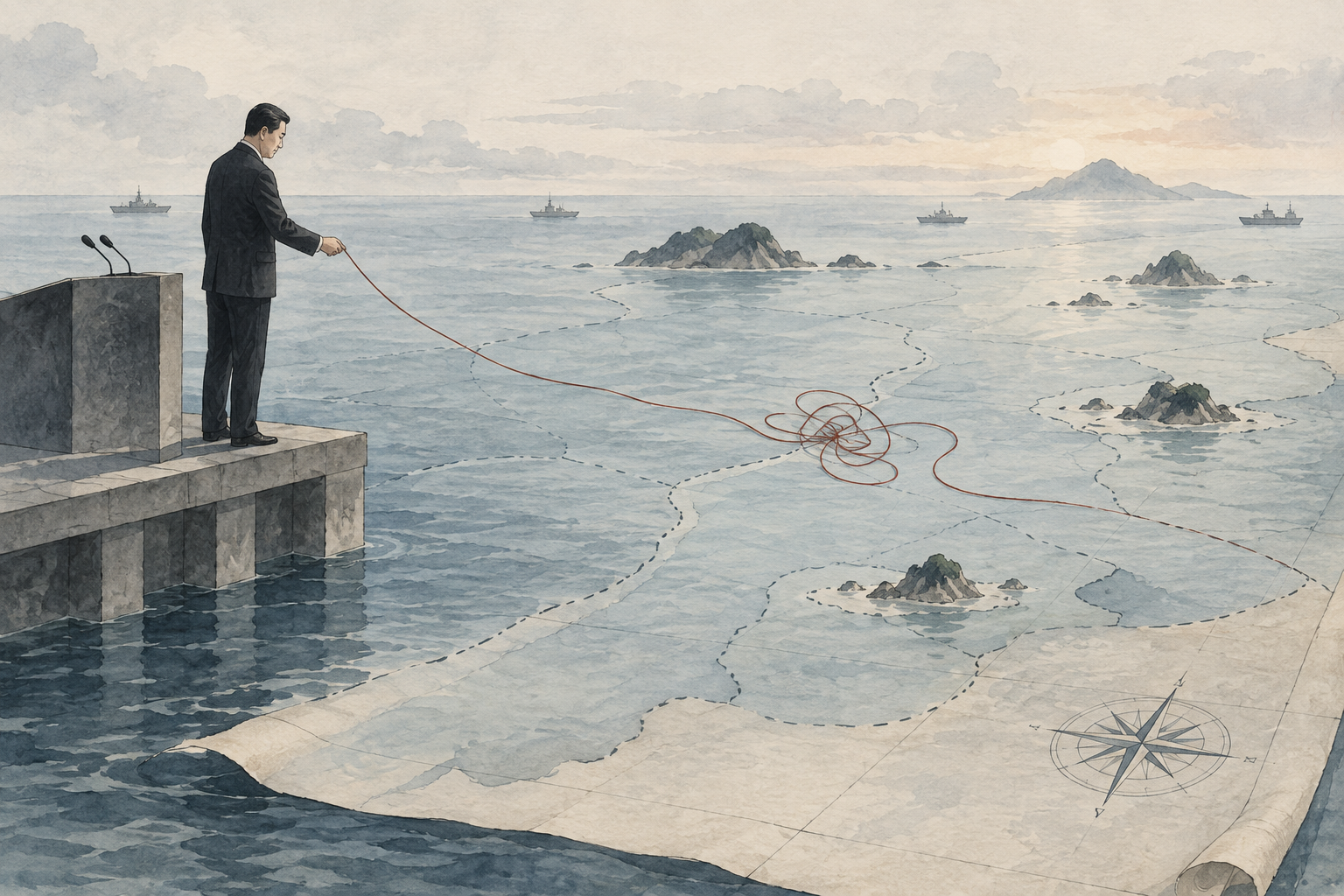
Japan used a United Nations General Assembly-side maritime ministerial in New York on September 23 to recast its South China Sea and East China Sea messaging from a regional dispute into a broader coalition argument about international law, freedom of navigation and maritime stability.
Foreign Minister Toshimitsu Motegi told the meeting, titled “Reinforcing Maritime Cooperation to Achieve a Secure and Stable Maritime Domain,” that compliance with international law as reflected in the United Nations Convention on the Law of the Sea is “of paramount importance.” He also reiterated Japan’s opposition to unilateral attempts to change the status quo by force or coercion in the East China Sea and South China Sea.1 Motegi emphasized adherence by the parties to the 2016 arbitral tribunal award between the Philippines and China, marking its tenth anniversary.1
The format mattered as much as the message. Japan co-chaired the meeting with Estonia, the Netherlands, the Philippines, Canada, the European Union and Bahrain. The session drew 53 countries and organizations, including foreign ministers.1 That gave Tokyo a platform to place maritime coercion in Asian waters alongside concerns about the Strait of Hormuz, Bab el-Mandeb, Black Sea navigation, undersea cables and global supply chains. The diplomatic move broadened the South China Sea file beyond bilateral incidents and into a rules-based coalition frame.1
Motegi’s remarks linked Japan’s updated Free and Open Indo-Pacific, or FOIP, to the maintenance of a free and open maritime order based on the rule of law.1 In that framing, UNCLOS is not only a legal reference for disputed waters in Asia. It is a common language for countries concerned about disruptions to chokepoints, shipping lanes and critical maritime infrastructure.
The participant list underscored that broader intent. Qatar’s readout said its minister of state, Mohammed bin Abdulaziz bin Saleh Al Khulaifi, stressed adherence to UNCLOS principles, including freedom of navigation, amid challenges facing the Strait of Hormuz and Bab el-Mandeb.3 Qatar also connected maritime security to the uninterrupted operation of supply chains, energy markets and the delivery of essential commodities and humanitarian aid.3 A Qatar Tribune/QNA report similarly described the event as a call for collective action to protect maritime security, freedom of navigation and critical waterways.8
Lithuania’s Foreign Ministry readout added a European security dimension. It said Foreign Minister Kęstutis Budrys used the meeting to stress that a safe, resilient and predictable maritime space depends on UNCLOS and the UN Charter.4 Lithuania emphasized freedom of navigation, vital sea lanes, critical undersea infrastructure and action against Russia’s so-called shadow fleet. The message reinforced the idea that maritime law concerns are being linked across theaters rather than confined to the Indo-Pacific.4
Japan’s direct references to the East and South China Seas remain central. Tokyo has long objected to coercive efforts to alter maritime facts on the ground. Motegi’s citation of the 2016 arbitral award gave Japan’s position a specific legal anchor.1 The award, issued in the Philippines-China arbitration, rejected key elements of China’s expansive maritime claims under UNCLOS, though Beijing has refused to accept the ruling.
By raising the award at a 53-member ministerial, rather than only in bilateral or regional statements, Japan signaled that the South China Sea is being treated as a test case for the durability of maritime law. The argument is that if legal rulings and UNCLOS constraints can be disregarded in one heavily trafficked sea, similar pressure could affect other waterways, ports, undersea assets and supply chains.
That coalition framing also allows Japan to connect concerns shared by different groups of states. Southeast Asian governments may focus on coast guard activity and disputed features in the South China Sea. Gulf states may emphasize chokepoint security and energy flows. European states may focus on sanctions evasion, undersea infrastructure and Black Sea grain exports. The UNGA-side format gave Tokyo a venue to join those concerns under a shared maritime-order agenda.
The maritime event was one part of a broader Japanese diplomatic push during the 81st UN General Assembly. Japan’s Foreign Ministry roundup of Prime Minister Sanae Takaichi and Motegi’s U.S. visit listed the maritime ministerial alongside Motegi’s bilateral meetings with the Maldives and Fiji, talks with Australia and the United States, a G7 foreign ministers’ meeting, and a Japan-U.S.-ROK foreign ministers’ meeting.2
That schedule shows Tokyo using New York not only for public statements but also for a networked diplomatic campaign. The maritime meeting supplied the multilateral legal message. The bilateral meetings helped translate FOIP into country-specific partnerships.
In Motegi’s September 23 meeting with Fiji’s Foreign Minister Sakiasi Ditoka, Japan described Fiji as an important partner in maintaining a free and open international order based on the rule of law. It also welcomed the handover of patrol boats under Japan’s Official Security Assistance program.6 Motegi tied Japan’s support to the updated FOIP concept, including resilience and the ability of regional countries to make decisions for themselves.6
The same day, Motegi met Maldives Foreign Minister Iruthisham Adam and called the Maldives an important partner in realizing FOIP.7 The two sides discussed Indo-Pacific peace and stability, resilience, development cooperation and defense cooperation, broadening Japan’s maritime-security diplomacy beyond the South China Sea and into the Indian Ocean.7
Japan’s coalition message is also being paired with operational and capacity-building activity. A Philippine government report published September 23 said the Philippines and Japan are co-chairing the ASEAN Defence Ministers’ Meeting-Plus Experts’ Working Group on Maritime Security, including a joint cooperative activity and Future Leaders’ Program from September 20 to 26.5
The Philippine Information Agency said the activity involves personnel, naval assets, ships and aircraft from eight ADMM-Plus countries, with observers from other ASEAN members and dialogue partners invited.5 It also said the program gives junior naval officers a forum to engage on maritime security, UNCLOS, climate change and critical underwater infrastructure security.5
For Tokyo, that practical track complements the UNGA legal track. Japan’s message in New York stressed UNCLOS and the 2016 arbitral award. Its work with Manila shows how that message is being supported through exercises, professional networks and regional maritime-security cooperation.
The September 23 meeting suggests Tokyo is not treating maritime coercion as a series of isolated bilateral disputes. Instead, Japan is presenting the issue as part of a broader contest over whether states accept common rules for the maritime domain — from the South China Sea to the Strait of Hormuz, and from the Black Sea to undersea cables.
That approach serves several purposes. It reduces the risk that South China Sea incidents are viewed only as local confrontations. It gives smaller and middle powers a shared legal vocabulary for resisting coercion. And it connects Asian maritime disputes to global concerns about supply chains, energy flows and infrastructure resilience.
The result is a more internationalized Japanese maritime-law campaign: UNCLOS as the baseline, FOIP as the strategic frame and UNGA-side diplomacy as the convening platform.

India’s entry into the Pacific Islands Forum’s Strategic Partner Stream marks a shift from episodic summit diplomacy toward more regular institutional access in the Pacific. New Delhi is pairing that access with health, renewable energy, training and quick-impact projects aimed at sustaining influence among island states.

New Zealand’s National Cyber Security Centre said nearly a quarter of nationally significant cyber incidents in 2025/26 had suspected state-sponsored links, identifying China as the most persistent and capable state actor targeting the country. Beijing rejected the assessment, accusing Wellington of spreading cyber-security disinformation for political purposes.

Kyiv’s latest contact with Tehran reflects a widening diplomatic battlefield: Ukraine must deter Iranian support for Russia while also limiting the risk that U.S.-Iran and Middle East escalation spills into its war effort.

Hundreds of thousands of Gaza children have returned to in-person classes for the first time in nearly three years, but many are studying in tents, damaged buildings and overcrowded makeshift rooms. The reopening offers a visible milestone nearly a year into the ceasefire, while exposing the gap between reconstruction pledges and daily civilian conditions.
UNCLOS
The United Nations Convention on the Law of the Sea is the main global treaty setting rules for maritime zones, navigation rights and states’ rights and duties at sea.
FOIP
Japan’s Free and Open Indo-Pacific concept links rule of law, freedom of navigation, connectivity, resilience and security cooperation across the Indo-Pacific.
2016 Philippines-China arbitral award
A tribunal constituted under UNCLOS rejected key elements of China’s expansive South China Sea claims in a case brought by the Philippines; China rejects the ruling.
ADMM-Plus
The ASEAN Defence Ministers’ Meeting-Plus is a defense cooperation framework involving ASEAN and eight dialogue partners, including Japan.





Comments