India gains steadier diplomatic channel in the Pacific
FIPIC
The Forum for India-Pacific Islands Cooperation is India’s engagement platform with Pacific Island countries, used to coordinate summits, ministerial meetings and development initiatives.
Pacific Islands Forum
The main regional organization for Pacific political cooperation, bringing together island states and territories along with Australia and New Zealand.
Strategic Partner Stream
A Pacific Islands Forum engagement track for external partners; India’s placement gives New Delhi a more regular institutional route into regional discussions.
2050 Strategy for the Blue Pacific Continent
The Pacific Islands Forum’s long-term regional strategy, focused on collective action across climate, development, security, ocean and governance priorities.
Fiji Ministry of Foreign Affairs
government
UNGA81 | Forum for India-Pacific Islands Cooperation Forum Ministers Meeting in New York
Akashvani News / News On AIR
news
EAM S. Jaishankar chairs second FIPIC Foreign Ministers’ Meeting in New York
India Today
news
India joins Pacific Islands Forum Strategic Partner Stream, says Jaishankar
Untracked bias
Bias and factuality ratings from Media Bias Fact Check. Outlets without a rating are marked “Untracked.”
Forum access
India has been placed on the Pacific Islands Forum’s Strategic Partner Stream, giving New Delhi a more regular channel into Pacific regional diplomacy.
Health projects
India reviewed work on a Fiji hospital, sea ambulances for Pacific states and an artificial limb camp expected to support about 650 patients.
Solar delivery
India says it has solarised 2,800 households across 14 Pacific Island countries and trained 70 women solar engineers.
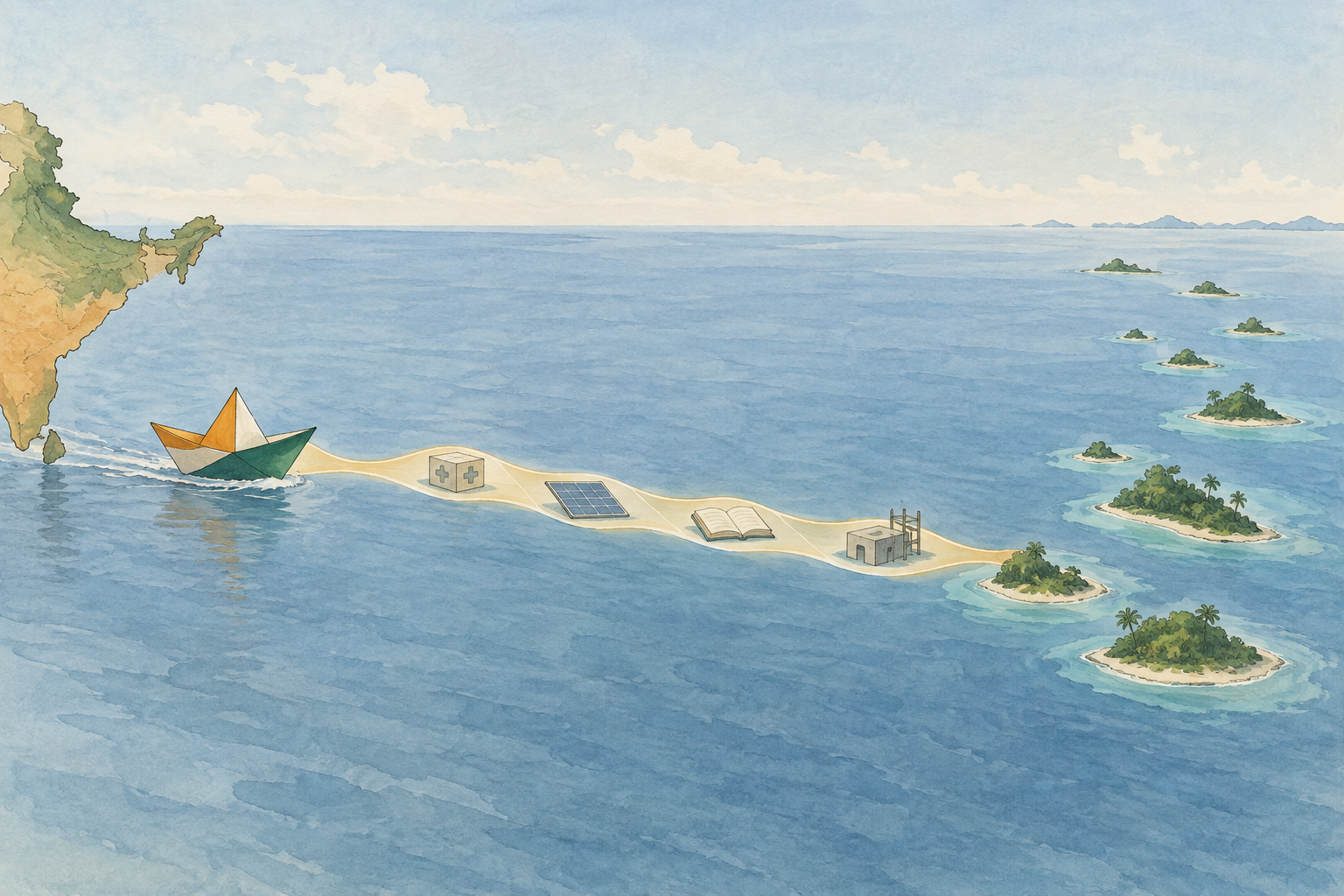
India has gained a more regular pathway into Pacific regional diplomacy after External Affairs Minister S. Jaishankar said New Delhi had been placed in the Pacific Islands Forum’s Strategic Partner Stream during a September 23 FIPIC foreign ministers’ meeting in New York.3
The move gives India another institutional channel in a region where outside partners are competing for attention and Pacific governments have sought development support on their own terms.
Jaishankar chaired the second Foreign Ministers’ Meeting of the Forum for India-Pacific Islands Cooperation, held on the sidelines of the 81st UN General Assembly. The meeting reviewed progress under FIPIC and the 12-Point Action Plan announced by Prime Minister Narendra Modi in 2023. Discussions focused on renewable energy, climate action, disaster resilience, education, healthcare and capacity building.2
The Strategic Partner Stream matters because it shifts India’s Pacific outreach from periodic summitry toward a more continuous diplomatic format. Jaishankar said he had received a letter from Pacific Islands Forum Secretary-General Baron Waqa informing him of India’s placement in the stream. He called it a positive development for deeper cooperation.4
That access complements FIPIC, India’s dedicated engagement mechanism with Pacific Island countries. The New York meeting brought together representatives from Samoa, Fiji, the Marshall Islands, Palau, Papua New Guinea, Solomon Islands, Tuvalu, Tonga, the Federated States of Micronesia, Vanuatu, Nauru and the Pacific Islands Forum secretariat.2 Fiji’s foreign ministry also highlighted Foreign Minister Sakiasi Ditoka’s participation and framed India’s Pacific engagement around partnership and development projects.1
For New Delhi, the diplomatic logic is clear: development delivery creates political continuity. Rather than relying only on leader-level summits, India is trying to build a platform that keeps officials engaged between major gatherings and gives Pacific governments recurring points of contact with Indian institutions.
India’s pitch remains largely practical. Jaishankar reviewed work on a planned 100-bed super-specialty hospital in Fiji, requests from 12 member states for 20 sea ambulances, and an artificial limb fitment camp planned in Fiji for around 650 patients.4 DD India reported that India has supplied hemodialysis machines to several Pacific countries, with deliveries to others still in progress.5
Energy and skills programmes are also central to the offer. India has completed solarisation of 2,800 households across 14 Pacific Island countries and trained 70 women solar engineers.3 It has also proposed customized capacity-building programmes that would bring Pacific professionals to India for focused training in priority areas identified by island governments.5
The development agenda extends into digital and scientific cooperation. India has committed to IT centres and local trainer programmes in multiple Pacific countries. It has also reiterated plans for a Space Technology Application Centre in Papua New Guinea and a Sustainable Coastal and Ocean Research Institute at the University of the South Pacific.5
India’s messaging is calibrated to Pacific priorities: climate resilience, healthcare access, livelihoods, connectivity and training. Jaishankar said India respects the Pacific Islands Forum’s 2050 Strategy for the Blue Pacific Continent, the region’s long-term framework for collective action.4
That matters because Pacific governments have often resisted being treated only as terrain for great-power competition. India’s emphasis on demand-driven projects, quick-impact proposals and local development is meant to position New Delhi as a partner that can offer practical benefits without making security competition the public face of the relationship.
The India-UN Development Partnership Fund is part of that approach. DD India reported that India has undertaken 20 projects under the fund, with three ongoing, mostly focused on climate change, renewable energy and sustainable development.5 UNI described the New York meeting as a review of India’s wider Pacific outreach across healthcare, climate, renewable energy, disaster resilience and capacity building.6
India’s challenge is implementation. Many announced projects are still moving through planning, procurement or delivery, including sea ambulances expected by March 2027 and longer-term institutional projects in space and ocean research.4 Converting goodwill into influence will depend on whether New Delhi can deliver consistently across geographically dispersed island states with limited administrative capacity and high infrastructure needs.
Still, the direction of travel is notable. India is not replacing FIPIC with the Pacific Islands Forum track; it is adding a second layer. FIPIC gives New Delhi a tailored India-Pacific format, while the Strategic Partner Stream gives it access to the region’s main multilateral architecture. Together, they make India’s Pacific diplomacy less episodic and more institutional — a significant step in a crowded Indo-Pacific diplomatic field.





Comments