Lecornu’s 2027 budget test shifts from Bercy to a fractured Assembly
AI Writer·September 12, 2026·7 min read·AI-generated
Le Monde
news
French government bets on modest economic recovery in 2027
“Published 2026-09-11: Core source on Lecornu government’s 2027 budget assumptions, 1% growth forecast, lower 2026 growth, abandoned deficit ambition, and the coming parliamentary difficulty.”
AFP via Boursorama
news
Le gouvernement français abaisse encore sa prévision de croissance et appelle à un budget rapide
“Published 2026-09-11: AFP report gives the government’s revised growth and deficit framing, Roland Lescure’s call for a rapid 2027 budget, and Eric Coquerel’s Assembly finance-committee reaction.”
La Tribune
news
Budget 2027 : Bercy abandonne la cible de déficit à 5% en 2026
“Published 2026-09-11: Details Bercy’s revised macro framework, abandonment of the 5% deficit target for 2026, and protected pro-business lines such as CIR, Dutreil and apprenticeship.”
MoneyVox avec AFP
Budget 2027 : abattement de 10% ou indexation des retraites, le gouvernement veut faire un choix
Reuters via Journal Chrétien
La France divise par deux, à 0,5%, sa prévision de croissance pour 2026
Le Monde
French economy falls behind rest of Europe: Slow growth, rising inflation and unemployment
Assembly test
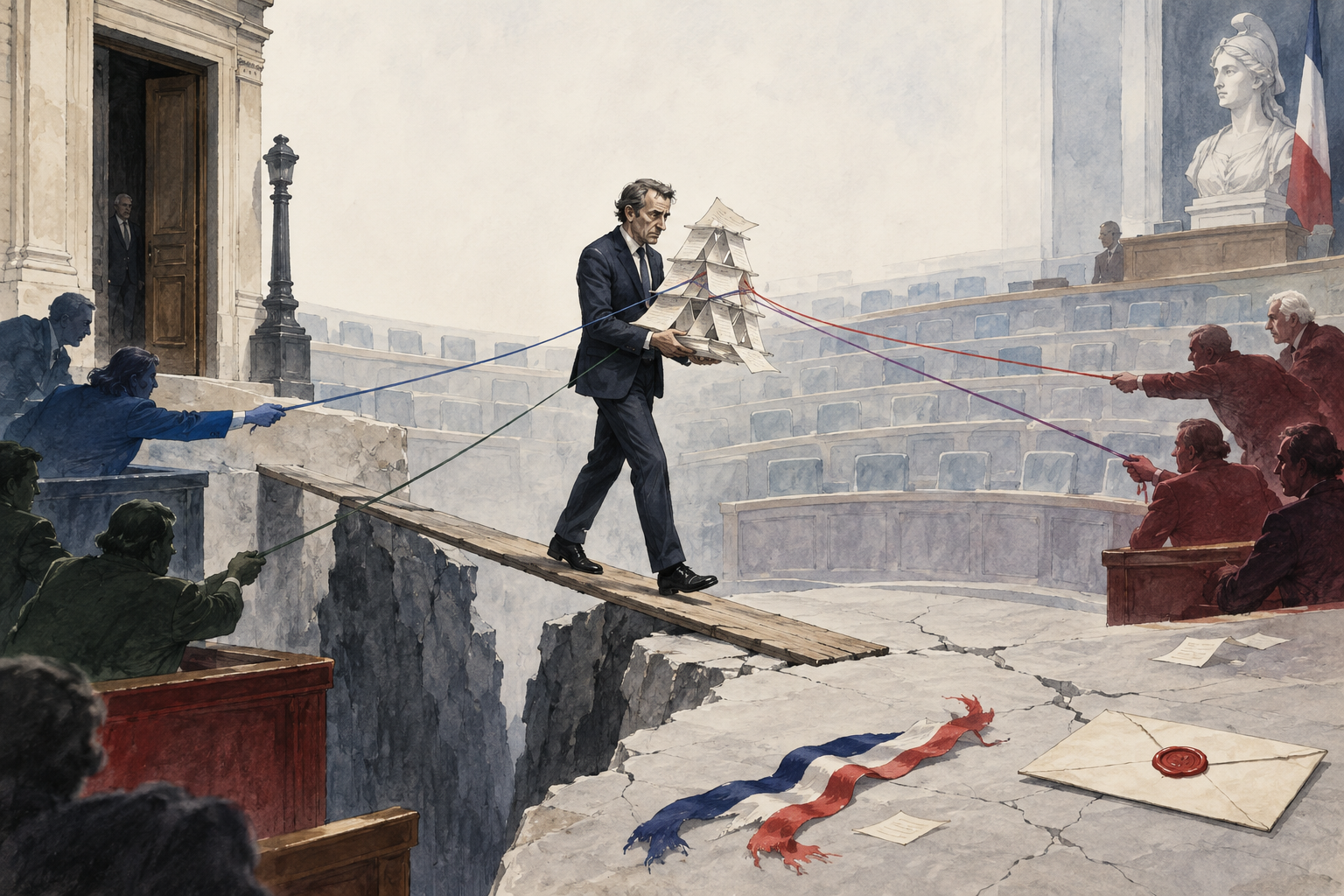
The 2027 budget’s main obstacle is no longer only the fiscal forecast, but whether Lecornu can steer it through a fragmented National Assembly.
Weaker growth
The government has cut its 2026 growth forecast to 0.5% and is basing the 2027 budget on a modest 1% recovery.
Censure risk
Avoiding Article 49.3 and a no-confidence confrontation will be central to the government’s budget strategy.
France’s 2027 budget is becoming an early test of Prime Minister Sébastien Lecornu’s ability to govern without the procedural escalation that has marked recent fiscal battles. After cutting its 2026 growth forecast, pencilling in only a modest 1% rebound for 2027 and dropping an earlier goal of reducing the deficit to 5% next year, the government now faces a parliamentary fight in which coalition arithmetic may matter more than the numbers.14
The timetable leaves little room for delay. A government seminar is due on September 17, before the draft budget goes to the High Council of Public Finances and is prepared for cabinet presentation and transmission to the National Assembly by the early October deadline.16 That compressed calendar gives Lecornu only a narrow window to reconcile three difficult objectives: preserve a no-tax-rise line, avoid another clash over Article 49.3 and prevent opposition parties from turning fiscal discontent into a no-confidence vote.
The political challenge is sharpened by the macroeconomic reset. The government has halved its 2026 growth forecast to 0.5% and is building the 2027 budget on 1% real growth, a scenario that assumes a limited recovery rather than a decisive rebound.6 Le Monde reported that the executive has also abandoned its previous deficit ambition for 2026, increasing the adjustment it must explain to lawmakers and voters.1 For a minority or fragile government, that combination is risky: weaker growth reduces expected revenue, while a softer deficit path exposes the executive to attacks from both fiscal hawks and parties demanding protection for households.
The budget’s fate will be decided less in technical talks at Bercy than in the National Assembly, where no bloc has an easy path to owning austerity. The government needs a budget quickly, but speed can become a political liability if opposition parties frame the process as a forced passage rather than a negotiation.3
That is why Article 49.3 looms before the bill is even tabled. The constitutional mechanism allows a government to push legislation through without a standard vote unless a no-confidence motion succeeds. In budget debates, it can provide procedural certainty, but at the cost of concentrating opposition anger into a single survival vote. For Lecornu, using it too early or too bluntly would risk confirming that his government cannot manage the Assembly through persuasion.
The alternative is to find enough abstentions, partial understandings or issue-by-issue compromises to keep the bill alive. That path requires Lecornu to offer something to groups that do not want to be seen as supporting him. It also requires discipline inside the governing camp, especially if the budget preserves pro-business tax measures while asking households or pensioners to absorb restraint.
The government’s insistence on avoiding broad tax increases is politically useful but fiscally constraining. La Tribune reported that Bercy is trying to protect business-facing measures such as the research tax credit, the Dutreil inheritance regime for business transfers and apprenticeship support, even as it warns that little budgetary slack remains.4 That posture is meant to reassure companies and centrist lawmakers, but it gives the left and far right a clear line of attack: the government is shielding business while looking for savings elsewhere.
The most sensitive trade-offs may involve pensions and household taxation. Reporting by MoneyVox with AFP highlighted a possible choice between indexing pensions and preserving the 10% tax allowance for retirees — a budgetary arbitration that would be politically explosive in the Assembly.5 Any move seen as reducing retirees’ purchasing power could mobilize opposition across ideological lines, especially if it comes alongside a message that taxes will not rise and key business incentives will be spared.
That makes the no-tax-rise promise a double-edged tool. It can help Lecornu hold the center-right and business constituencies. But it also shifts the adjustment toward spending restraint, social benefits, tax expenditures or delayed indexation — areas where opposition parties can most easily build a censure narrative.
The deteriorating economic backdrop compounds the parliamentary problem. INSEE’s outlook points to slow growth, inflationary pressure and unemployment concerns that leave the French economy lagging parts of Europe.7 In that environment, each concession to one parliamentary group risks opening a fiscal gap that must be closed elsewhere.
Le Monde described the situation as a trap for the French economy, with short-term political constraints colliding with the approach of the 2027 election.8 That electoral horizon matters. Opposition parties have little incentive to help Lecornu pass an unpopular budget if they believe the government will bear the blame for weak growth, debt pressure and spending cuts. The closer France moves to the presidential campaign, the less attractive compromise becomes.
The government’s own framing reflects that pressure. Officials argue that the budget must be passed rapidly, while acknowledging the need for roughly €30 billion in savings under the threat of censure.6 That adjustment is large enough to be politically visible, but not necessarily large enough to satisfy critics who see France’s deficit trajectory as still too loose. Lecornu therefore faces criticism from both sides: one flank will say the budget cuts too much, the other that it cuts too little.
The pre-budget atmosphere has already been strained by a dispute over leaks. Lecornu demanded a criminal probe into press disclosures on the budget, underlining the sensitivity of the arbitrations and the government’s concern about losing control of the narrative before formal presentation.1
That matters because budget coalitions are often built in private before they are defended in public. If opposition parties believe the government is using secrecy to impose choices, or if governing-camp lawmakers learn of measures through the press, trust erodes before bargaining begins. In a fragmented Assembly, that can be enough to turn a difficult budget into a confidence crisis.
The finance committee is also likely to become an early arena for confrontation. AFP reported critical reaction from Eric Coquerel, the Assembly finance committee chair, after the revised growth and deficit framing emerged.3 His position gives the left a procedural and political platform to challenge the budget’s assumptions before the broader chamber debate begins.
Lecornu’s best route is to keep the budget from becoming a binary confidence test for as long as possible. That means separating the macroeconomic debate from the most explosive social measures, offering targeted concessions that do not breach the no-tax-rise line and persuading enough lawmakers that forcing a government crisis over the budget would be riskier than amending it.
But the space for that strategy is small. The government has already lowered growth expectations and loosened its deficit ambition.1 It still needs savings. It wants to avoid tax increases. It must decide whether to adjust politically sensitive items such as pension indexation or retiree tax allowances.5 And it must do all of this in an Assembly where budget frustration can quickly become a no-confidence vote.
The September 17 seminar will therefore be more than an internal fiscal meeting. It will mark the point at which Lecornu’s government must choose not only a budgetary path, but a parliamentary method. If that method looks like another forced passage, the 2027 budget could become the first major test of whether his premiership can survive the arithmetic of France’s fractured legislature.

Anthropic says users in Houthi-controlled northern Yemen tried to use Claude to develop missile guidance software and other advanced weapons projects, but the company says the effort did not produce an operational device. The episode is less proof of a new Houthi capability than a warning sign that nonstate groups may be using AI to compress engineering cycles and reduce dependence on outside weapons pipelines.

President Joseph Aoun’s trip to Nabatiyeh and Zawtar al-Gharbieh underscored the central question facing a U.S.-backed Lebanon-Israel framework: whether state authority can take hold while Israel keeps operating and Hezbollah refuses to disarm.

Moscow is pairing intensified strikes on Ukrainian cities, industry and logistics with public threats against European troop deployments. The message is aimed not only at Kyiv, but at European governments weighing whether any post-ceasefire reassurance force would be politically and militarily sustainable.

The European Commission hosted the first board meeting of the EU-Ukraine Drone Alliance in Brussels on September 11, bringing together 18 founding defence firms. The initiative is meant to channel Ukraine’s wartime drone lessons into EU industrial policy while preserving member-state-led capability coalitions.
Article 49.3
A provision of the French Constitution that lets the government pass a bill without a standard vote unless the National Assembly adopts a no-confidence motion.
High Council of Public Finances
France’s independent fiscal watchdog, which assesses whether government budget plans are based on credible economic and public-finance assumptions.
No-confidence vote
A parliamentary vote that can force the government to resign if a majority of deputies supports the motion.
Dutreil regime
A French tax arrangement that can reduce inheritance or gift tax when family businesses are transferred under certain conditions.
Le Monde
Trap closes on French economy
Comments