Sudan famine risk grows as violence strains fragile aid routes
Associated Press
news
Sudan’s famine risk worsened by conflict, drought and funding shortages, report says
World Health Organization
government
IPC Sudan Food Insecurity and Malnutrition Alert
United Nations in Sudan
government
Statement by the United Nations Resident and Humanitarian Coordinator in Sudan, Denise Brown
Untracked bias
100% of tracked sources are High factuality
Ahram Online
Sudan's famine risk worsened by conflict, drought and funding shortages: Report
The Independent
Sudan's famine risk worsened by conflict, draught and funding shortages, report says
Local 10
Sudan's famine risk worsened by conflict, drought and funding shortages, report says
ClickOnDetroit
Sudan's famine risk worsened by conflict, draught and funding shortages, report says
WSB-TV
Sudan's famine risk worsened by conflict, draught and funding shortages, report says
WSOC-TV
Sudan's famine risk worsened by conflict, draught and funding shortages, report says
SeattlePI
Sudan's famine risk worsened by conflict, draught and funding shortages, report says
CT Insider
Sudan's famine risk worsened by conflict, draught and funding shortages, report says
Bias and factuality ratings from Media Bias Fact Check. Outlets without a rating are marked “Untracked.”
Famine risk
The IPC warned that parts of Greater Darfur and Greater Kordofan face a growing risk of famine as conflict, drought and aid shortfalls worsen conditions.
Civilian attacks
Recent strikes in Blue Nile state killed civilians near displacement sites and in residential areas, according to the U.N., AP and rights monitors.
Aid under threat
WHO said 37% of Sudan’s health facilities had stopped functioning by 2026, while aid convoys have faced deadly attacks.
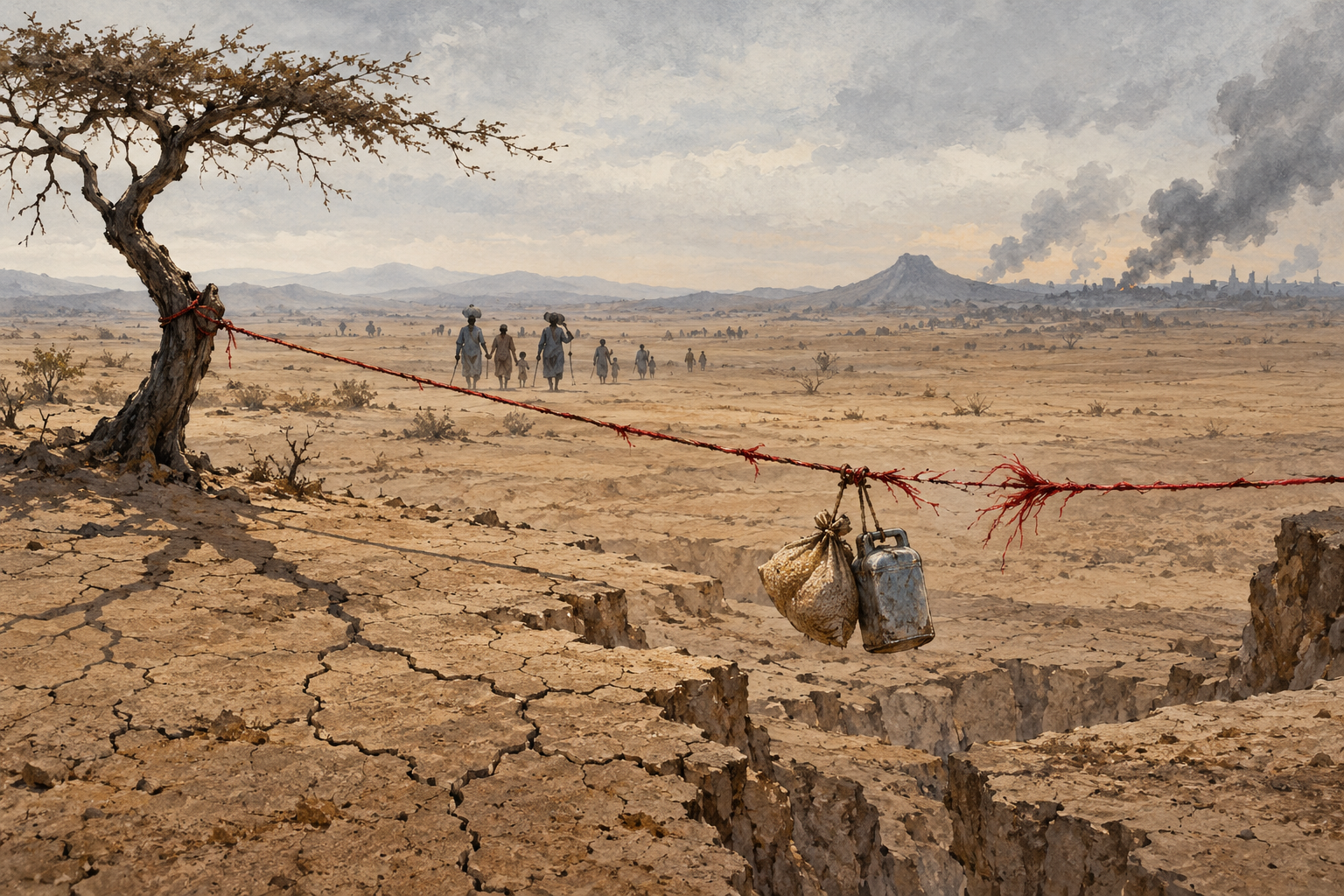
Sudan’s humanitarian crisis is entering a more dangerous phase, with famine risk rising in parts of Darfur and Kordofan as attacks on civilians and aid routes spread into areas already weakened by drought, displacement and deep funding gaps.
The Integrated Food Security Phase Classification, or IPC, warned Monday that conditions are deteriorating across Greater Darfur and Greater Kordofan, including areas identified as at risk of famine.1 The World Health Organization, an IPC member, said conflict, mass displacement, severe drought and inadequate humanitarian funding are worsening the crisis. Limited health care and scarce clean water are leaving malnourished communities more vulnerable to disease and death.2
The warning follows a week of reported attacks in Blue Nile state and South Kordofan that show how Sudan’s war is increasing pressure on civilians and humanitarian systems. The United Nations said at least 31 civilians, mostly women and children, were killed in a drone strike near a displacement site in Wad Al Mahi, Blue Nile State, where people had already fled recent fighting in Geissan and Kurmuk.3 The Associated Press reported that the rights monitor Emergency Lawyers attributed a separate drone strike in Abu Shandi, near the Ethiopian border, to the Rapid Support Forces, saying it killed 41 displaced people, including eight children and many women.4
The IPC alert puts food insecurity at the center of Sudan’s worsening emergency. In May, nearly 19.5 million people — more than 40% of Sudan’s population — faced high levels of acute food insecurity, AP reported, citing IPC data. Of those, 135,000 were in IPC Phase 5, the most severe classification, associated with extreme food shortages, starvation, severe malnutrition and deaths linked to hunger or disease.1
Drought is compounding the damage from war. The IPC said severe drought linked to El Niño is affecting more than half of Sudan, reducing harvests, cutting household income and pushing more families toward markets or aid at a time when both are less reliable.1 WHO said the drought is affecting roughly half the country, reducing food availability, raising prices and damaging livelihoods.2
The agricultural picture is especially severe in parts of Darfur and Kordofan. AP reported that poor vegetation growth affects 64% of croplands in North Darfur and about half of croplands in South Darfur, West Kordofan and South Kordofan. In Nyala, children admitted for severe acute malnutrition among those accessing nutrition services rose from about 5% in January to 11% in August. Two displacement camps in South Darfur recorded global acute malnutrition above famine thresholds.1
WHO said Sudan’s weakened health system is making the food crisis more lethal. Since the war began on April 15, 2023, WHO has verified 228 attacks on health care, resulting in 2,055 deaths and 817 injuries. By 2026, 37% of Sudan’s health facilities had stopped functioning, and WHO said only 23% of its $97.7 million humanitarian appeal had been funded.2
The food-security alert came as reports of civilian casualties mounted outside the war’s most familiar front lines. On Oct. 10, U.N. Resident and Humanitarian Coordinator Denise Brown said Blue Nile State had been under continuous attack in recent weeks, displacing thousands and exposing civilians to death, injury and further hardship.3
Emergency Lawyers, a Sudanese rights group that tracks the conflict, said the Abu Shandi strike hit a gathering of displaced people and blamed the RSF, according to AP. The RSF did not respond to AP’s request for comment.4 Days earlier, AP reported that another drone strike hit homes and a mosque in Damazin, the capital of Blue Nile state, killing at least four women and wounding dozens. Emergency Lawyers also blamed that attack on the RSF, which did not immediately comment.5
The attacks point to a widening threat in areas where displacement has become a survival strategy. People fleeing violence often arrive in informal sites with limited food, water, sanitation and medical care. When those sites are struck, humanitarian needs rise while safe places to deliver assistance shrink.
Humanitarian agencies have repeatedly said ending the conflict and securing safe, sustained access are essential to preventing further deterioration.1 Recent attacks have also raised concerns about aid groups’ ability to move food through contested areas.
AP reported that an airstrike hit two World Food Programme trucks in South Kordofan’s Dilling area, killing a driver. The U.N. said the trucks were clearly marked, had required travel permits and were carrying lifesaving assistance.5 The Committee for Justice said it documented the killing of a humanitarian aid truck driver in an Oct. 3 airstrike on two WFP-contracted trucks traveling from Al-Dilling to Kadugli with food assistance shipments. The group said the vehicles bore clear humanitarian markings and called for an independent investigation.6
The danger to convoys is not isolated. AP, citing the U.N., reported that 17 trucks carrying food have been destroyed and eight drivers killed in Sudan over the past two years.5 For communities already facing drought, crop failure and market disruption, each attack on aid transport can mean fewer rations, longer delays and higher malnutrition risk.
International efforts to reduce weapons flows have not kept pace with the war’s geographic spread. On Oct. 8, the U.N. Security Council unanimously adopted Resolution 2830, renewing Sudan’s sanctions regime for two months and the mandate of the Panel of Experts for three months, including the Darfur arms embargo.7 The short extension left unresolved a central dispute: whether restrictions should remain focused on Darfur or expand nationwide.
The National reported that the United States has pushed for a countrywide embargo, while China, Russia and several other council members want sanctions confined to Darfur. The report said the brief extension reflected divisions over how to stop weapons from reaching combatants, including concerns about drones, arms traffickers and outside support.9
Sudanese rights advocates said the limited rollover was inadequate. The Sudanese Alliance for Rights argued that the war is nationwide, supply networks are transnational and continued arms flows are affecting civilians beyond Darfur. It called for stronger measures addressing weapons, drones, dual-use technologies and networks financing or materially supporting violations.8
The debate over weapons flows has direct humanitarian consequences. Drones and other weapons are increasingly cited in attacks on civilian areas, displacement sites and aid movements. As violence spreads into places where drought and funding cuts have already weakened health, water and food systems, civilians face a narrowing margin for survival.
Sudan’s war began in April 2023 after tensions between the Sudanese Armed Forces and the RSF escalated into open fighting in Khartoum and then spread across the country. AP reported that the conflict has killed at least 150,000 people, citing ACLED, while aid groups say the true toll is likely higher. The war has also displaced about 13 million people and pushed parts of the country into famine.1
The latest IPC alert does not stand apart from the violence. It shows how hunger, disease, displacement and insecurity are reinforcing one another. Drought is reducing food production. Funding shortages are limiting relief. Health facilities are damaged or closed. Attacks are killing civilians and making aid delivery more dangerous.
Without a rapid increase in assistance, safe humanitarian access and a reduction in violence, the IPC warned that food insecurity, acute malnutrition and excess mortality are likely to intensify.1 For Darfur, Kordofan and increasingly Blue Nile, the next phase of Sudan’s crisis may be defined not only by where fighting occurs, but by where weakened civilian systems can no longer absorb it.

Renewed fighting in northern Ethiopia has moved beyond a domestic contest over Tigray, drawing in claims of Eritrean incursions, Ethiopian self-defense at the United Nations and a new alignment among Egypt, Eritrea, Sudan and Somalia. The escalation is testing the 2022 peace settlement and reviving disputes over Red Sea access, Nile water politics and regional security.

Brazil’s October 25 presidential runoff has become a compressed contest over turnout, right-wing consolidation, street pressure and trust in election rules. After Flávio Bolsonaro led the first round, Lula is racing to reassemble a broad anti-Bolsonaro coalition in a country whose Congress and electorate have shifted right.

Saudi Arabia is investigating how a Houthi barrage of drones, cruise missiles and ballistic missiles reached King Khalid International Airport, killing at least 13 people and wounding more than 300. The attack has turned a long-running cross-border campaign into a strategic test of Gulf missile defenses and U.S. appetite for deeper involvement.

President Volodymyr Zelenskyy says Russia continued hitting Ukrainian energy facilities after President Donald Trump claimed Moscow and Kyiv had agreed to pause attacks on each other’s energy infrastructure. Kyiv has signaled conditional compliance, while Moscow has not clearly confirmed the arrangement.
IPC
The Integrated Food Security Phase Classification is a global system used by governments, U.N. agencies and aid groups to assess food insecurity and famine risk.
IPC Phase 5
The most severe IPC category, indicating catastrophe or famine-level conditions marked by extreme food gaps, starvation, severe malnutrition and elevated deaths.
RSF
The Rapid Support Forces are a Sudanese paramilitary force fighting the Sudanese Armed Forces in a war that began in April 2023.
Darfur arms embargo
A U.N. sanctions measure restricting arms transfers related to Darfur; some countries have pushed to expand it across all of Sudan.





Comments