Andersson faces coalition test after Sweden’s left-leaning bloc wins narrow majority
Untracked bias
100% of tracked sources are High factuality
Bias and factuality ratings from Media Bias Fact Check. Outlets without a rating are marked “Untracked.”
176-seat majority
The Social Democrats, Greens, Left Party and Centre Party won 176 Riksdag seats against 173 for the outgoing right bloc.
Caretaker cabinet
Ulf Kristersson submitted his resignation, but his government remains in place as a caretaker until a new cabinet takes office.
Coalition dispute
Magdalena Andersson must bridge Centre Party resistance to Left Party cabinet seats with the Left’s demand for influence.
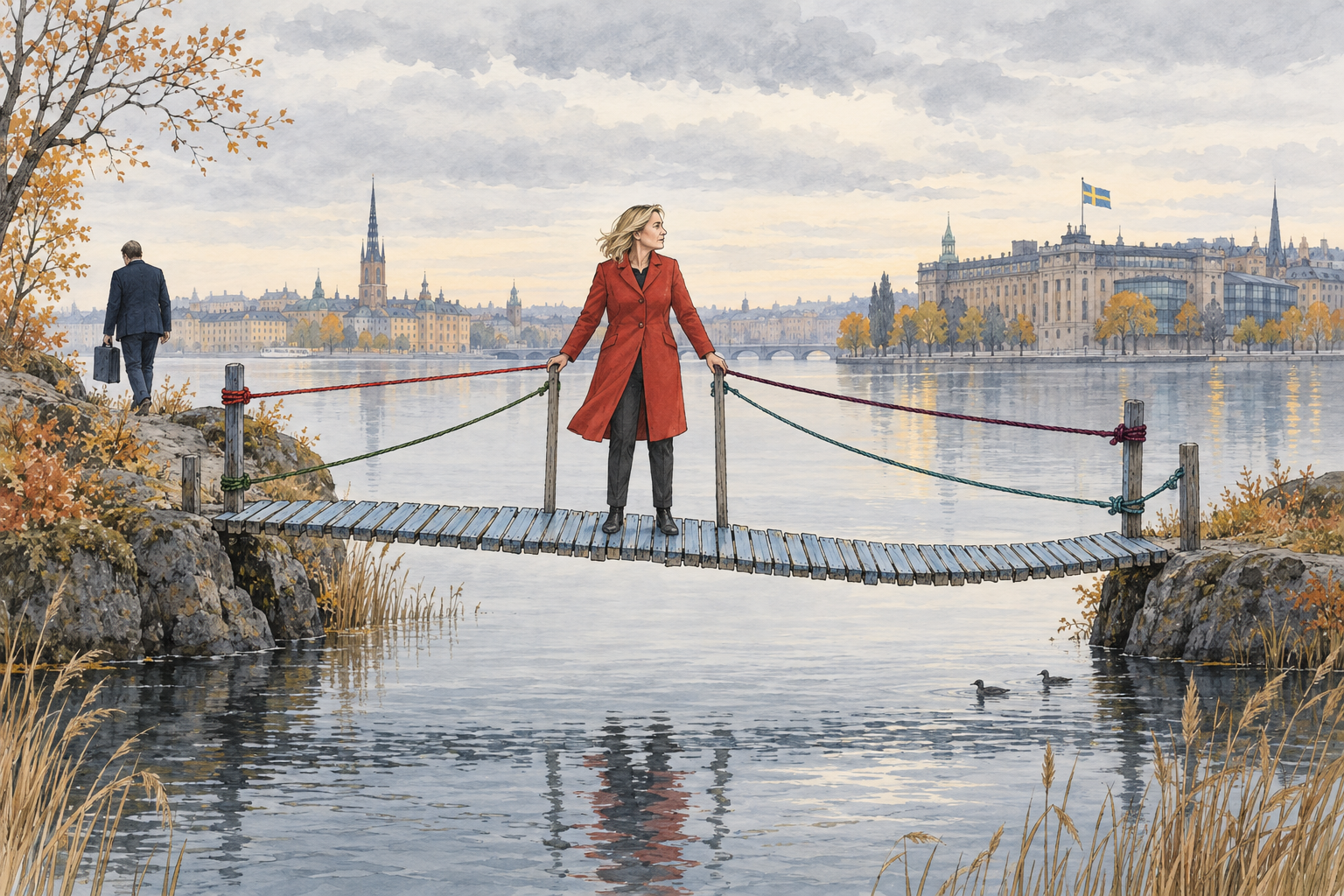
Sweden’s government-formation process began on September 17 after the final election count gave the Social Democrats, Greens, Left Party and Centre Party 176 seats in the 349-member Riksdag, ahead of the outgoing right bloc’s 173 seats. Prime Minister Ulf Kristersson then submitted his resignation.12
Speaker Andreas Norlén accepted Kristersson’s resignation request and began the constitutional process of proposing a new prime minister. The outgoing government remains in office in a caretaker capacity until a successor is installed.24
Norlén scheduled consultations with party representatives for September 18, including the Social Democrats, Left Party, Centre Party and Greens. The meetings are the first formal step toward testing whether Social Democratic leader Magdalena Andersson can command enough parliamentary support.3
The arithmetic points toward Andersson’s return to office, but the politics are less settled. The Election Authority’s updated preliminary distribution gave the Social Democrats 99 seats, the Centre Party 25, the Greens 22 and the Left Party 30 — just enough to outnumber the Moderates, Sweden Democrats, Christian Democrats and Liberals, who together hold 173 seats.1
International and Swedish reporting described the result as a narrow left-leaning opposition win that forced Kristersson to stand down. It also marked the start of potentially difficult negotiations across deep policy and strategic divides.57
Andersson’s main task is to bridge a bloc united largely by opposition to the outgoing right-wing government and the influence of the Sweden Democrats, but divided over economic policy, cabinet composition and the role of the Left Party.
The Centre Party has historically resisted giving the Left Party ministerial posts, while the Left has signalled that it wants representation or a more formal role after helping deliver the majority.78
That conflict could determine whether Andersson seeks a broad coalition, a minority cabinet or a looser parliamentary support arrangement. Reporting immediately after the result pointed to an early impasse: Centre Party alternatives were described as excluding Left Party cabinet seats, while Left sources rejected both a single-party Social Democratic government and a Social Democratic-Green-Centre cabinet unless the Left was included.10
The problem is familiar in Swedish politics. Recent government formation has often required extended bargaining, and European-facing analysis after the vote noted precedents for long coalition talks when no ideologically coherent bloc can easily govern alone.8
Andersson’s challenge is therefore not simply to assemble 176 votes against the right, but to prevent the bloc’s internal contradictions from producing another prolonged negotiation.
Policy trade-offs are expected to centre on welfare, climate, schools, healthcare, elderly care and immigration — priorities Andersson raised as she began outreach after the election.6
Those issues offer possible common ground with the Greens and Left, particularly on public services and climate policy. But they may also test the Centre Party’s tolerance for higher spending, regulation or left-wing influence over economic policy.
For the Centre Party, a durable arrangement may require assurances that a new government will not move too far left on business, taxation and market-oriented policy. For the Left Party, support may depend on visible influence over welfare and labour-market priorities, as well as recognition that its 30 seats are indispensable to the majority.110
Immigration could be another sensitive area. The outgoing right bloc governed with support from the Sweden Democrats and pursued a tougher line, while Andersson has signalled interest in priorities that include immigration alongside welfare and climate.6
A new government may seek to soften parts of the right’s agenda without creating an opening for renewed attacks from the opposition on crime, integration and border policy.
Under Sweden’s parliamentary system, the speaker plays the central role in nominating a prime ministerial candidate. Norlén’s consultations on September 18 are intended to clarify which party leader has the best chance of being tolerated by the Riksdag.3
A nominee does not need an absolute majority in favour, but must avoid a majority voting against them. That rule gives Andersson room to manoeuvre if she can secure support or abstentions from enough parties.
But with only a three-seat edge over the right bloc, defections, abstention disputes or disagreements over the cabinet programme could quickly threaten any deal.
The Social Democrats have already moved to frame the election outcome as an opening for broader cooperation. Swedish public broadcaster SVT reported that the party invited opposition group leaders to talks and that Andersson called for a new era of cooperation as the parliamentary strategy took shape before formal negotiations.9
Kristersson’s resignation ends the outgoing right bloc’s mandate, but it does not yet begin a stable Andersson government. The final count delivered a numerical anti-right majority. The next phase will determine whether that majority can be converted into a cabinet, a policy programme and parliamentary discipline strong enough to survive.
If Andersson can reconcile the Centre Party’s resistance to Left Party cabinet power with the Left’s demand for influence, Sweden may move quickly to a new centre-left-led government.
If not, Norlén’s process could expose the same fragmentation that has made Swedish coalition bargaining increasingly protracted in recent years.810

Russia and China blocked a U.S. proposal to extend the U.N. expert panel that monitors Iran sanctions, removing a formal Security Council enforcement tool while inspectors remain unable to verify Iran’s enriched-uranium stockpile. The move is likely to shift monitoring toward Western-led intelligence sharing, national sanctions and ad hoc investigations outside the Council.

The Houthi seizure of Mokha and nearby islands has turned a Red Sea shipping crisis back into a Yemeni ground war, threatening Saudi-linked energy routes and adding a second maritime pressure point for Iran alongside Hormuz. The advance redraws front lines around Mokha, Marib and Taiz while exposing limits in Saudi and U.S. deterrence.

Russia’s Sept. 17 missile-and-drone wave hit Kyiv and western Ukraine while Poland scrambled aircraft, sounded sirens in eastern areas and temporarily halted flights at Rzeszow and Lublin. Even without a confirmed Polish airspace violation, the attack pattern is making NATO-adjacent logistics hubs a more acute escalation-management problem.

Ursula von der Leyen’s proposal to make Canada the EU’s first “associate member” has created a political opening but not yet a legal category. The next test is whether EU institutions and member states turn the label into a formal foreign-policy instrument or leave it as diplomatic shorthand for closer cooperation.
Riksdag
Sweden’s national parliament, with 349 seats. A government must be able to survive votes in the Riksdag.
Speaker’s consultations
After a prime minister resigns, the speaker meets party leaders to determine who can be nominated to form a government.
Negative parliamentarism
In Sweden, a prime ministerial candidate can take office unless a majority of lawmakers votes against them.
Caretaker government
An outgoing cabinet that remains in office temporarily to handle routine duties until a new government is formed.



Comments