China promotes digital-trade rules while leaving U.S. AI safety channels unclear
Ministry of Foreign Affairs of the People's Republic of China
government
Foreign Ministry Spokesperson Guo Jiakun’s Regular Press Conference on September 24, 2026
The State Council of the People's Republic of China / Xinhua
government
China to ease market access, boost digital trade: Premier Li
The State Council of the People's Republic of China / Xinhua
government
Highlights of Chinese premier's speech at Fifth Global Digital Trade Expo
Untracked bias
100% of tracked sources are High factuality
Bias and factuality ratings from Media Bias Fact Check. Outlets without a rating are marked “Untracked.”
AI governance
Li Qiang used the Hangzhou expo to link digital trade with stronger AI-era governance rules.
Digital trade
China said digital trade creates opportunities but also exposes development gaps, trade barriers and rule deficits.
U.S. channel
Beijing did not publicly confirm U.S. claims of a formal AI safety dialogue and incident line.
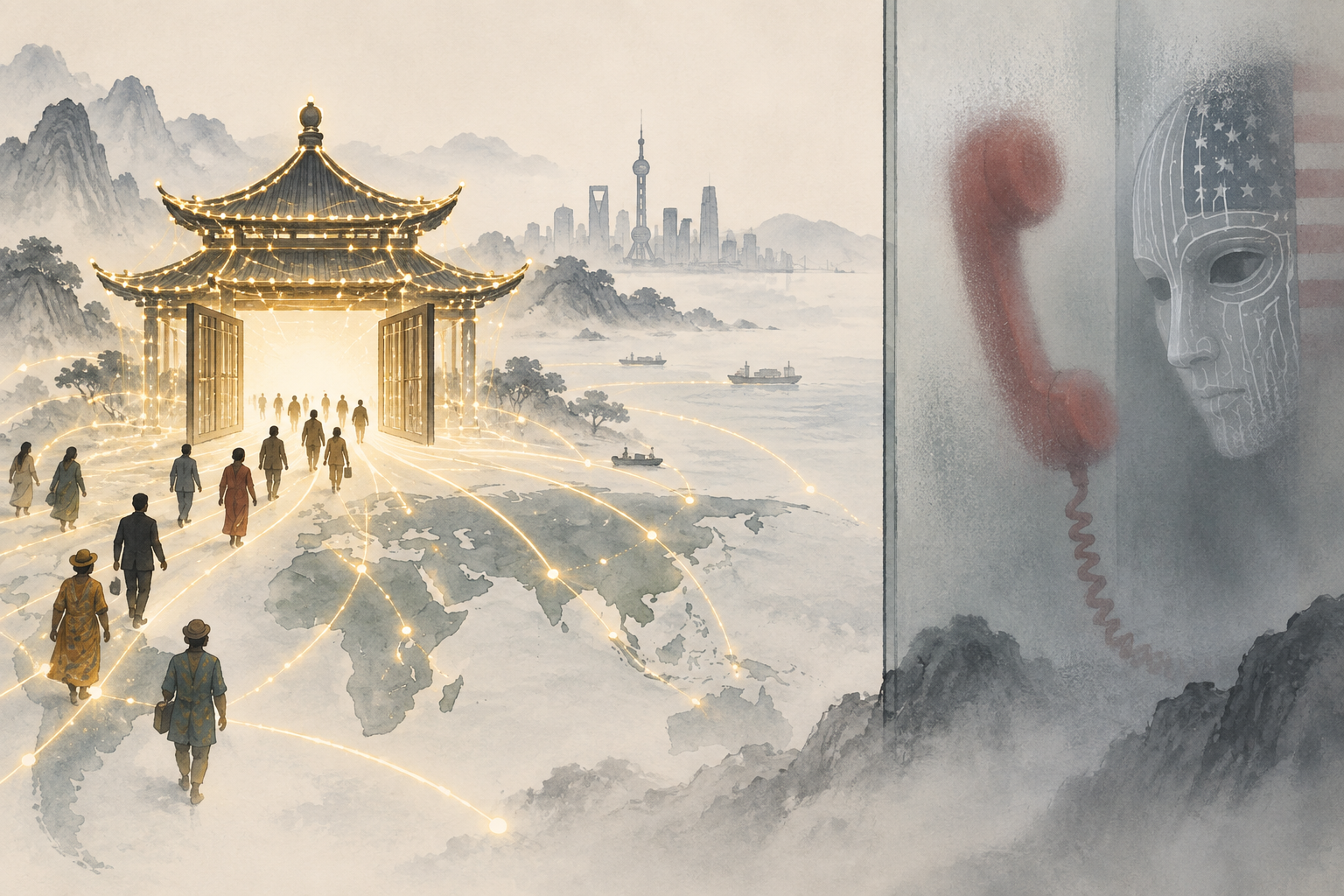
China is casting itself as a rule-shaper for digital trade and artificial intelligence governance, using the September 24 Global Digital Trade Expo in Hangzhou to call for stronger digital connectivity, more support for developing countries and fuller global rules. At the same time, Beijing is keeping U.S.-China AI risk-management arrangements opaque, declining at a Foreign Ministry briefing to confirm a U.S.-described formal AI safety dialogue and incident-notification line.1
The contrast is central to Beijing’s current digital diplomacy: expansive multilateral language in public forums, tightly controlled detail when mechanisms involve Washington. Premier Li Qiang told the Hangzhou expo that global digital trade is creating new opportunities while also widening development gaps, creating new trade barriers and exposing gaps in international rules, according to official Chinese accounts.12 His response was a three-part agenda: improve digital connectivity, bridge the digital divide and strengthen digital governance.1
The setting reinforced the message. The fifth Global Digital Trade Expo, held in Hangzhou from September 23 to 27 under the theme “Meet the AI Future at GDTE,” put artificial intelligence at the center of a trade event with more than 2,000 exhibitors and 170,000 square meters of exhibition space.4 Malaysian Prime Minister Anwar Ibrahim attended the opening, along with Kyrgyzstan’s Adylbek Kasymaliev and representatives of international organizations.12
Li framed digital trade as both an economic growth engine and a governance challenge. Official readouts said he called for alignment and mutual recognition of standards, closer North-South cooperation and more support for developing countries in technology, infrastructure and personnel training.2 A separate official summary described the speech as a defense of open cooperation over distrust and “beggar-thy-neighbor” approaches. It also said China would implement national treatment for foreign-invested enterprises and address reasonable concerns.3
For Asia-Pacific audiences, the emphasis on North-South cooperation is not incidental. It links China’s digital-trade agenda to its broader effort to position itself as an advocate for developing economies in debates over technology access, standards and governance. In the Foreign Ministry’s account, Li said China’s technology development follows an open-source approach in fields such as AI and that Beijing would offer “China’s solutions” for fuller international rules.1
That framing was reinforced in a bilateral meeting the same day. Li met Anwar in Hangzhou, where the official readout said the Malaysian leader supported China’s proposal to strengthen AI governance and praised China’s role in improving global governance and safeguarding Global South interests.9 The readout also tied digital issues to practical cooperation, including infrastructure, emerging industries and AI.9
Beijing was less expansive when asked about U.S.-China AI safety mechanisms. At the Foreign Ministry’s September 24 briefing, a reporter cited U.S. Treasury Secretary Scott Bessent as saying the two countries had agreed to establish a formal AI dialogue, including an incident line for AI safety events. Spokesperson Guo Jiakun did not confirm the arrangement, instead referring reporters to China’s readout of economic and trade consultations and to “competent authorities” for more information.1
The Ministry of Commerce readout was only slightly more specific. It said Vice Premier He Lifeng and Bessent, as the two sides’ economic and trade leads, held a first AI dialogue under the China-U.S. economic and trade consultation mechanism, and that China would maintain close communication with the U.S. side on follow-up work.5 It did not describe the dialogue’s scope, the status of an incident line, what would trigger a notification, or whether AI safety would be handled separately from trade issues.5
The ambiguity matters because risk-management channels are a recurring demand in U.S.-China technology diplomacy. Associated Press reporting from the Washington summit said U.S. officials had proposed a new notification mechanism for AI incidents, while Xi Jinping’s public remarks emphasized keeping AI under human control and using the technology for human progress.7 China’s September 25 readout of Xi’s talks with U.S. President Donald Trump said the two sides could continue AI dialogue, exchange views on risks and benefits, and jointly prevent misuse. It likewise offered no technical architecture for an incident line or safety protocol.6
China’s public documents suggest a deliberate distinction between global rulemaking and bilateral risk management. In multilateral settings, Beijing is willing to outline broad objectives: digital connectivity, standards alignment, support for developing countries, AI governance and international rule formation.128 In bilateral settings with the United States, it is acknowledging dialogue while leaving operational details undefined.56
That approach gives Beijing diplomatic flexibility. It can claim support for AI governance and digital-trade rules without publicly accepting U.S. terminology or signaling that Washington has defined the agenda. It also avoids revealing whether any AI safety channel would cover commercial systems, frontier models, military-relevant incidents, cyber-enabled misuse, export-control disputes or emergency escalation.
A Ministry of Commerce item on a WTO artificial intelligence and e-commerce training session reflects the broader posture. The ministry described the September 22–24 training in Beijing as a practical step in China’s adherence to multilateralism, participation in global AI governance and involvement in international rulemaking.8 That message aligns with Li’s Hangzhou speech: China wants to be seen not only as a large digital market, but also as a participant in writing the rules for digital trade and AI.
For regional governments, Beijing’s stance offers both opportunity and uncertainty. The Hangzhou agenda speaks directly to concerns in Southeast Asia and the wider Global South: infrastructure gaps, unequal technology access, standards barriers and the risk that AI governance could be dominated by advanced economies.23 Malaysia’s visible participation and stated support for stronger AI governance show how China can use digital forums to gather backing from partners seeking both technology investment and a voice in rulemaking.9
But the guarded response on U.S.-China AI safety channels also signals limits. If the world’s two largest AI powers are discussing incident notification, trade-risk management or misuse prevention, Beijing is not yet presenting those mechanisms as transparent public goods. For now, China’s digital diplomacy is more open in principle than in process: expansive on the need for rules, cautious on the mechanisms that would test them.

Pakistan used UNGA-related forums to argue that the Indus Waters Treaty remains binding, while India’s defence leadership framed the treaty’s suspension as part of a broader response to terrorism after the Pahalgam attack. The dispute over water is increasingly being folded into the two countries’ wider confrontation over deterrence, diplomacy and international messaging.

Prime Minister Sanae Takaichi’s call to delete the UN Charter’s postwar “enemy state” language has reopened a long-running legal grievance for Tokyo. Beijing is treating the demand as evidence that Japan’s defense normalization and historical posture are challenging the postwar order.

Saudi Arabia’s interception of six Houthi ballistic missiles has turned the widening Iran-linked conflict into an immediate test of Riyadh’s air defenses and its emerging security framework with Turkey and Pakistan. The attacks also raise risks for Red Sea and Gulf maritime security as pressure builds around both Bab el-Mandeb and Hormuz.

Trump’s Board of Peace has put forward a $2.45 billion, six-month Gaza recovery plan, but reconstruction remains contingent on unresolved disputes over Hamas disarmament, Israeli troop withdrawal and control of postwar governance.
Global Digital Trade Expo
A Hangzhou-based trade forum used by Beijing to showcase digital industries and promote cooperation on e-commerce, AI and digital services.
Digital divide
The gap between countries or communities with strong access to digital infrastructure, skills and markets and those without it.
AI incident line
A proposed communication channel for governments to notify each other about serious AI safety or misuse events, though China has not publicly detailed such a mechanism with the United States.
North-South cooperation
Diplomatic language referring to cooperation between developed economies and developing countries, especially on technology, infrastructure and capacity building.




Comments