DOJ probes TV networks over White House pool coverage halt
Associated Press
news
DOJ says it’s investigating whether White House TV pool’s coverage halt violated antitrust law
The Washington Post
news
DOJ investigating five TV networks over White House pool coverage
The Straits Times / The New York Times
news
US Justice Department is investigating TV networks over Trump pool coverage
Untracked bias
83% of tracked sources are High factuality
Deadline
DOJ Launches Investigation Of Networks For Suspending TV Pool Amid Trump's Ban On CNN
Bias and factuality ratings from Media Bias Fact Check. Outlets without a rating are marked “Untracked.”
DOJ probe
The Justice Department is investigating ABC, CBS, CNN, Fox News and NBC over a brief halt in White House TV pool coverage.
Antitrust basis
DOJ cited the Sherman Act and said group boycotts among commercial competitors can violate federal antitrust law.
Access fight
The networks’ suspension followed White House restrictions on CNN, MS NOW and Politico, which sued on First Amendment grounds.
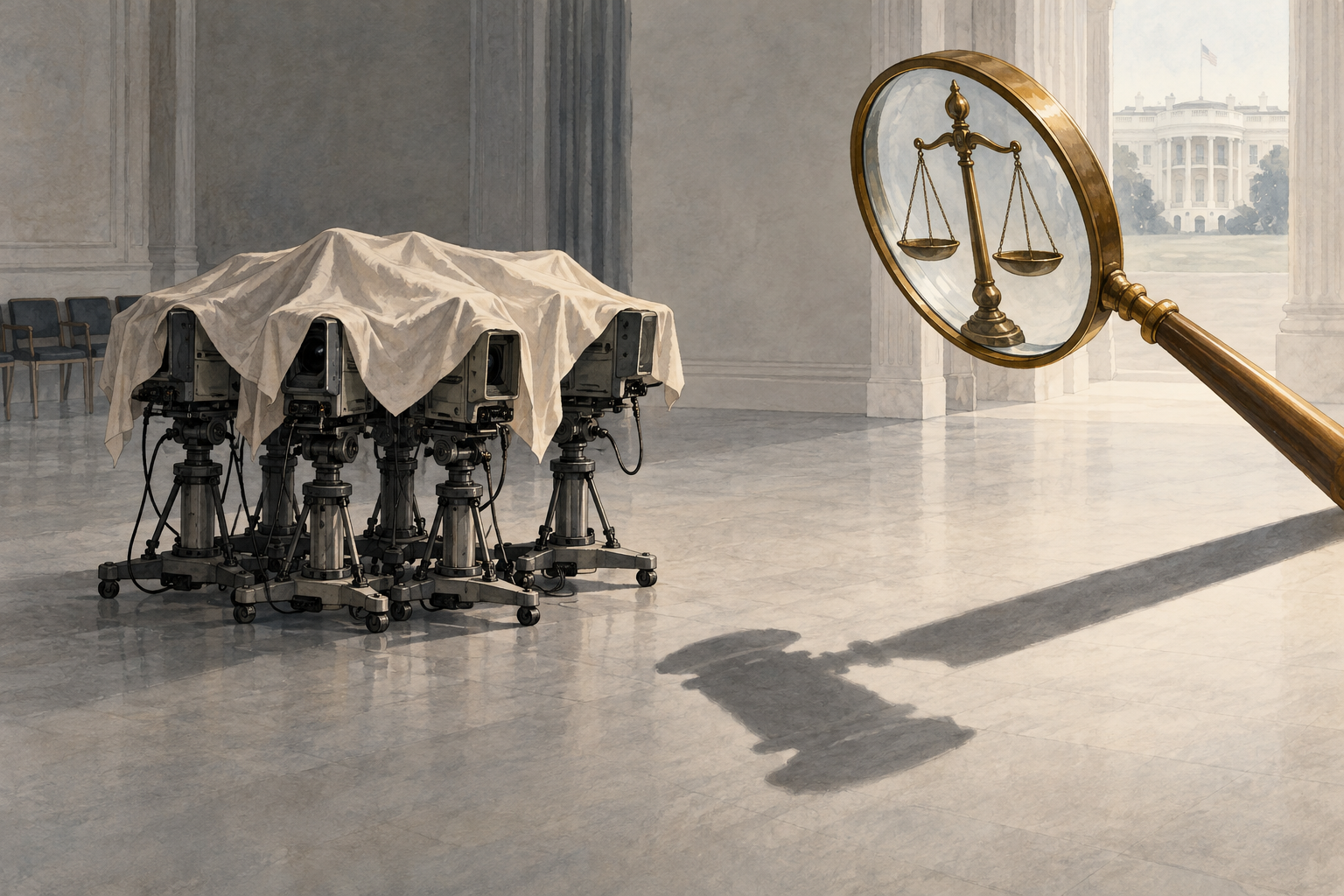
The Justice Department is investigating whether a brief halt in White House television pool coverage of President Donald Trump violated federal antitrust law, according to reports by The Associated Press, The Washington Post and other outlets published October 10 and October 11.12
The probe focuses on the five networks that make up the core White House TV pool — ABC, CBS, CNN, Fox News and NBC. They collectively suspended pooled coverage last month after the administration barred CNN, MS NOW and Politico from White House grounds.12
The investigation moves a dispute over presidential access and press rights into the Justice Department’s Antitrust Division. It also raises a governance question: whether federal competition law is being applied to a press-access confrontation weeks before the November 3 midterm elections.
Justice Department spokesperson Emily Covington said the department is examining whether the networks’ conduct crossed a legal line.
“Group boycotts among commercial competitors can violate the Sherman Act,” Covington said, according to multiple reports.23
She said the Antitrust Division is investigating whether the news organizations violated antitrust laws.14
The dispute began in September, when the White House blocked CNN, MS NOW and Politico from entering White House grounds. The move prevented them from participating in coverage arrangements that rely on access to restricted spaces.15
The administration said White House access was a privilege. The affected outlets argued in court that the exclusions violated the First Amendment and amounted to retaliation over their coverage.34
Reuters reported that the White House revoked credentials on September 19 and that CNN, Politico and MS NOW sued, alleging retaliation and unconstitutional exclusion.4 The Straits Times, carrying a New York Times report, said Trump had barred CNN, Politico and MS NOW on September 18 after complaining about what he called negative coverage.3
A federal judge later temporarily blocked the ban, and the White House restored access to the three outlets, according to the reports.13 AP reported that the court reprieve was in place until Tuesday, October 13, and that television pool coverage of the White House had resumed.1
The White House television pool is a long-running arrangement in which networks rotate responsibility for recording the president’s movements and events, then share footage with other outlets. The system reduces the need for every outlet to have a camera crew in every restricted space while ensuring broader distribution of presidential footage.23
After CNN, MS NOW and Politico were barred, the five-network TV pool suspended designated pooled coverage for several days.12 Reuters reported that all five networks, including Fox News, suspended coverage in solidarity and refused to provide replacement coverage.4
The Washington Post reported that the suspension meant major TV stations did not carry pooled footage of several White House events, including Trump’s ceremonial airport greeting of Chinese President Xi Jinping.2 The networks later resumed pool coverage after the court order restoring access to the excluded outlets, the Post reported.2
The Justice Department’s stated legal theory centers on whether competing networks acted together in a way that could constitute an unlawful group boycott under the Sherman Act, one of the main federal antitrust laws.23
The Straits Times/New York Times report said Justice Department officials contacted networks on October 9 and demanded communications and materials related to the White House TV pool.3 The BBC, in a report carried by AOL, also said the department asked ABC, CBS, CNN, NBC and Fox News to turn over communications tied to the pool system.5
Antitrust law typically focuses on competition, prices, markets and coordinated conduct among commercial rivals. Here, the department is applying that framework to a joint press-pool response to government-imposed access restrictions — an unusual setting because the pool is not simply a commercial distribution arrangement, but also a mechanism for covering the presidency.
The Washington Post described the inquiry as a sharp escalation in the administration’s fight with the press.2 Reuters reported that the action places legal and potential financial pressure on media organizations to continue covering the president even when they object to how the White House handles access.4
The press-access dispute is already the subject of First Amendment litigation by CNN, MS NOW and Politico, which challenged the White House restrictions after they were blocked from White House grounds.14 The BBC report noted that courts have traditionally interpreted the First Amendment’s press protections to bar the government from discriminating against media outlets based on the content of their coverage.5
Press-freedom advocates also criticized the Justice Department’s investigation. AP reported that Jose Zamora, the Committee to Protect Journalists’ regional director for the Americas, said the government should not use antitrust investigations to intimidate news outlets defending press access, and that the public’s right to know depends on that access.1
The reports reviewed did not describe a formal congressional oversight action in response to the antitrust probe as of October 11. But the timing — less than a month before the midterm elections — gives the dispute broader significance for press freedom and executive-branch accountability.
For now, the central legal question is whether the networks’ coordinated suspension of pool coverage can be treated as an antitrust matter. The central governance question is whether the Justice Department’s competition authority is being used to examine commercial coordination or to pressure news organizations in a fight over access to the president.

MPs are due to debate e-petition 749128 in Westminster Hall on 12 October after 111,687 people signed a call for the UK to apply to rejoin the EU. The debate is non-binding, but it will test whether pressure on ministers is moving beyond closer cooperation toward an explicit rejoin demand.

New federal restrictions have already removed Medicaid coverage from some lawfully present immigrants, including refugees, asylees and trafficking victims. The next phase will be fought through state eligibility systems, marketplace notices, appeals and possible legislation rather than campaign rhetoric.

India’s Foreign Ministry said U.S. action affecting Permanent Labor Certification applications for selected companies does not advance shared bilateral ambitions, framing skilled migration as central to the U.S.-India technology partnership. New Delhi also stressed that the move is separate from H-1B status and defended Indian professionals as contributors to the U.S. economy.

Tokyo has launched two new Japan-Australia consultation formats in the same week, signaling a shift toward regularized coordination on security, economic security, energy resilience and regional strategy. The move places middle-power diplomacy at the center of Japan’s Free and Open Indo-Pacific agenda.
White House TV pool
A rotating system in which television networks take turns recording presidential events and share footage with other outlets.
Sherman Act
A foundational federal antitrust law used to police monopolization, restraints of trade and some coordinated conduct among competitors.
Group boycott
An antitrust concept involving competitors acting together to refuse to deal with another party or withhold a service.
First Amendment retaliation
A claim that the government punished a speaker or news organization because of protected expression or coverage.





Comments