Fatal Hormuz strike raises stakes for Oman shipping talks
Associated Press
news
An Iranian commercial ship is struck near Strait of Hormuz with 1 dead, Iranian media say
Associated Press
news
Iranian media say 1 killed in ship strike on the Strait of Hormuz, and other Mideast developments
Iran International
news
Iranian vessel struck near Qeshm Island, killing one and wounding four
Untracked bias
100% of tracked sources are High factuality
Bias and factuality ratings from Media Bias Fact Check. Outlets without a rating are marked “Untracked.”
Fatal strike
Iranian media said one person was killed when a commercial vessel was struck near Qeshm Island in the Strait of Hormuz.
Oman talks
Iraq says it will attend Monday’s regional meeting in Oman on managing Hormuz shipping, while Bahrain has declined to participate.
Oil chokepoint
About one-fifth of global oil supplies passed through the Strait of Hormuz before the current war, according to Reuters-sourced reporting.
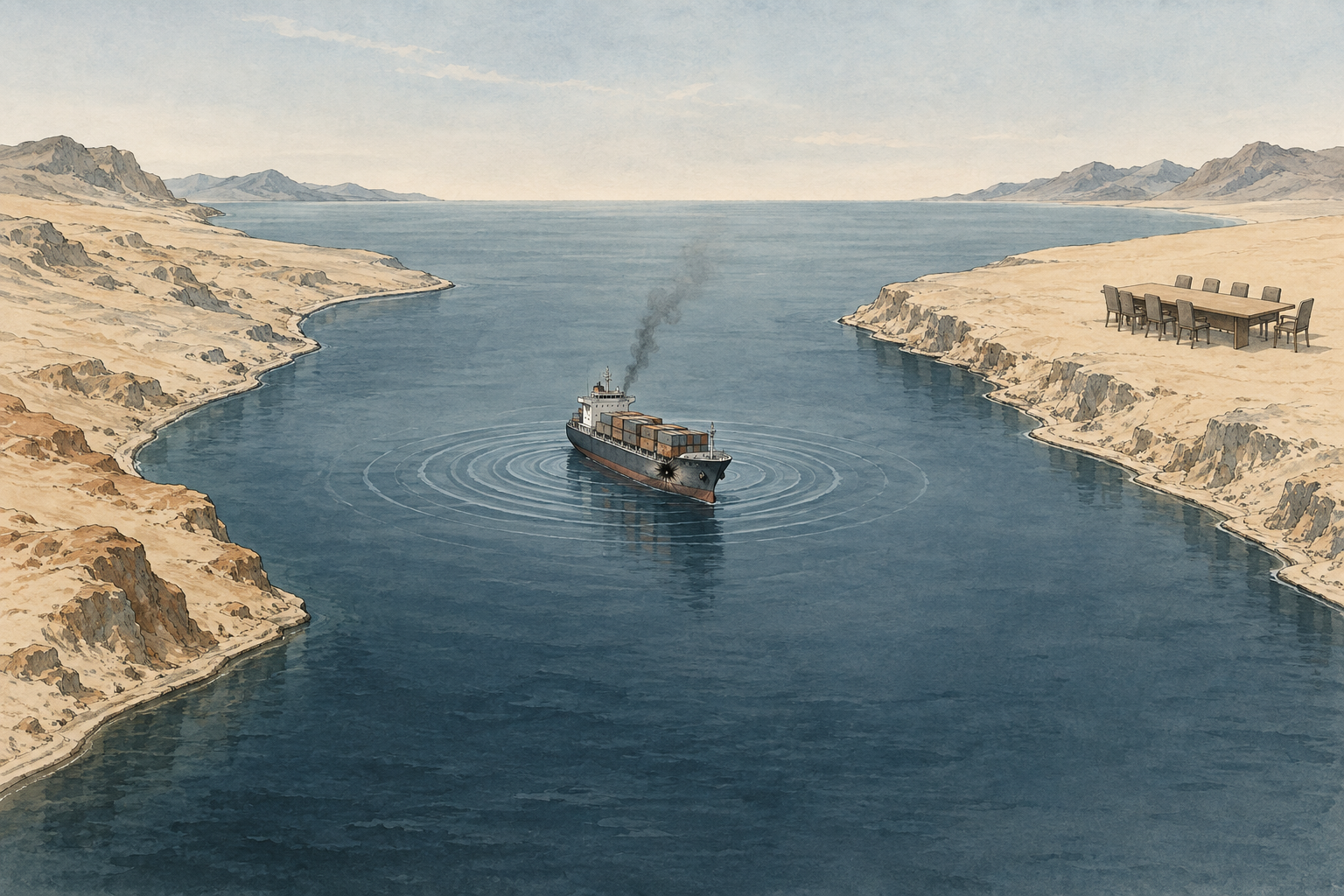
CAIRO — A fatal strike on an Iranian commercial vessel near Qeshm Island in the Strait of Hormuz has raised the stakes for regional talks set for Monday in Oman, where Iraq says it will join discussions on managing shipping through one of the world’s most sensitive maritime chokepoints.
Iranian state media said the vessel was struck early Sunday off Qeshm Island, killing one person and wounding four, according to the Associated Press. Other Iranian-linked accounts initially cited three wounded before later reports put the toll at four injured.14 The Qeshm governor, quoted by Iran’s state-run IRNA news agency, blamed a “terrorist enemy,” but no independent attribution was immediately established.1
Separately, the United Kingdom Maritime Trade Operations monitor said a vessel transiting the Strait of Hormuz had been hit by a projectile and that a fire later broke out on board, prompting local authorities to evacuate crew members.15 UKMTO did not identify the vessel, its flag, the weapon used or the party responsible, underscoring the uncertainty around the incident.4
The strike is an immediate test of whether regional diplomacy can reduce escalation risks around Hormuz, where Iran and Oman have been discussing shipping traffic, routes and potential fees. Iraqi Foreign Minister Fuad Hussein told Iran’s top diplomat that an Iraqi delegation would attend Monday’s regional meeting, the Iraqi News Agency reported, giving the Oman-hosted talks a rare public commitment from a neighboring state.2
For Middle East security watchers, the most consequential unknown is who fired the projectile. Iranian state media later attributed the strike to the United States, according to Business Upturn’s summary of Mehr News Agency reporting, but UKMTO described the munition as unidentified and U.S. Central Command had not confirmed responsibility.4 AP also reported no immediate comment from the U.S. military.1
That ambiguity matters because Hormuz is already operating in a conflict environment. AP reported that the United States has struck Iranian-flagged vessels during its blockade of Iranian ports, while U.S. forces have faced Iranian ballistic missile threats against warships.1 Business Upturn, citing U.S. Central Command, reported that U.S. forces had redirected 100 commercial vessels over 60 days since the blockade resumed on July 14, and said no ship had passed the blockade zone without American permission.4
A confirmed U.S. role in the latest strike would likely harden Tehran’s negotiating position before the Oman meeting. An unconfirmed or disputed attribution may be just as destabilizing if regional governments arrive under pressure to respond to Iranian claims, protect shipping interests and avoid being drawn further into the conflict.
Iran has framed Monday’s meeting as a regional consultation on the future of the strait. Its foreign ministry said Gulf states would meet in Oman to discuss the strategic waterway and that Iraq and other littoral Persian Gulf states would participate.8 But Bahrain has said it will not attend, citing the absence of diplomatic relations with Tehran, AP reported.2
Expectations for a breakthrough are limited. A Reuters-sourced Gulf Times report said an Iranian source described the Iran-Oman understanding as a basis for reopening the strait, but not an agreement for its immediate reopening.7 The same report said a senior Iranian official did not expect Monday’s meeting to produce a signed Hormuz agreement. It also said Iran still sought a system allowing it to collect fees from ships using the waterway, a proposal Oman rejects.7
Iranian officials have also linked reopening Hormuz to U.S. concessions. Iran International reported that Foreign Minister Abbas Araghchi said the Oman maritime route agreement “does not in any way mean reopening” the strait and that Tehran would reopen it only if the United States returned to commitments under the Islamabad memorandum.3
The Hormuz talks come as regional shipping routes are under pressure on multiple fronts. AP said commercial traffic remains low in the strait and that Washington has asserted oil is still moving as U.S. forces help guide ships along Oman’s coast.1 Before the war, about a fifth of global oil supplies passed through Hormuz, according to the Reuters-sourced Gulf Times report.7
At the same time, the Red Sea route has grown riskier as Iran-backed Houthis in Yemen apply pressure near the Bab el-Mandeb Strait, another crucial maritime passage. AP said the Qeshm incident was a reminder of the challenge to global shipping even as attention shifts to the Houthi advance along Yemen’s Red Sea coast.1
The immediate question for Monday is whether Iraq and other participants can use the Oman forum to establish practical maritime deconfliction measures despite the fatal strike. The larger question is whether any regional arrangement can gain credibility while the U.S. blockade, Iranian conditions for reopening Hormuz and disputed attribution for new attacks remain unresolved.

An Israeli strike in Gaza City killed two people, according to AP, as Israel said it targeted Hamas operatives. The latest UN reporting points to a parallel civilian crisis, with severe water insecurity and stalled approvals for parts and fuel inputs threatening essential services.

Kyiv says a new Ukraine-U.S.-Russia negotiating round could come in October, but Moscow is already narrowing the space for diplomacy by ruling out a pause in attacks during talks. The central question is whether Washington can bridge Kyiv’s demand for an unconditional ceasefire with Russia’s insistence on negotiating while maintaining battlefield pressure.

The European Parliament is due to vote on 15 September on recommendations for the European Democracy Shield, including support for an EU centre for democratic resilience with its own legal act and budget. The debate has exposed a fault line between groups seeking stronger EU-level monitoring and crisis response and conservatives warning against Brussels involvement in national electoral processes.

Ursula von der Leyen’s 16 September State of the Union address is set to function less as a ceremonial stocktake than as the first move in a crowded autumn negotiation with the European Parliament. MEPs are expected to test the Commission’s priorities on the 2028-2034 budget, defence readiness, enlargement, democracy protections and climate files.
Strait of Hormuz
A narrow waterway between Iran and Oman that links the Persian Gulf to the Gulf of Oman and global energy markets.
UKMTO
The United Kingdom Maritime Trade Operations office issues security advisories and incident reports for commercial shipping.
Maritime deconfliction
Practical coordination intended to reduce the risk of miscalculation, accidental clashes or attacks on ships in contested waters.
Qeshm Island
A strategically located Iranian island near Bandar Abbas and the Strait of Hormuz, close to key shipping lanes.




Comments