Georgia ballot-secrecy fight pushes election-integrity debate beyond vote counts
Associated Press
news
The secret ballot has been an article of faith in US elections. That’s being tested in Georgia
Our Midland / Associated Press
news
The secret ballot has been an article of faith in US elections. That's being tested in Georgia
Georgia State Election Board
government
Rules & Laws
Untracked bias
100% of tracked sources are High factuality
Bias and factuality ratings from Media Bias Fact Check. Outlets without a rating are marked “Untracked.”
Core concern
Researchers say Georgia election records can be recombined to connect some voters with their ballots.
System flaw
The reported vulnerability involves reversing the order of randomized ballot images and cast-vote records.
Election timing
The dispute is unfolding before Georgia’s November 3, 2026, general election.
Georgia’s latest election-integrity dispute is not about whether votes are counted correctly. It is about whether the state’s voting system adequately protects the secret ballot.
Election-security researchers say a flaw in Georgia’s voting system can allow electronic ballot records to be restored to the order in which ballots were cast and, when combined with other public records, potentially match voters to their ballots, the Associated Press reported September 13.1 The concern comes less than two months before Georgia’s November 3, 2026, general election, a midterm contest in a battleground state where confidence in election administration has been politically charged since 2020.8
State officials do not dispute that ballot secrecy is legally required. Georgia’s Constitution says elections are to be conducted by secret ballot, and state law requires electronic ballot-marking systems to permit voting in “absolute secrecy.”7 But officials in the secretary of state’s office have pushed back on the practical risk described by advocates. They say coercion or vote-buying would be easier through other methods and that the office is taking steps to keep sensitive information from being released in a form that could be exploited.1
Georgia voters use touchscreen ballot-marking devices that print paper ballots. Voters then insert those ballots into scanners that tally the votes. The scanners create electronic ballot images and cast-vote records showing how each ballot was recorded.1
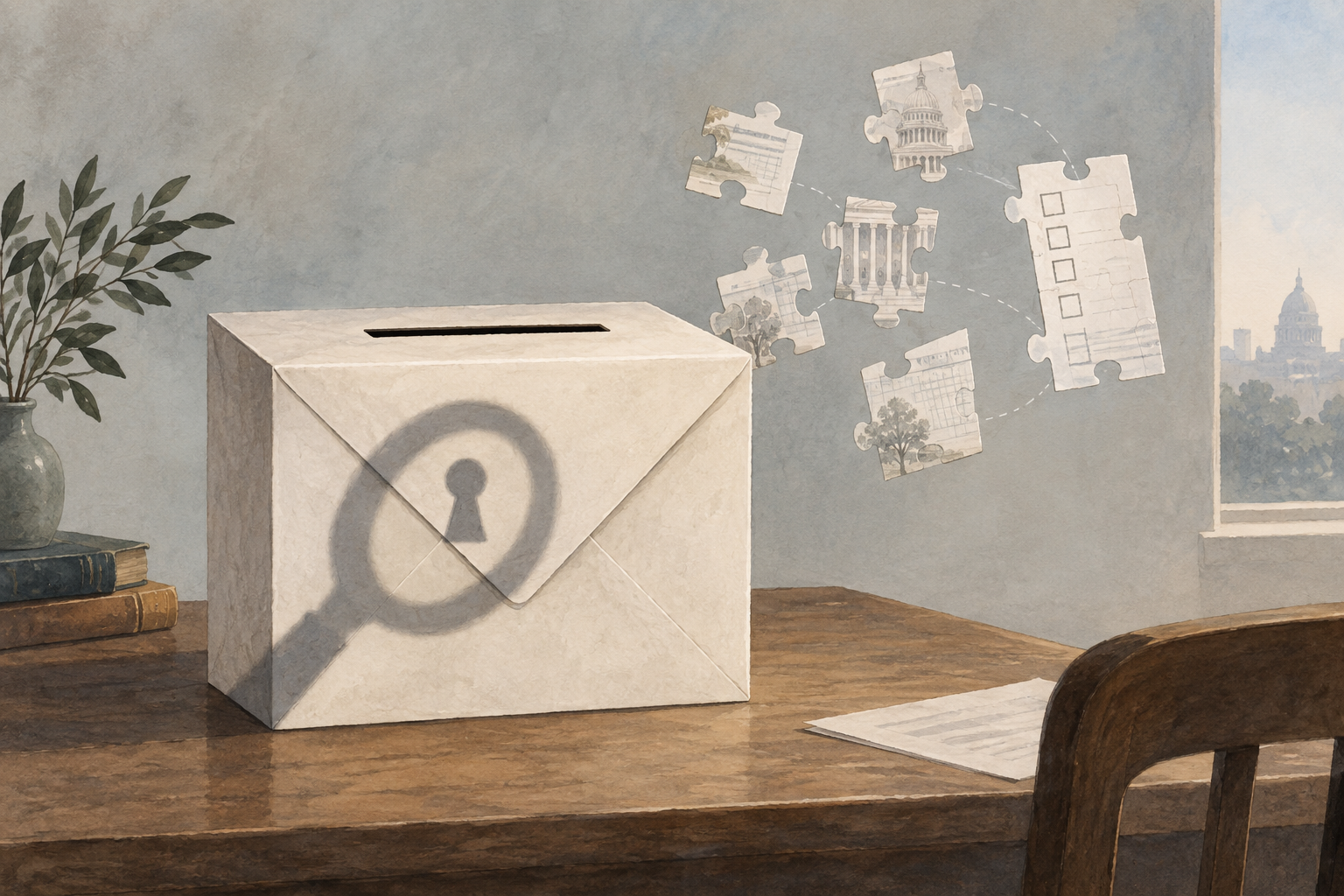
Those records are supposed to be randomized before public release. According to researchers cited by AP, a software flaw can allow that shuffling to be reversed, restoring the order in which ballots were cast. Once that order is reconstructed, other records — including check-in records, early-voting lists and scanner audit logs — can narrow or identify which voter cast which ballot.1
Max Springer, a Princeton University researcher who studies artificial intelligence and was not part of the original 2022 discovery, told AP he tested the issue by giving a publicly available AI assistant the earlier research and public election records from Georgia’s May 2026 primary. He said the tool was able to reverse the electronic ballot-order shuffling and help identify what additional records would be needed to link voters with ballots.1
The allegation is politically sensitive because the records at issue are not vote totals. A ballot-secrecy breach could leave the count accurate while still exposing how individual people voted.
The secretary of state’s office has told county election officials to refer open-records requests for certain election materials to the state office. According to AP, officials said they plan to redact problematic information from some records and withhold other documents. They also said they are working with a vendor to scramble the original order of ballot images and cast-vote records before release.1
That approach addresses access to records that could be used to exploit the flaw. But it does not satisfy advocates who say the state should prevent ballots from being linkable in the first place. Marilyn Marks, executive director of the Coalition for Good Governance, told AP that limiting public access is not the proper solution if election records contain identifiers that can trace ballots to voters.1
The State Election Board has already treated ballot secrecy as a rulemaking issue. Its public rules page lists a proposed amendment to Rule 183-1-11-.01, Ballot Secrecy, with written comments due August 18, 2026, and a public hearing scheduled for August 19.3 The proposed rule said its purpose was to set uniform requirements for voting equipment to protect ballot secrecy and specifically called for software updates to randomize electronic ballot-image identifiers.4
AP reported that board member Salleigh Grubbs proposed requiring the secretary of state’s office to apply the manufacturer-recommended update by September 15, but the board rejected the proposal. Some members questioned whether the board had authority to order the secretary of state to act and cited the short timeline before the midterms.1
Georgia election politics after 2020 centered heavily on claims about vote-count accuracy, voting machines and ballot tabulation. Courts, audits and state officials repeatedly addressed those disputes. The secretary of state’s office has continued to defend Georgia’s voting system as secure and auditable, and in April 2025 celebrated the dismissal of Curling v. Raffensperger, a long-running federal challenge to Georgia’s electronic voting system.5
Ballot secrecy raises a different question. A system can, in theory, count votes accurately while creating records that expose how a person voted. That makes the Georgia issue harder to fit into the familiar partisan frame of “fraud” versus “no fraud.”
Court records in Curling show that Georgia’s voting system has long been the subject of litigation over cybersecurity and election administration. In a 2023 order, U.S. District Judge Amy Totenberg described the case as focused not on fraud or partisan advantage, but on whether the state’s electronic voting system had cybersecurity deficiencies affecting voters’ rights.6 The court record also noted the 2021 Coffee County breach and the broader concern that copied voting-system software could have “serious ramifications” for future system vulnerability.6
The ballot-secrecy issue shifts the public debate from whether machines accurately add up votes to whether election records and software architecture protect voters from being identified.
Secret ballots are meant to protect voters from coercion, retaliation and vote-buying. If someone can prove how a person voted, pressure from an employer, family member, political organization or government actor becomes more plausible. AP also noted that ballot-level voter information could be valuable to campaigns.1
That is why the issue has resonance in Georgia. The state remains closely watched nationally, and voters there have lived through years of litigation, audits, machine-security debates and partisan conflict over election rules. A ballot-secrecy dispute gives election-security advocates and political actors a new way to argue about trust in the system.
For advocates, the flaw is evidence that Georgia has moved too slowly to install known software fixes. For state officials, the immediate question is how to reduce risk without disrupting voting administration shortly before a statewide election.
The general election is scheduled for November 3, 2026, with early voting beginning in October.8 That leaves little time for a statewide software change if officials maintain that certification, funding and implementation logistics would take months.
Short-term options include redacting or withholding records that could be used to reconstruct ballot order, scrambling ballot-image and cast-vote-record order before release, or changing ballot-handling procedures so ballots are physically shuffled before scanning. Marks told AP that one interim approach would be to collect ballots in locked boxes at precincts, then shuffle and scan them at a central tabulation center.1
Longer term, the dispute is likely to feed Georgia’s continuing debate over ballot-marking devices, QR-code tabulation, hand-marked paper ballots and the balance between public transparency and voter privacy. The State Election Board’s own records show it has considered both ballot-secrecy rules and contingency planning for hand-marked paper ballots in 2026.3
The central question for November is narrower: whether Georgia can reassure voters that public election records will not let outsiders discover how they voted. In a state where election integrity has often meant proving the count was right, the new fight asks whether the system also protects the voter behind the ballot.

MPs are due to take the Sovereign Grant Bill through second reading and all remaining Commons stages on 14 September 2026, using primary legislation to set royal funding at £99.9 million for 2027-28 and lower the future Crown Estate surplus share to 20.5%. A Liberal Democrat amendment seeks National Audit Office scrutiny and a Commons vote before any future increase in the percentage used to calculate the grant.

North Korea fired multiple short-range ballistic missiles from the Wonsan area on September 12, a day after the United States, South Korea and Japan ended the Freedom Edge exercise. The launch put renewed focus on whether the three governments can sustain real-time information-sharing and deterrence coordination while leaving room for diplomacy on the peninsula.

India secured unanimous adoption of the New Delhi Declaration, but the text’s careful wording on West Asia, sanctions and global governance shows how BRICS influence still depends on keeping rivals inside a lowest-common-denominator consensus. China’s 2027 chairmanship now becomes the next test of whether that consensus can translate into coordinated action.

Narendra Modi and Xi Jinping used their BRICS sideline meeting in New Delhi to signal a reset in India-China ties, but the practical test remains whether border calm can support expanded travel, trade and business access. The meeting suggested a controlled effort to stabilize relations rather than a settlement of the disputes that have constrained them since the 2020 Ladakh clash.
Cast-vote record
A digital record showing how a scanned ballot was interpreted by the voting system.
Ballot image
An electronic image of a paper ballot created by a scanner during tabulation.
Ballot-marking device
A touchscreen voting machine that lets voters make selections and prints a paper ballot for scanning.
Secret ballot
The legal principle that no one should be able to determine how an individual voter cast a ballot.
Comments