Hormuz drone clash highlights persistent U.S.-Iran maritime contest
Associated Press
news
House votes for a third time to end the Iran war as conflict drags on
Associated Press
news
Saudi crown prince seeks Egypt’s backing as Houthis step up attacks
Associated Press
news
US military says it destroyed 2 small Iranian boats trying to steal a sea drone
Untracked bias
100% of tracked sources are High factuality
Bias and factuality ratings from Media Bias Fact Check. Outlets without a rating are marked “Untracked.”
Drone clash
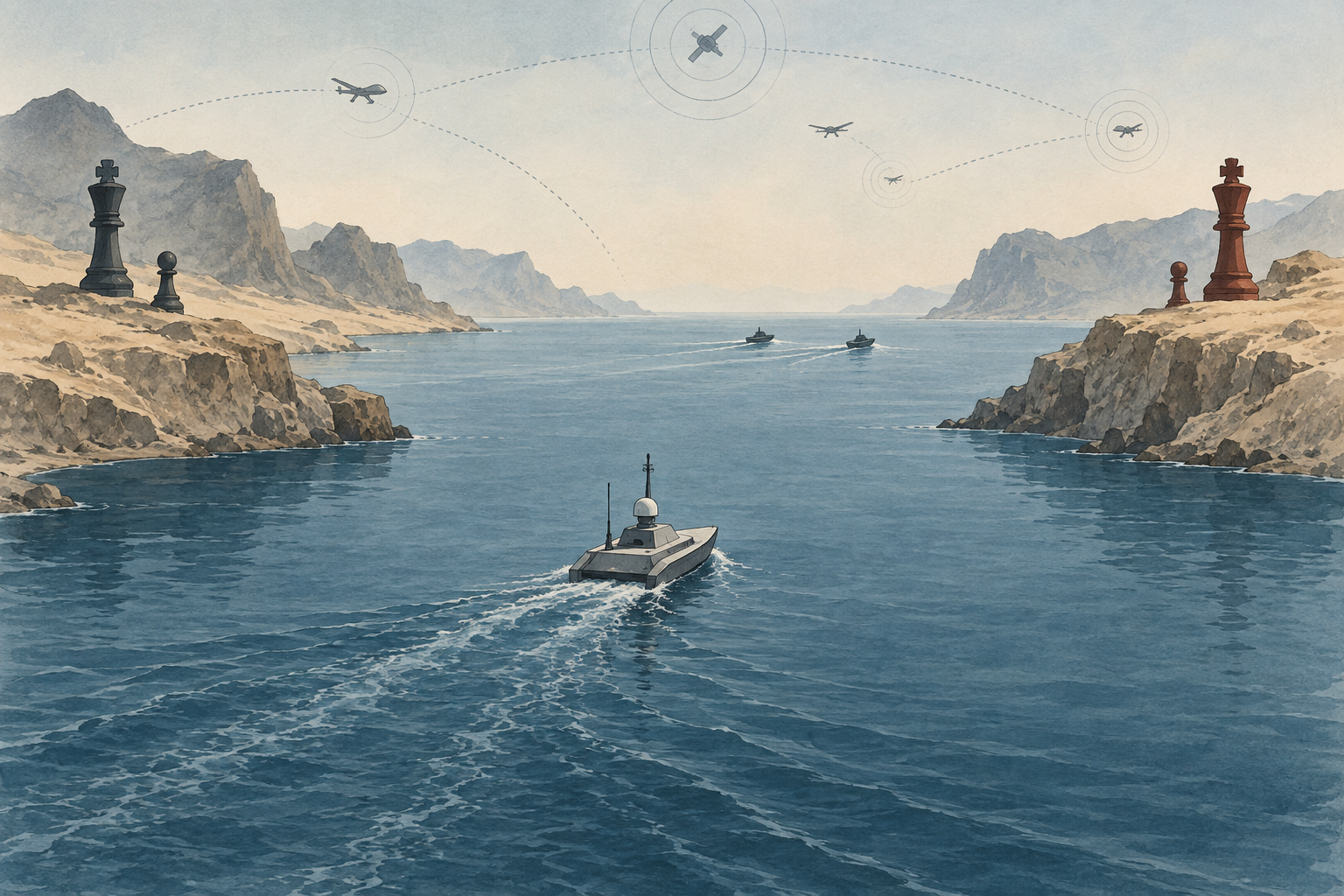
U.S. forces destroyed two small Iranian boats that officials said were trying to seize a Navy unmanned surface vessel near the Strait of Hormuz.
Quiet coordination
Axios reported that U.S., Israeli and Arab military chiefs held a secret Germany meeting focused on Iran and Hormuz security.
Chokepoint risk
The incident adds pressure around Hormuz as regional states also contend with maritime threats linked to the Red Sea and Bab el-Mandeb.
U.S. forces destroyed two small Iranian boats near the Strait of Hormuz after the vessels allegedly tried to seize a U.S. Navy sea drone, according to reports from The Associated Press and Axios citing U.S. military accounts.34
The episode is significant less for its scale than for what it signals: The U.S.-Iran confrontation is increasingly playing out through persistent, low-level engagements involving unmanned systems, small boats and contested maritime access, rather than only through large, episodic strikes.
The clash occurred in one of the world’s most sensitive maritime corridors, where U.S. officials have framed expanded naval activity as part of an effort to protect freedom of navigation and restore commercial confidence in Hormuz traffic.4 Iran and its aligned media presented a different version, with Tasnim describing the vessels as fishing boats attacked south of Iran by a U.S. drone.6
The dueling accounts fit a familiar Gulf pattern: Each side casts its actions as defensive while the operating environment becomes more crowded, automated and prone to escalation.
At the same time, Axios reported that senior U.S., Israeli and Arab military commanders recently held a secret meeting in Germany focused on Iran. CENTCOM acknowledged regional military coordination and discussion of expanding ship traffic through the Strait of Hormuz.5
Together, the sea-drone incident and the reported Germany meeting point to a broader shift. Washington and its partners are trying to manage an active maritime security campaign while quietly building a regional framework to contain Iran, keep shipping moving and avoid an uncontrolled wider war.
The reported incident centers on an unmanned surface vessel, or USV, a class of naval system increasingly used for surveillance, patrol and distributed maritime operations.
According to AP, U.S. Central Command said Iranian small boats attempted to take the American sea drone and were destroyed by U.S. forces.3 Axios similarly reported that U.S. forces struck Iranian boats that were trying to seize a Navy drone in or near the Strait of Hormuz, citing U.S. officials and noting that the confrontation came as Washington pushes to restore vessel traffic through the waterway.4
For defense planners, the operational lesson is direct: Unmanned systems are not just background sensors in the Gulf. They are becoming objects of confrontation themselves.
A relatively inexpensive unmanned vessel can extend surveillance and complicate an adversary’s freedom of movement, but it can also become a target for capture, interference or propaganda. If a small-boat force can seize or disable a drone without triggering a major response, it may gain intelligence value and political leverage. If the United States responds with lethal force, the incident can escalate quickly even when no U.S. personnel are aboard the platform.
That dynamic lowers some risks while raising others. Unmanned systems can reduce the immediate danger to sailors and aircrews. But their forward deployment creates more frequent contact points with Iranian forces, especially in narrow or heavily trafficked waters.
The result is a contest that may be less visible than a major missile exchange but more constant: shadowing, jamming, attempted seizures, warning shots, drone interceptions and selective strikes.
The U.S. and Iranian descriptions of the episode diverged sharply.
CENTCOM’s account, as reported by AP, cast the Iranian boats as attempting to steal a U.S. unmanned vessel and described the U.S. action as a response to that threat.3 Axios reported the same basic U.S. claim and placed it in the context of heightened American efforts to secure Hormuz transit.4
Tasnim, by contrast, reported that fishing boats had been attacked south of Iran, portraying the event as U.S. aggression rather than an Iranian attempt to seize military equipment.6
That information split matters. In maritime gray-zone encounters, facts are often contested before independent verification is possible. Small boats, drones and patrol craft can operate close together. Civilian and military vessels may share the same waters. Governments can release selective imagery or statements to support their interpretation.
For outside observers, the central analytical point is not only which version is accurate, but how quickly such incidents become instruments of signaling.
Iran’s reported claim that two U.S.-made MQ-1 drones were intercepted near the Strait of Hormuz further illustrates the unmanned dimension of the confrontation.7 Even if individual claims remain disputed, the trend is clear: Aerial and maritime drones are now central to the tactical competition around Iran’s southern approaches.
Washington’s public framing remains anchored in freedom of navigation through the Strait of Hormuz, a route whose disruption would carry global energy and security consequences.
A State Department readout said Secretary of State Marco Rubio discussed de-escalation with Oman’s foreign minister while reiterating the U.S. commitment to freedom of navigation through the strait.9 That combination — de-escalation language paired with navigational enforcement — captures the current U.S. posture.
The policy challenge is that keeping the waterway open may require more patrols, escorts and unmanned surveillance, all of which increase contact with Iranian forces. Axios reported that U.S. officials see restoring traffic through Hormuz as producing more direct confrontation with Iran.4
In practice, a freedom-of-navigation campaign can become a rolling series of operational tests: whether U.S. drones can patrol unmolested, whether commercial ships can transit without harassment, whether Iran will challenge naval escorts, and whether regional partners will contribute openly or quietly.
The Red Sea and Bab el-Mandeb are part of the same strategic picture. AP reported that Saudi Arabia’s crown prince sought Egypt’s backing as Houthi attacks intensified, with Saudi-Egyptian statements linking maritime navigation security to broader regional instability.2
For Gulf states, the concern is not confined to one chokepoint. Pressure near Hormuz, in the Red Sea and around Bab el-Mandeb can compound into a regional maritime security crisis, especially if Iran or allied groups can threaten shipping in multiple corridors at once.
The reported Germany meeting among U.S., Israeli and Arab military chiefs suggests that regional militaries are preparing for a longer contest even as governments avoid advertising every step of cooperation.5
Such coordination is politically sensitive. Some Arab governments share concerns about Iranian military activity and proxy networks, but open military alignment with Israel can carry domestic and regional costs, especially during periods of active conflict.
That makes quiet operational planning more attractive than public coalition-building. The likely focus is practical: deconfliction, air and missile defense, maritime surveillance, intelligence-sharing and procedures for keeping shipping lanes open.
CENTCOM’s acknowledged role, as reported by Axios, indicates that the United States remains the central organizer of this security architecture.5
The sea-drone clash gives that coordination immediate relevance. If unmanned U.S. systems are operating near Hormuz, partner militaries may need shared awareness of their locations, missions and rules of engagement. If Iranian forces or allied groups attempt seizures or attacks, commanders will need rapid channels to decide whether to warn, intercept, escort or strike.
The more persistent the maritime campaign becomes, the more valuable those quiet links become.
Despite the military tempo, diplomatic channels remain active, if limited.
The National reported that Iran dismissed U.S. talks absent conditions that include sanctions relief and an end to military operations, linking Tehran’s negotiating posture directly to the deepening Hormuz crisis.8 The State Department’s Oman readout points to Muscat’s continuing role as a de-escalation interlocutor.9 China’s Foreign Ministry, after talks with Iran’s foreign minister, urged restraint, a return to negotiations, dialogue between Iran and Gulf states and reopening the Strait of Hormuz.10
Those signals do not amount to a diplomatic breakthrough. They do show that the military contest is unfolding alongside efforts to preserve off-ramps.
For Iran, sanctions relief remains a central demand. For the United States and its partners, the immediate priority is keeping maritime routes open while limiting Iranian coercive options. The space between those positions is narrow, but neither side appears to have fully abandoned the language of talks.
The confrontation is also producing pressure inside the United States.
AP reported that the House voted for a third time to end the Iran war as the conflict dragged on, reflecting congressional efforts to limit continued military action.1 That domestic context matters for U.S. commanders and diplomats alike.
Persistent maritime engagements may avoid the visibility of a major ground campaign, but they can still raise war-powers questions if they become routine, lethal and open-ended.
For the administration, the operational argument is that U.S. forces are defending navigation, deterring seizures and protecting international commerce. Critics in Congress are likely to focus on duration, authorization and escalation risk. The more frequent the clashes become, the harder it will be to treat them as isolated incidents.
The reported destruction of two Iranian boats near a U.S. Navy sea drone is best understood as part of a widening maritime contest, not a standalone episode.
The Strait of Hormuz is becoming a proving ground for unmanned systems, small-boat tactics, regional coordination and crisis messaging. The United States is trying to keep ships moving and drones operating. Iran is trying to impose costs, contest surveillance and shape the political narrative. Regional militaries are quietly coordinating, and diplomats are keeping channels open without resolving the underlying dispute.
That mix points to a conflict pattern likely to persist: lower-level than full-scale war, more dangerous than routine patrols, and increasingly defined by machines operating near forces that may have only minutes to decide whether to interfere, withdraw or fire.

India summoned Pakistan’s top diplomat in New Delhi on September 16 after alleging Pakistani naval units acted unsafely and caused a collision with an Indian Navy vessel in international waters. The dispute has put renewed scrutiny on a 1991 bilateral military-notification agreement designed to prevent exactly the kind of close naval encounter both sides now accuse the other of mishandling.

Taiwan’s plan to open a second representative office in the Philippines has drawn a warning from Beijing, turning a consular and economic proposal into a fresh measure of Manila’s balancing act under its one-China policy. The Cebu plan comes as the Philippines deepens security and economic coordination with the United States and Japan while disputes with China worsen.

Chinese Defence Minister Dong Jun opened the Beijing Xiangshan Forum with warnings against “provocative acts,” militarism and historical revisionism, language widely read as aimed at Japan and U.S.-aligned partners. The message underscored Beijing’s effort to turn the forum into a platform for an alternative regional security order built around Chinese concepts of dialogue, sovereignty and “common security.”

A war-damaged building in Gaza City collapsed on September 16, killing 19 people and underscoring how Gaza’s post-ceasefire emergency is shifting from battlefield deaths to hazards from unstable infrastructure, limited rescue capacity and intermittent Israeli attacks. The collapse followed September 15 strikes that medics said killed at least five Palestinians, including children and a Hamas commander.
Unmanned surface vessel
A crewless naval craft used for missions such as surveillance, patrol, sensing and distributed maritime operations.
Strait of Hormuz
A narrow waterway between Iran and Oman that connects the Persian Gulf with the Gulf of Oman and is critical to global energy shipping.
Freedom of navigation
The principle that ships and aircraft should be able to transit international waters and airspace without unlawful interference.
Gray-zone conflict
Coercive activity below the threshold of declared war, often involving deniable actions, maritime harassment, cyber operations or proxy forces.
Comments