India rejects Pakistan-China boundary panel, exposing limits of Modi-Xi thaw
Ministry of Foreign Affairs, Government of Pakistan
government
Transcript of the Press Briefing by the Spokesperson on Wednesday 17th September 2026
The Indian Express
news
‘Has no legal basis’: India rejects Pakistan-China ‘boundary commission’
The Indian Express
news
New China-Pakistan boundary joint commission: What it is, why India has objected
Untracked bias
India Today
India rejects Pakistan-China Boundary Joint Commission, calls it legally baseless
The Indian Express
‘Has no legal basis’: India rejects Pakistan-China ‘boundary commission’
Bias and factuality ratings from Media Bias Fact Check. Outlets without a rating are marked “Untracked.”
India rejects
India said the Pakistan-China Boundary Joint Commission has no legal basis because it concerns territory New Delhi claims in Jammu and Kashmir and Ladakh.
1963 dispute
New Delhi reiterated that it has never recognized the 1963 China-Pakistan Boundary Agreement, which involved the Shaksgam Valley area claimed by India.
CPEC link
The commission is tied to border management, trade flows and connectivity, including routes linked to the China-Pakistan Economic Corridor and the Khunjerab crossing.
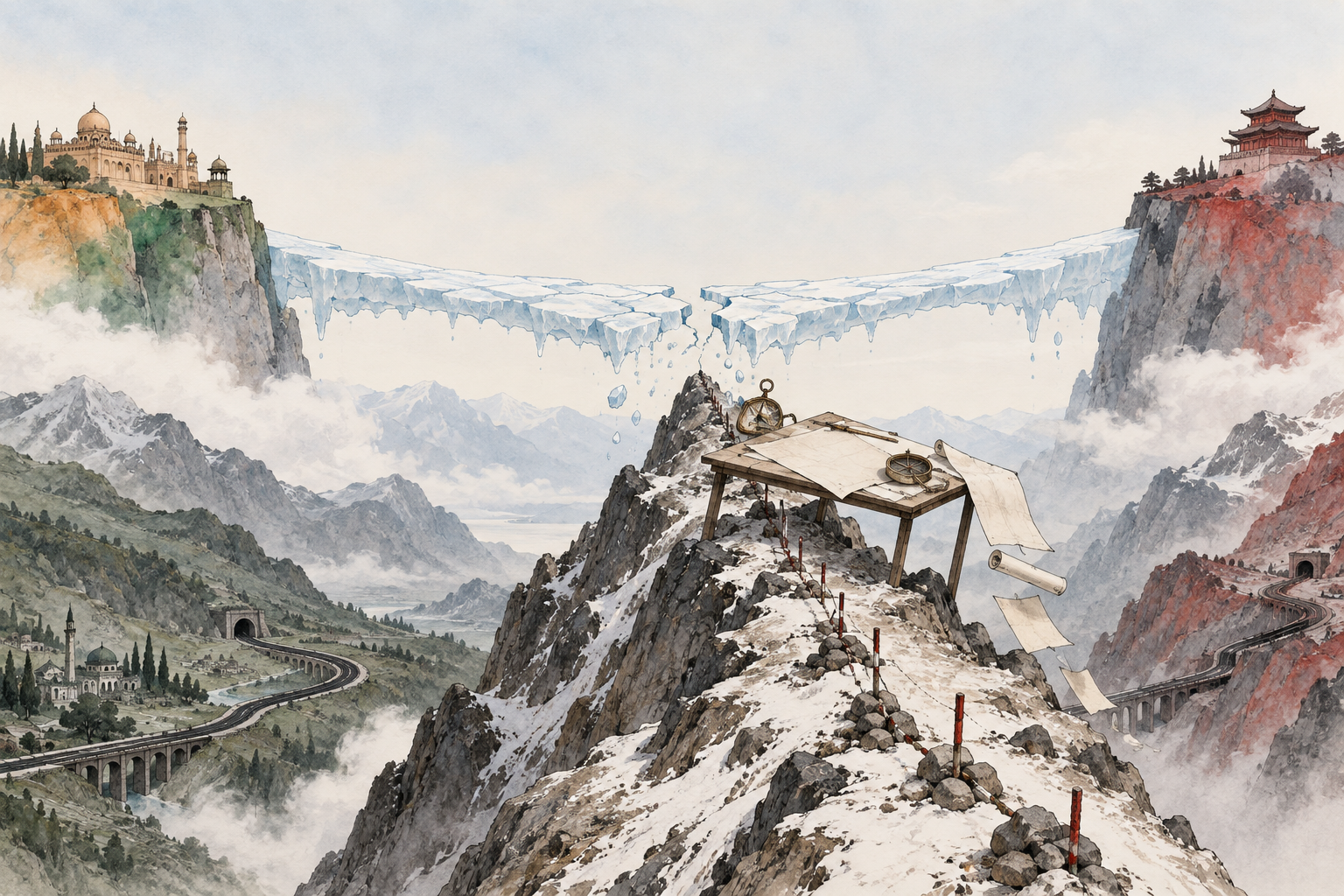
India has rejected the newly operationalized Pakistan-China Boundary Joint Commission, saying there is no legally valid Pakistan-China boundary involving territory New Delhi claims in Jammu and Kashmir and Ladakh. The objection is a sharp reminder that India’s tentative diplomatic reset with Beijing remains constrained by unresolved sovereignty disputes.2
Ministry of External Affairs spokesperson Randhir Jaiswal said India’s position was “clear and consistent.” He rejected the “so-called” commission as having no legal basis and reiterated that Jammu and Kashmir and Ladakh are integral and inalienable parts of India.2 New Delhi also said it has never recognized the 1963 China-Pakistan Boundary Agreement, which India considers illegal and invalid. It objected to any China-Pakistan cooperation concerning territory it says is under Pakistan’s illegal occupation.28
Pakistan rejected India’s objections on September 17, saying the 1963 agreement is valid and describing Jammu and Kashmir as an internationally recognized disputed territory whose final status should be decided under UN Security Council resolutions.1 Pakistan’s Foreign Office said the Boundary Joint Commission was operationalized on September 16 at the Ministry of Foreign Affairs in Islamabad. Its mandate covers border management, joint surveys, trade facilitation and people-to-people connectivity.1
The exchange came days after Prime Minister Narendra Modi and Chinese President Xi Jinping held bilateral talks on the sidelines of the 18th BRICS Summit in New Delhi. Both sides signaled support for a fair, reasonable and mutually acceptable settlement of the India-China boundary question.9 Modi also said differences should not become disputes and stressed that peace and tranquillity along the border are essential to the broader relationship.910
For India-China policy watchers, the dispute highlights a central tension in the current thaw. New Delhi may be willing to stabilize ties with Beijing after years of border friction, but it is not softening its objections to Chinese activity tied to Pakistan-administered Kashmir.
Pakistan and China described the commission as a practical mechanism. Pakistan’s state news agency said the inaugural meeting formally launched a body envisaged under the 2013 China-Pakistan Agreement on Boundary Management System.4 Pakistan’s delegation was led by Bilal Mahmood Chaudhary, Director General for China at Pakistan’s Foreign Ministry. The Chinese side was led by Li Ya, Deputy Director General of the Department of Boundary and Ocean Affairs at China’s Foreign Ministry.4
The meeting included officials from foreign affairs, defence, interior, commerce, communications, customs, survey and other boundary-management authorities. It covered cross-border coordination, movement of goods and people, joint border surveys and people-to-people links.4 Pakistan and China signed minutes at the end of the meeting and agreed to hold the next session in China on mutually convenient dates.7
Dawn reported that the commission stems from Article 45 of the 2013 boundary-management agreement. It is designed to oversee border-management arrangements, including boundary maintenance, inspections, marker issues, cross-border facilities and incident handling.6 The mechanism is separate from the demarcation commission created under the 1963 boundary agreement, whose work concluded after surveys, maps and boundary markers were completed.6
India’s objection is rooted in its position that Pakistan cannot enter into arrangements involving territory New Delhi claims as part of the Union Territories of Jammu and Kashmir and Ladakh. The 1963 China-Pakistan Boundary Agreement, signed after the 1962 India-China war, involved the Trans-Karakoram Tract, including Shaksgam Valley. India claims the area, but Pakistan had controlled it before ceding it to China.3
The Indian Express reported that India has consistently held that Pakistan’s transfer of Shaksgam Valley to China was illegal and unacceptable.2 The outlet’s backgrounder said the area spans more than 5,000 square kilometers and lies north of the Siachen glacier in the Hunza-Gilgit region.3
India’s criticism has also been tied to the China-Pakistan Economic Corridor, the Belt and Road-linked route connecting Kashgar in China with Gwadar port on the Arabian Sea. New Delhi has long objected to CPEC because it passes through Pakistan-occupied Kashmir.3 Dawn reported that the new commission gives Islamabad and Beijing a regular coordination mechanism for a border central to movement through the Khunjerab crossing and to trade and connectivity linked to CPEC.67
The timing gives the commission broader diplomatic significance. The Modi-Xi meeting at BRICS focused on stabilizing India-China ties, managing differences and preventing the boundary dispute from dominating the relationship.9 But the Pakistan-China move shows that New Delhi’s sovereignty concerns are not limited to the Line of Actual Control with China. They also extend to Beijing’s institutional cooperation with Islamabad in areas India claims.
Pakistan has cast the commission as an administrative and connectivity mechanism, not a reopening of the 1963 boundary settlement. Its Foreign Office said the body would support cooperation in border management, joint surveys, trade facilitation and people-to-people connectivity.1 Pakistani state and media reports similarly emphasized practical coordination, future meetings and the commission’s link to the 2013 boundary-management framework.47
That framing has not eased Indian opposition. New Delhi’s response indicates that any attempt by China and Pakistan to institutionalize border governance in contested areas will be treated as a challenge to India’s sovereignty claims, whether the mechanism is presented as technical, commercial or administrative.28
The result is a narrow but important test for India-China normalization. Bilateral diplomacy may resume and summit language may improve, but third-country arrangements involving Pakistan-administered Kashmir remain a hard boundary for New Delhi.

Prime Minister Sanae Takaichi retained Foreign Minister Toshimitsu Motegi and Defense Minister Shinjiro Koizumi in a Sept. 17 Cabinet reshuffle, underscoring continuity in alliance management and regional deterrence. The lineup comes ahead of a planned year-end review of Japan’s core security and defense strategy documents.

China is using pre-summit diplomacy to press for a U.S.-China reset built on equality, respect and recognition of Beijing’s core interests. For Japan and Taiwan, the risk is that Washington’s search for stability with Beijing could soften U.S. language on Taiwan.

Washington’s renewed denial of visas to Mahmoud Abbas and senior PA and PLO officials turns a procedural dispute over access to the U.N. General Assembly into a test of who can shape Gaza’s post-ceasefire political order. The move weakens the Palestinian Authority’s ability to press its case in New York just as reconstruction, ceasefire implementation and statehood recognition are all being contested.

UN-backed human rights experts said there are reasonable grounds to believe U.S. strikes in Iran on February 28 may have constituted war crimes, citing civilian deaths at a school in Minab and a sports complex area in Lamerd. The findings intensify pressure on Washington to disclose its Pentagon review as the Trump administration says Iran wants a deal and regional diplomacy remains stalled.
Pakistan-China Boundary Joint Commission
A newly operationalized mechanism between Pakistan and China for border management, joint surveys, trade facilitation and people-to-people connectivity.
1963 China-Pakistan Boundary Agreement
An agreement between Pakistan and China that demarcated their boundary in areas India claims as part of Jammu and Kashmir and Ladakh; India says it is illegal and invalid.
Shaksgam Valley
Also known as part of the Trans-Karakoram Tract, it is territory claimed by India that Pakistan ceded to China under the 1963 agreement.
CPEC
The China-Pakistan Economic Corridor is a Belt and Road Initiative project linking western China to Pakistan’s Gwadar port; India objects because parts pass through Pakistan-administered Kashmir.




Comments