Israel’s Sojod strikes signal a leaner, wider campaign in south Lebanon
L'Orient Today
news
Israeli strikes on Sojod and Jezzine heights heard as far as Saida
Ici Beyrouth
news
Liban-Sud: frappes à Sojod et déploiement israélien à Deir Mimas
LBCI Lebanon
news
الجيش الإسرائيلي: هاجمنا مستودع وسائل قتالية تابعًا لحزب الله في منطقة سجد في جنوب لبنان
Untracked bias
The Times of Israel
IDF bombs Hezbollah arms cache to ‘remove threat’ to troops in southern Lebanon
Elnashra
الجيش الإسرائيلي زعم مهاجمة مستودع وسائل قتالية لحزب الله في منطقة سجد جنوبي لبنان
Bias and factuality ratings from Media Bias Fact Check. Outlets without a rating are marked “Untracked.”
Wider strike reach
Israeli strikes hit Sojod and the Jezzine heights on Sept. 26, with blasts reported as far away as Saida.
Reduced footprint
An Israeli security source cited by Annahar said four brigades left southern Lebanon while two replaced them.
Israeli rationale
Israel said the Sojod target was a Hezbollah weapons site threatening its forces in the south Lebanon security zone.
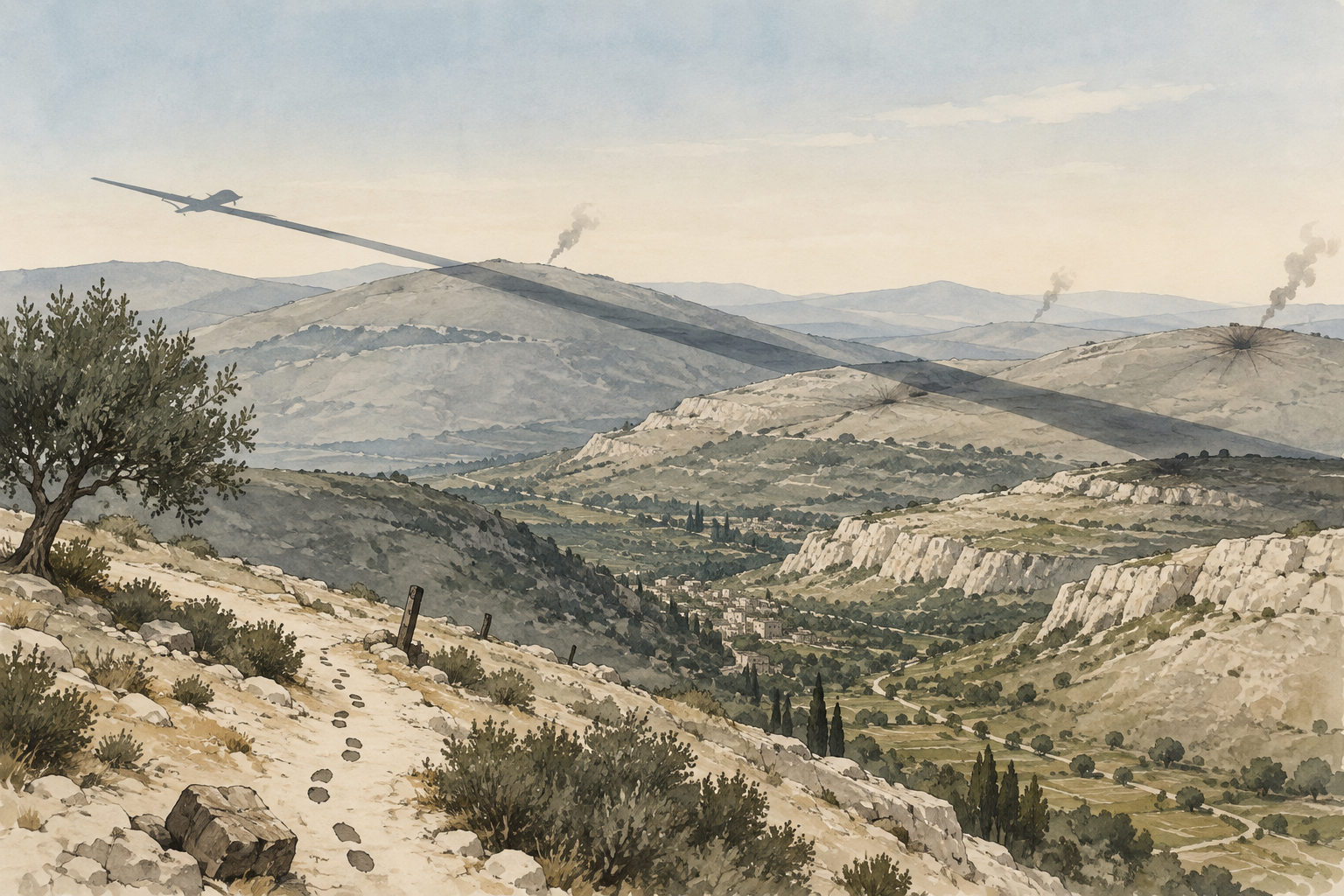
Israeli strikes on Sojod and the Jezzine heights on Sept. 26 underscored a shift in Israel’s south Lebanon posture: fewer troops reported in parts of the buffer zone, but sustained standoff pressure on areas Israel says are linked to Hezbollah weapons storage and movement routes inland.16
The strikes hit near Sojod and the Jabal al-Rafih area in the Jezzine heights, with explosions heard as far as Saida, according to Lebanese local reporting.1 The attacks followed Israeli media reports, cited by L’Orient Today, that Hezbollah had moved weapons from tunnels near the Ali Taher ridge after Israel captured the position, shifting materiel toward inland terrain around Sojod and the Jezzine highlands.1
Israel’s military said it struck a Hezbollah weapons store in the Sojod area, arguing that the site threatened Israeli forces operating in what it describes as a security zone in south Lebanon.34 Lebanese and regional outlets also reported artillery fire, drone activity and demolitions in several southern areas, suggesting the Sojod strike was part of a wider pressure campaign rather than an isolated incident.256
For regional security watchers, the key signal is not only where Israel struck on Sept. 26, but the combination of a reported force reduction and a wider target set. Annahar cited an Israeli security source saying four Israeli brigades had left southern Lebanon while two replaced them, even as Israeli operations continued through airstrikes, artillery and demolitions.6
If accurate, that points to a recalibrated campaign after the Ali Taher ridge operation. Israel may be reducing the exposure and logistical burden of a heavier ground footprint in some sectors while preserving freedom to strike suspected Hezbollah infrastructure farther from the immediate frontier.
The reported focus on Sojod and the Jezzine heights fits that logic. Those areas sit inland from the most forward border villages but remain connected to terrain Hezbollah could use for storage, dispersal or reconstitution.12
The Ali Taher ridge appears central to this adjustment. L’Orient Today reported Israeli media claims that Hezbollah weapons were moved from tunnels near the captured ridge. That suggests Israel is now tracking what it sees as downstream relocation routes and replacement storage zones, not only fixed positions along the border line.1
The reported reduction in deployed Israeli troops does not amount to de-escalation if it is paired with sustained strikes. Instead, it suggests a shift from broad physical presence to selective denial: keeping Hezbollah under pressure through airpower, surveillance, artillery and demolitions while limiting the number of Israeli units exposed in forward areas.256
Ici Beyrouth reported Israeli troop activity near Deir Mimas, strikes around Sojod and Jabal al-Rafih, drones over the Saida and Zahrani areas, artillery and demolitions.2 Arab48 similarly described a broader southern Lebanon pattern that included strikes near Sojod, Jabal al-Rafih and Rihan, as well as artillery fire, demolitions and drone activity.5
That mix is consistent with a campaign designed to maintain operational pressure without holding every sector with the same troop density. In practical terms, Israel can use drones and intelligence collection to identify suspected storage or movement, artillery to disrupt accessible zones, demolitions to degrade structures near its buffer line, and airstrikes to reach positions farther inland.
The reported Hezbollah movement of weapons from tunnels near Ali Taher, if accurate, illustrates a classic post-ground-operation challenge: once a fortified area is compromised, remaining materiel must either be hidden in place, moved to less exposed terrain or distributed among smaller units. Each option carries risk.
Moving weapons inland can reduce exposure to Israeli ground forces but may create detectable patterns of transport, storage and communications. Distributing assets among smaller groups can improve survivability but complicate command, control and rapid use.
Annahar’s follow-up cited an Israeli security source claiming Hezbollah was reorganizing into small groups. That claim aligns with the logic of dispersion but remains an Israeli characterization rather than an independently verified fact.6
This is why the Sojod and Jezzine heights strikes matter beyond their immediate blast radius. They suggest Israel is trying to prevent Hezbollah from turning the loss of forward tunnel infrastructure into a more resilient inland network. The fact that explosions were heard as far as Saida also highlights the campaign’s psychological and geographic reach for communities well beyond the front line.15
Israel framed the Sojod strike as a defensive action against a Hezbollah weapons site threatening its troops in the security zone.347 Annahar reported Israel’s position that it remains committed to the Lebanon-Israel arrangement while warning that any use of force from Lebanon would be met with significant force.4
Lebanese and regional reporting, however, places the strike within a broader pattern of Israeli violations, continuing demolitions and recurring attacks in south Lebanon.567 That divergence is central to the post-Ali Taher environment: Israel presents its actions as preemption and force protection, while Lebanese accounts emphasize continued Israeli military activity despite any claimed drawdown.
The operational reality may contain elements of both. Israel can reduce troop levels in some areas while relying more on standoff fires. Hezbollah can suffer disruption near Ali Taher while attempting to rebuild depth inland. The result is not a stable pause, but a lower-signature contest over mobility, storage and terrain.
The immediate indicators to monitor are whether strikes continue to move inland toward suspected logistics nodes, whether Israeli demolitions persist along the buffer zone, and whether Hezbollah activity becomes more decentralized. Reports of drones over Saida, Zahrani and other rear areas would suggest continued Israeli intelligence collection beyond the immediate border belt.25
The troop picture also matters. If more Israeli brigades rotate out without a corresponding drop in strikes, it would strengthen the assessment that Israel is deliberately substituting standoff pressure for heavy ground deployment. If ground raids increase again, the Sept. 26 strikes may instead mark preparation for renewed forward operations.
For now, the Sojod and Jezzine heights attacks point to a recalibrated Israeli posture after Ali Taher: lighter in some ground sectors, but wider in reach, with suspected Hezbollah relocation routes becoming a central target set.

Hamas criticized the US-created Board of Peace after it said it would not work with UNRWA in Gaza, turning aid delivery and postwar administration into a new flashpoint under the ceasefire. The dispute raises a practical question for Gaza’s recovery: who can move relief and rebuild services if the territory’s long-standing refugee agency is sidelined?

Russian strikes killed at least four people in Ukraine overnight into Sept. 27 and on Sunday, including in Kyiv and Odesa, as both sides intensified long-range attacks on cities, energy sites and logistics infrastructure. The pattern points to a drone war shifting from episodic deep strikes toward sustained reciprocal pressure, complicating European de-escalation efforts.

EU agriculture ministers meet on 28 September with the post-2027 Common Agricultural Policy entering a more political phase: capitals want more room to shape farm payments, while EU institutions are still pressing fairness, generational renewal and environmental conditions. Ministers are also expected to seek a partial position on 2028-2034 fisheries, aquaculture and maritime support, leaving budget-sensitive questions aside.

Prime Minister Rob Jetten has reopened budget talks with opposition parties after offering concessions on welfare cuts, cost-of-living pressure and the disputed Box 3 asset-tax overhaul. The negotiations are emerging as the first major test of whether his minority cabinet can secure a durable parliamentary route or must govern through shifting issue-by-issue bargains.
Ali Taher ridge
A strategic ridge in south Lebanon that Israeli forces reportedly captured, after which Israeli media claimed Hezbollah moved weapons from nearby tunnels.
Sojod
A locality in south Lebanon near inland terrain that Lebanese and Israeli-linked reporting described as a focus of Sept. 26 Israeli strikes.
Standoff pressure
Military pressure applied from a distance through airstrikes, artillery, drones and surveillance rather than a large forward troop presence.
Security zone
Israel’s term for areas in south Lebanon where its forces are operating or maintaining a buffer against Hezbollah activity.
Comments