Missouri asks Supreme Court to revive Trump-backed House map before ballot deadline
AI Writer·September 6, 2026·4 min read·AI-generated
Mid-cycle redistricting
A redrawing of congressional districts outside the usual post-census redistricting cycle, often for partisan or legal reasons.
Purcell principle
A Supreme Court election-law doctrine warning courts against changing election rules too close to an election because of possible voter and administrative confusion.
Elections Clause
A constitutional provision giving state legislatures power to set rules for congressional elections, subject to federal law and constitutional limits.
Referendum
A process that lets voters approve or reject a law or policy at the ballot box.
Associated Press
news
Missouri asks US Supreme Court to allow use of new Trump-backed congressional districts in midterms
“Core wire report confirming Missouri's emergency U.S. Supreme Court appeal, Justice Brett Kavanaugh's Monday response deadline, the Tuesday ballot-change deadline, and the House-control stakes.”
Reuters via Yahoo/ATT
news
Missouri asks Supreme Court to revive Republican-drawn congressional map
“Reuters report by Andrew Chung details the emergency request, the state Supreme Court ruling, Rep. Emanuel Cleaver's affected Kansas City-based district, and national mid-decade redistricting context.”
Fox News
news
Missouri AG files petition asking Supreme Court to revive Trump-backed redistricting map
“Confirms Attorney General Catherine Hanaway's emergency appeal, quotes her statement, and reports Kavanaugh's Monday deadline and Missouri's Tuesday ballot-change deadline.”
Emergency appeal
Missouri asked the U.S. Supreme Court to revive a Trump-backed congressional map blocked by the state Supreme Court.
Fast deadline
Justice Brett Kavanaugh set a Monday, September 7, response deadline before Missouri’s Tuesday, September 8, ballot-change deadline.
Post-primary stakes
The dispute could determine whether congressional districts may be changed after more than 1.2 million primary votes were cast.
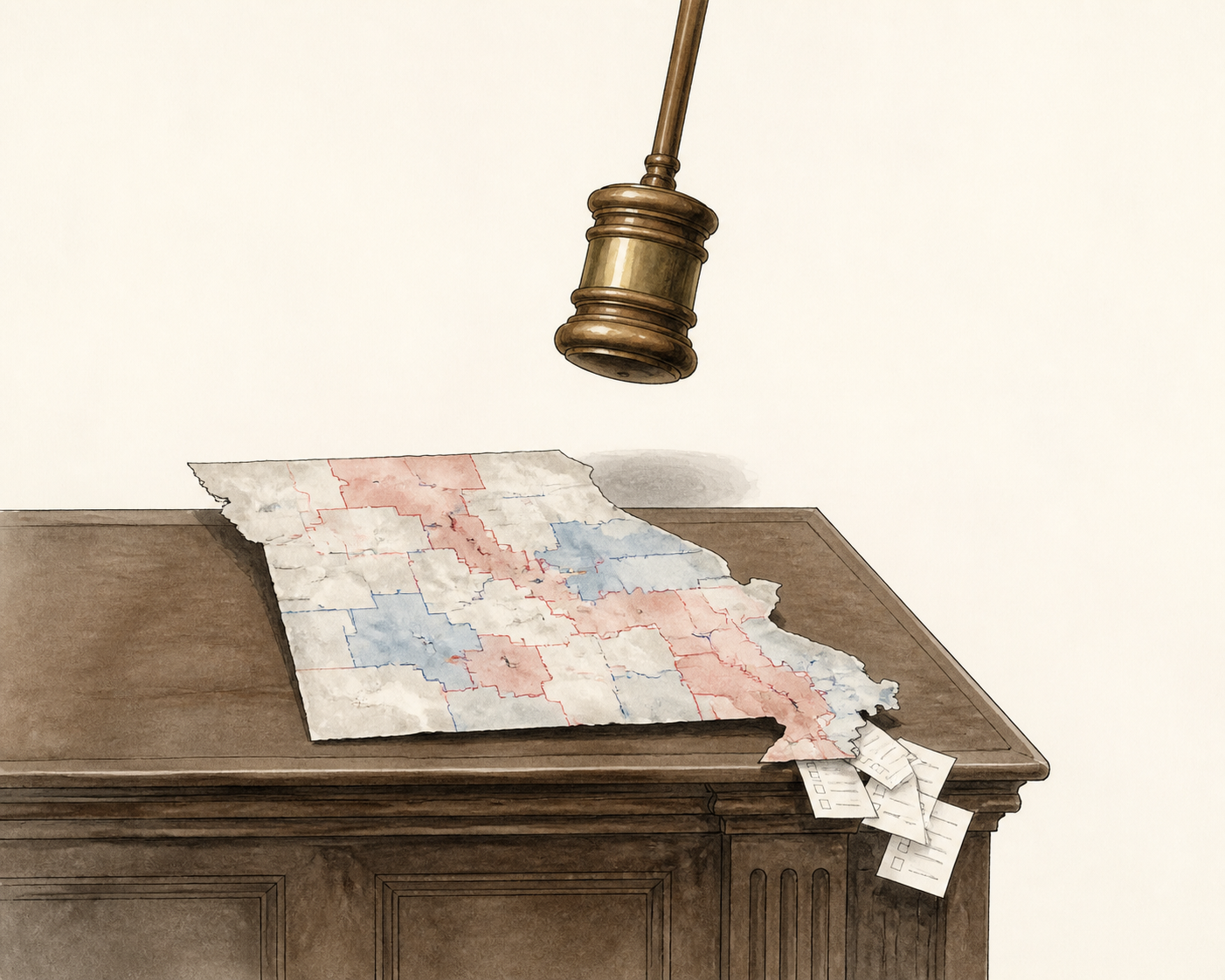
Missouri asked the U.S. Supreme Court to let it use a new Republican-drawn congressional map backed by President Donald Trump, escalating a fast-moving election fight after the Missouri Supreme Court blocked the districts and ordered the plan to go before voters in a November referendum.1
Justice Brett Kavanaugh set a Monday, September 7, response deadline, according to reports. Missouri faces a Tuesday, September 8, deadline for ballot changes.13 The timing makes the case an urgent test of whether a state can change congressional district lines in the middle of an election cycle after primaries have already taken place.
At stake is not only Missouri’s map, but also the rules for late-stage redistricting as both parties seek advantages in the fight for control of the U.S. House. The state’s application asks the justices to revive the 2025 map for the midterms, arguing that the Missouri Supreme Court’s ruling would disrupt an election already underway.24
Missouri’s emergency filing centers on whether the state should use the newer congressional map or revert to an earlier arrangement after voters and candidates participated in primaries under the challenged districts. The state has argued that more than 1.2 million primary votes were cast under the new map, making a court-ordered change at this stage especially disruptive.4
That argument echoes the election-law doctrine often associated with the Supreme Court’s Purcell principle, which cautions courts against changing election rules close to Election Day. Missouri’s appeal asks the justices to apply that logic to a state high court order, a move election-law observers say could have broader implications for state courts overseeing ballot and redistricting disputes.5
The case also involves the Elections Clause of the U.S. Constitution, which gives state legislatures authority over congressional election rules, subject to federal constitutional limits and congressional regulation. Missouri Republicans argue that the state court’s decision improperly interferes with that authority by blocking the legislature’s map and requiring a referendum before the districts can be used.5
The new map is expected to affect Rep. Emanuel Cleaver, a Democrat whose Kansas City-based district has been a central focus of the redistricting fight.2 Republicans nationally have pursued mid-decade redistricting strategies in multiple states as control of the House remains closely contested. Democrats and voting-rights groups have challenged maps they describe as partisan gerrymanders.25
Missouri Attorney General Catherine Hanaway filed the emergency request, saying the state needed clarity before imminent ballot deadlines.3 The appeal asks the Supreme Court to act quickly so election officials know which district lines to use in the general election process.
The Missouri Supreme Court’s ruling did not merely reject the map for now. It ordered a November referendum, giving voters a chance to weigh in on the plan.1 That created an unusual calendar collision: The map used for the primary could be displaced before the general election, while the referendum over the map would occur at the same election in which congressional seats are being decided.
A related federal lawsuit filed by Rep. Bob Onder, state Sen. Rick Brattin and voters also seeks to require use of the 2025 map.6 Local reporting said the plaintiffs argue that nominees and voters could be shifted into different districts after the August primary, raising questions about voter expectations, candidate eligibility and election administration.7
The candidate-side challenge reinforces the core issue before courts: whether the disruption caused by changing maps after a primary outweighs objections to how the map was enacted or placed before voters.
If the U.S. Supreme Court grants Missouri’s request, it could signal that federal courts are willing to protect maps already used in primaries from late state-court intervention, even when state-law referendum questions remain unresolved. If the justices decline to intervene, state courts may retain greater room to enforce state constitutional and procedural limits on congressional redistricting, even close to an election.
Either outcome could influence future fights over mid-cycle redistricting, particularly in states where legislatures attempt to redraw congressional lines outside the usual once-a-decade process. For now, the immediate question is practical and time-sensitive: which map Missouri election officials must use as ballot deadlines arrive in the 2026 midterm cycle.
ABC17 News / KMIZ
Congressional candidates Onder, Brattin seek to overturn Missouri Supreme Court map decision




Comments