Lords to test electoral reform bill’s participation gains against finance and ID risks
Untracked bias
100% of tracked sources are High factuality
Bias and factuality ratings from Media Bias Fact Check. Outlets without a rating are marked “Untracked.”
Lords debate
The bill is scheduled for House of Lords second reading on 14 September after being brought from the Commons on 3 September.
Votes at 16
The bill would extend the franchise to 16- and 17-year-olds for UK parliamentary elections and other reserved elections.
£72m donations
Reports of two £36m donations to Reform UK in two days have intensified scrutiny of proposed crypto and overseas-donor controls.
The House of Lords is set to begin detailed scrutiny of the Representation of the People Bill at second reading on Monday 14 September. Peers will weigh whether the government’s electoral modernisation package can expand participation and tighten campaign-finance security without creating new administrative or voter-ID risks.89
The bill, which cleared the Commons and was brought to the Lords on 3 September, would lower the voting age to 16 for UK parliamentary elections and other reserved polls. It would enable automatic electoral registration, widen accepted voter ID in Great Britain to include in-date bank cards, and introduce political-finance reforms, including restrictions on overseas-elector donations, a cryptoasset donation moratorium and stronger “know your donor” checks.89
The finance provisions will reach the Lords under intensified political pressure. BBC News reported that Reform UK received a record £36m donation from crypto entrepreneur Ben Delo on 12 September, followed by a second £36m donation from Christopher Harborne. The broadcaster noted that the bill is due for Lords debate on 14 September.12 The Block reported that the two gifts gave Reform £72m in two days and linked the donations to provisions that would halt crypto donations and cap certain overseas-linked donations at £100,000 a year.4
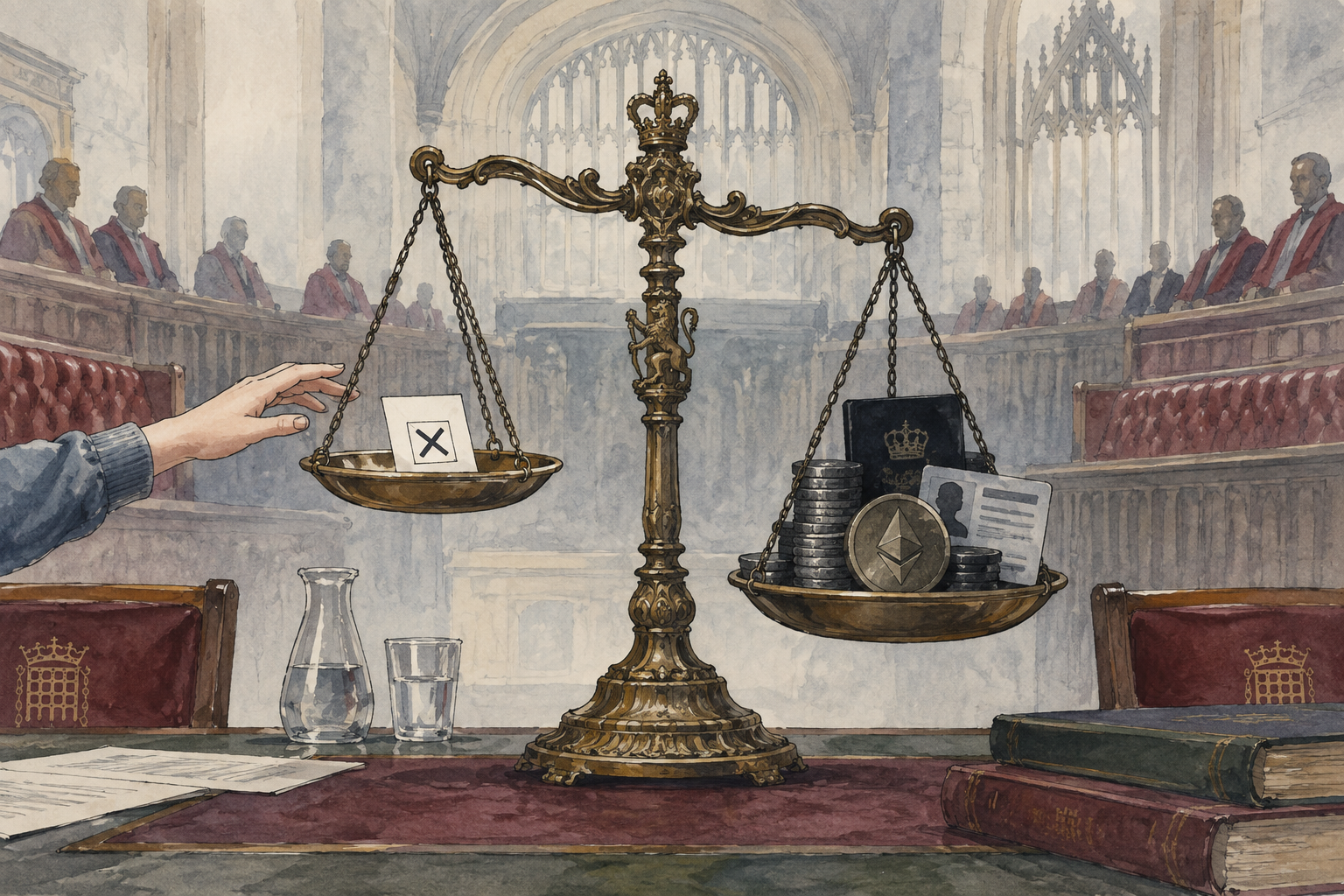
The central question for peers is whether the bill’s two ambitions — widening access to the franchise and hardening the system against foreign or opaque money — are mutually reinforcing or administratively fragile.
On participation, the bill would bring 16- and 17-year-olds into UK parliamentary elections and other reserved contests, while allowing eligible young people to be registered from age 14. It would also let electoral registration officers directly register individuals or amend entries without a prior application, and provide for pilots of new registration methods.9
On polling-day access, the government’s most visible voter-ID change is the addition of in-date bank cards to the list of accepted identification in Great Britain. The Lords Library briefing says the Electoral Commission and the Association of Electoral Administrators broadly welcomed the bill, but both raised concerns about the bank-card voter-ID proposal.9 Peers are therefore likely to probe whether a more familiar form of ID would reduce exclusion at polling stations, or whether non-photo and card-verification issues could increase pressure on polling staff.
The bill’s finance package is partly a response to the Rycroft review into countering foreign financial influence and interference in UK politics. The Lords Library says many later government amendments in the Commons implemented Rycroft recommendations, including measures on cryptoasset donations, overseas-elector donation caps, donor due diligence and Electoral Commission powers.9
The current controversy gives those provisions a concrete test case. The Coinomist reported that the proposed crypto suspension would apply to donations made on or after 25 March and require affected donations to be returned within 30 days once the rules take effect.5 The Block similarly reported that the bill’s restrictions would not take effect unless the bill completes its Lords stages and receives royal assent.4
Peers may focus on three finance questions: whether a £100,000 annual cap on donations from overseas electors and certain recent returners is the right level; whether a crypto moratorium is proportionate given traceability and permissibility concerns; and whether enhanced “know your donor” duties are workable for parties, candidates and regulated campaigners without overwhelming smaller political actors.459
The bill would give electoral administrators more tools, but also more duties. Automatic registration, registration pilots, new young-voter protections, altered absent-voting rules, voter-information powers and candidate identity requirements would all land on a system that already manages fragmented electoral law and tight statutory deadlines.9
That is where Lords scrutiny may become most technical. Supporters will argue that direct registration and expanded ID can reduce barriers for eligible voters. Critics and crossbench specialists may ask how data-sharing, accuracy checks, privacy protections for younger registrants and local-authority capacity would work in practice before the next general election.
The bill’s long title also reaches beyond franchise and finance into digital campaign transparency, offences and civil sanctions, Electoral Commission information powers, and protections against intimidation of candidates, campaigners and electoral staff.8 That breadth gives the Lords room to examine whether the package is coherent — or whether the most politically urgent finance changes risk moving faster than the administrative guidance, secondary legislation and training needed to implement them.
Second reading will not usually rewrite the bill line by line, but it will frame the fights for committee stage. Expect peers to press ministers on implementation dates, the evidence base for bank-card ID, safeguards around automatic registration, the mechanics of returning prohibited crypto donations, and the Electoral Commission’s resources and enforcement reach.
The government’s case is that the bill modernises participation while closing loopholes in political finance. The Lords’ task is to test whether those gains can be delivered securely — and whether the safeguards designed to protect elections from foreign influence, opaque money and voter exclusion introduce new weak points of their own.

President Trump asked the Smithsonian to mount a five-year George Washington exhibition and install two Washington statues at the National Museum of American History. The demand turns a months-long White House campaign over Smithsonian programming into a concrete governance test involving Congress, the Board of Regents and museum control.

A federal judge ruled that the Trump administration’s Department of Homeland Security unlawfully displaced FEMA’s authority over staffing by directing the agency to plan for a 50% workforce reduction. The ruling tests whether Congress’s post-Katrina limits on DHS control can block broad federal workforce-cutting efforts at the disaster agency.

A Tokyo tabletop exercise on the Quad Indo-Pacific Logistics Network shows Australia, India, Japan and the United States moving from broad regional pledges toward operational planning. The initiative remains framed around disaster relief and crisis response, but its procedures could also strengthen maritime security support without turning the Quad into a formal alliance.

China will sharply increase visa fees for Japanese citizens from September 14, turning a consular fee adjustment into another visible marker of deteriorating China-Japan ties. Beijing says the move follows the principle of reciprocity, as broader disputes over security, history, Taiwan and trade controls continue to weigh on relations.
Second reading
A parliamentary stage focused on the general principles of a bill, before detailed line-by-line scrutiny usually takes place in committee.
Reserved elections
Elections controlled by UK-wide law rather than devolved institutions, including UK parliamentary elections.
Know your donor
Due-diligence requirements intended to help parties and campaigners verify whether political donations come from permissible and traceable sources.
Rycroft review
An independent review into foreign financial influence and interference in UK politics whose recommendations informed later amendments to the bill.





Comments