Russia combines annexation votes with battlefield and Black Sea pressure on Ukraine
Associated Press
news
Russia presses Ukrainian areas it seized to vote over Kyiv's objections
Ukrinform
government
Ukraine condemns Russia’s ‘elections’ in occupied territories
International Foundation for Electoral Systems
other
IFES Condemns Russian Sham Elections on Occupied Ukrainian Territory
Untracked bias
50% of tracked sources are Low factuality
Fox News
‘Voters get to choose — just not the result’: Russia’s parliamentary election reaches occupied Ukraine
UNITED24 Media
Ukraine Condemns Russian State Duma Elections in Occupied Territories as a “Farce”
Bias and factuality ratings from Media Bias Fact Check. Outlets without a rating are marked “Untracked.”
Occupied voting
Russia is holding State Duma voting in Ukrainian regions it annexed but does not fully control.
Non-recognition
Ukraine, the EU and election advocates say the votes are illegal and cannot create Russian jurisdiction.
Maritime pressure
Reported attacks on Black Sea vessels have increased risks for shipping and insurance tied to Ukraine’s wartime economy.
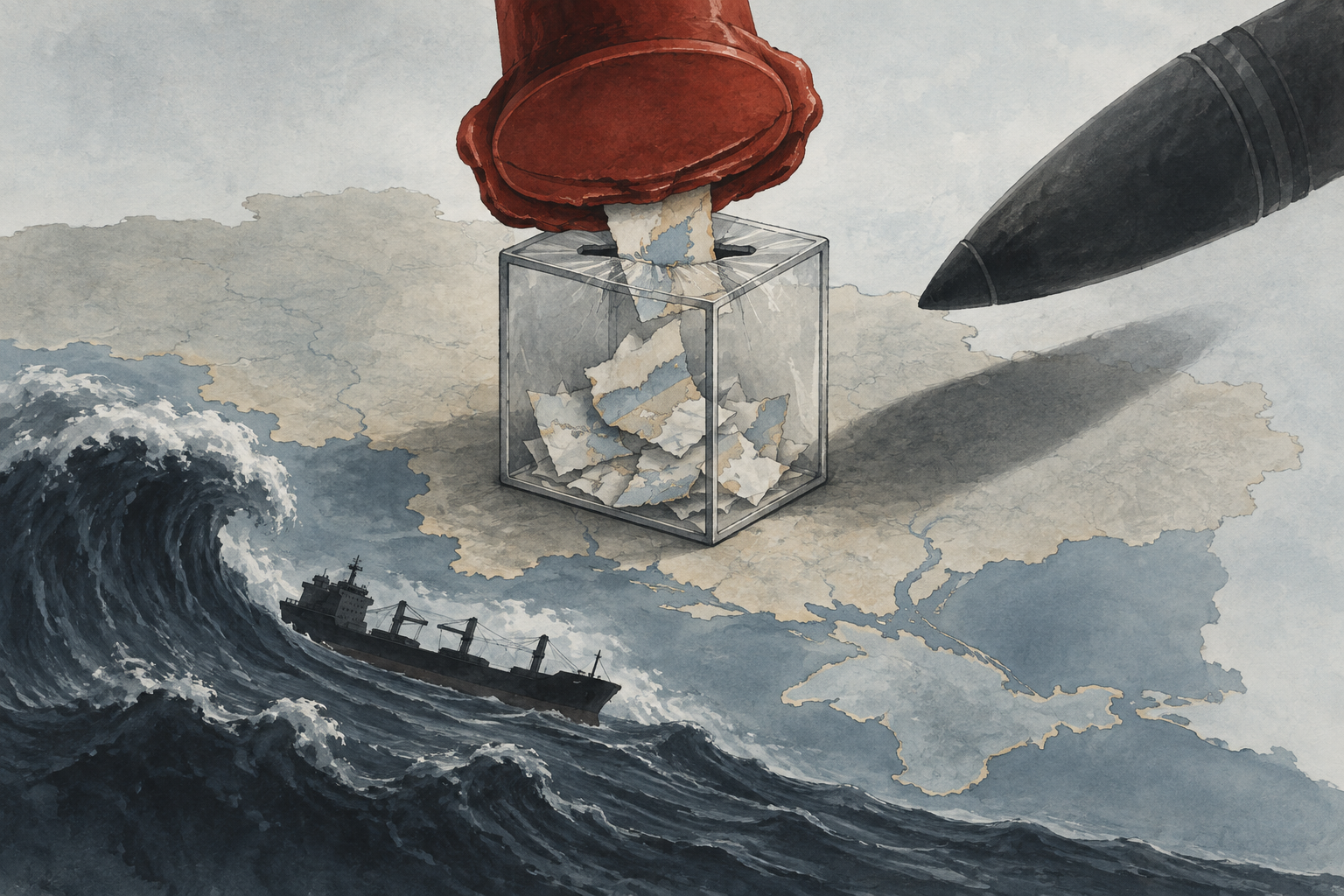
Russia is trying to turn military occupation into political administration by holding State Duma voting in Ukrainian regions it annexed but does not fully control. At the same time, its forces are intensifying attacks on Ukrainian cities, ports and Black Sea shipping.
The parallel pressure campaign suggests Moscow is seeking to normalize its territorial claims on paper while raising the military and economic costs for Kyiv to resist them.167
Ukraine says the voting in occupied parts of Donetsk, Luhansk, Zaporizhzhia and Kherson, as well as Crimea, is illegal, null and void. Ukrainian officials argue Russia cannot create lawful jurisdiction through elections staged under occupation. They have urged foreign governments and institutions not to recognize the results.2
International election and human-rights advocates have reached similar conclusions, saying voting held under armed occupation cannot be considered free or fair.34
The political move comes during a period of heavy battlefield pressure. Russian attacks over the past day were reported across multiple Ukrainian regions, including strikes that killed and wounded civilians in Kharkiv, Kherson, Zhytomyr and other areas.6710
Russia also said it struck commercial vessels it alleged were supplying Ukraine’s military. Reuters noted it could not independently verify Moscow’s claim.8 The attacks have heightened concern over Black Sea shipping risks, with London marine insurers widening high-risk reporting requirements as strikes on commercial shipping increase.9
The vote is not only symbolic. By inserting occupied Ukrainian territories into Russia’s parliamentary process, Moscow is trying to make its annexation claims appear administratively routine. Voters, polling stations, local officials and Duma representation all serve the same purpose: portraying seized land as already absorbed into the Russian state.1
That effort is complicated by the military reality. Russia does not fully control all four mainland regions it claimed to have annexed in 2022, and active fighting continues in or near parts of those territories. Holding elections there allows the Kremlin to project permanence despite contested front lines and the absence of internationally recognized sovereignty.13
Rights advocates and Ukrainian officials say the conditions make genuine consent impossible. The Associated Press reported concerns about coercion, including armed personnel around polling and pressure on residents in occupied areas.1 The Parliamentary Assembly of the Council of Europe’s platform linked the vote to a broader climate of fear and repression in Russian-occupied territory.4
Ukraine’s position is that Russia’s electoral process in occupied territory has no legal effect. The Ukrainian Foreign Ministry said the votes do not extend Russian jurisdiction and called on partners to reject the results.2
The European Commission also condemned the organization of what it called illegal so-called elections in temporarily occupied Ukrainian territories, reinforcing the EU’s non-recognition stance.5
Election monitors and democracy groups have framed the issue in similar terms. The International Foundation for Electoral Systems said elections conducted in occupied Crimea and parts of Donetsk, Luhansk, Zaporizhzhia and Kherson violate Ukraine’s sovereignty and cannot meet democratic standards under occupation.3
The legal dispute matters because Moscow has repeatedly used staged political processes to support territorial claims. Referendums, local appointments, passport distribution and parliamentary voting all help create the appearance of governance. But for Kyiv and its partners, those mechanisms are evidence not of sovereignty, but of attempted annexation by force.24
The timing links the vote to Russia’s wider coercive strategy. While Moscow tries to institutionalize its hold over occupied areas, missile and drone attacks continue to pressure Ukrainian cities and infrastructure.
AP reported deadly strikes in Zhytomyr and Kharkiv during the same period as regional leaders met President Volodymyr Zelenskyy in Ukraine and diplomacy remained stalled over territorial concessions.6
Al Jazeera reported a large overnight Russian barrage involving drones and Zircon anti-ship missiles, with civilian casualties in Kharkiv and Kherson and Russian claims of Black Sea vessel strikes.7 Euronews reported that Russian attacks killed at least 11 people and injured dozens over 24 hours, citing strikes across Kharkiv, Balakliia, Zaporizhzhia and areas linked to Odesa infrastructure damage.10
For Moscow, the combined effect is political and psychological. Elections are meant to suggest annexation is settled. Bombardment is meant to make continued resistance more costly. Together, they aim to weaken Ukraine’s negotiating position by presenting Russian control as both administratively established and militarily enforced.
Russia’s reported strikes on vessels add a maritime layer to the campaign. Moscow’s Defence Ministry said it hit cargo vessels and a tanker in Ukrainian ports and the Black Sea, alleging they were supplying Ukrainian forces. Reuters reported the claim but said it could not independently verify it.8
Even unverified or disputed claims can affect shipping behavior if insurers, operators and traders perceive greater danger. Reuters reported that London’s marine insurance market widened Black Sea high-risk reporting requirements as attacks on commercial shipping escalated.9 That raises the cost and complexity of moving goods through routes vital to Ukraine’s wartime economy.
Maritime pressure also supports Russia’s broader strategic message: that Ukraine’s territory, cities, ports and export corridors remain vulnerable. By threatening commercial vessels and port infrastructure, Moscow can try to constrain Kyiv economically while sustaining political claims on occupied land.
The Kremlin’s approach relies on creating facts on the ground in several domains at once. On land, it occupies territory and installs administrative structures. Politically, it holds votes designed to fold those areas into Russian institutions. Militarily, it uses strikes to punish Ukrainian resistance and signal escalation capacity. At sea, it pressures trade routes that help sustain Ukraine’s economy.179
For Ukraine and its partners, the challenge is to prevent those facts from hardening into accepted outcomes. Kyiv’s non-recognition campaign seeks to deny Russia legal legitimacy, while continued defense and diplomacy aim to prevent occupation from becoming permanent governance.25
The immediate result is a war fought not only over territory, but over administrative reality. Russia is trying to make annexation look routine before it is militarily complete. Ukraine is trying to ensure that ballots cast under occupation do not become another instrument of conquest.

Saudi Arabia’s nationwide aerial-threat alerts show that Houthi attacks are becoming a homeland-security challenge for Riyadh, not only a maritime chokepoint problem. The warnings also underscore why Saudi Arabia is seeking both air-defense support and diplomatic pressure through China and Iran.

A deadly building collapse in Gaza City has renewed attention on stalled reconstruction, shelter shortages and Israeli restrictions on materials nearly a year after an Israel-Hamas ceasefire reduced major fighting. Aid groups and local authorities say thousands of damaged buildings remain dangerous while disputes over security, Hamas disarmament and access to equipment slow repairs and rescue work.

More than three months after the June 7 deadline, 22 EU member states have still not fully transposed the bloc’s Pay Transparency Directive, leaving Brussels facing an early enforcement test for a flagship gender-equality policy. The uneven rollout has created a fragmented map of laws, drafts and delays that could blunt workers’ rights and complicate compliance for cross-border employers.

Regional elections on September 20 have become a national test of whether Germany’s mainstream parties can keep isolating the far-right AfD after its breakthrough in Saxony-Anhalt. For Chancellor Friedrich Merz, poor CDU results could deepen questions over his authority and sharpen internal disputes over the party’s refusal to cooperate with AfD.
State Duma
The lower house of Russia’s parliament. Moscow is using voting for Duma representation to portray occupied Ukrainian regions as part of Russia’s political system.
Annexed territories
Russia claims Crimea, Donetsk, Luhansk, Zaporizhzhia and Kherson as its own, but most countries recognize them as Ukrainian territory, and Russia does not fully control all four mainland regions.
Non-recognition
A diplomatic position under which states and institutions refuse to accept the legality of territorial changes or elections carried out by force or under occupation.
High-risk shipping zone
A maritime insurance designation that can increase reporting requirements, premiums and operational costs for vessels entering dangerous waters.
Comments