Russian strikes near Poland put Ukraine’s logistics routes on NATO’s edge
Associated Press
news
Poland to strengthen security on Ukraine border after drone attacks
Associated Press
news
Russian drone hits train near Ukraine-Poland border soon after visiting dignitaries passed through
European Commission Audiovisual Service
government
Doorstep Kaja Kallas, High Representative of the Union for Foreign Affairs and Security Policy and Vice-President of the European Commission
Untracked bias
100% of tracked sources are High factuality
Bias and factuality ratings from Media Bias Fact Check. Outlets without a rating are marked “Untracked.”
Border security
Poland pledged to increase security along its Ukraine frontier after Russian drone strikes landed near crossings and within kilometers of Polish territory.
Rail corridor
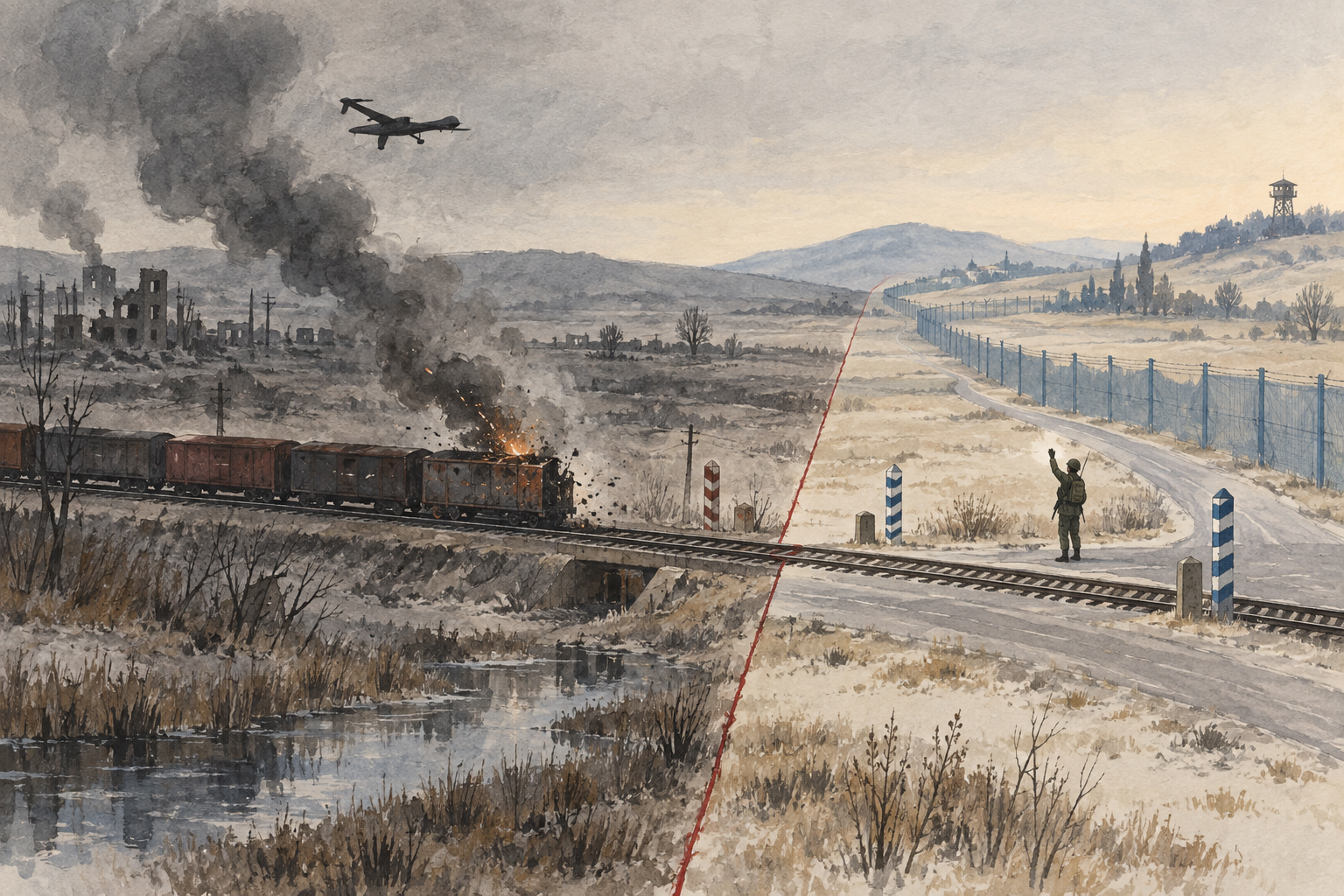
A Russian drone struck a train at Yahodyn near the Ukraine-Poland border shortly after a diplomatic delegation had passed through the station.
NATO response
NATO Secretary-General Mark Rutte said the strike would drive more alliance support for Kyiv and stronger defenses along NATO’s eastern flank.
Poland is strengthening security along its border with Ukraine after Russian drone strikes hit logistics and transport targets close to Polish territory, including a train at Yahodyn near the Dorohusk crossing minutes after a diplomatic delegation had passed through the station.12 For Warsaw, the immediate issue is border security. For NATO, the larger question is whether Russia is deliberately pushing its air campaign into the rail corridors and crossing points that sustain Western support for Kyiv.
The Yahodyn strike, reported by Ukraine’s state rail operator Ukrzaliznytsia, damaged a locomotive near one of the main Ukraine-Poland crossings. The company said a diplomatic train carrying former British Prime Minister Boris Johnson, former Swedish Prime Minister Carl Bildt and security advisers from several EU states had left the station ahead of schedule. Another train, carrying former CIA Director David Petraeus, was still at Yahodyn when the drone struck. No casualties were immediately reported.2
NATO Secretary-General Mark Rutte said the attack would push the alliance to increase support for Ukraine and reinforce defenses along NATO’s eastern border with Russia. He rejected the idea that Moscow could deter Western backing for Kyiv.1 EU foreign policy chief Kaja Kallas described the strike as a message meant to scare Western countries away from supporting and visiting Ukraine. She said Europe’s response should be to show it would not be intimidated.3
Russia has long targeted Ukraine’s energy grid, depots, ports, command nodes and transport infrastructure. What makes the latest strikes different is geography. They landed near the connective tissue between Ukraine and NATO territory: rail lines, border crossings, fuel stops and roads used by civilian passengers, visiting officials, aid flows and military-related logistics.
Reuters, citing Russia’s Defense Ministry, reported that Moscow said it had targeted infrastructure in western Ukraine that facilitates military cargo from Europe. The same report said Russia has begun targeting border crossings with Ukraine’s Western allies in recent weeks, as both sides step up long-range strikes against economic and logistics infrastructure.4
That framing matters. If Moscow defines infrastructure connected to European supply routes as legitimate targets, the rear-area network through which allies support Ukraine becomes a more direct security-management problem for Poland and NATO.
The railway dimension is especially sensitive. Since Russia’s full-scale invasion, rail has been one of Ukraine’s most resilient national systems, moving civilians, troops, equipment, diplomats and foreign visitors despite constant attack risk. Le Monde reported that Kyiv called the strike part of a systematic attack on the rail network, while noting that the Kyiv-Warsaw route was hit just before crossing into Poland.9
For Western governments, the implication is that support missions into Ukraine may increasingly require not only Ukrainian scheduling and air-defense precautions, but also allied contingency planning on the Polish side of the border.
There is no public evidence proving that Russia intended to strike NATO territory in this incident. The attacks occurred on the Ukrainian side of the border, and Polish authorities said they had not recorded a violation of Polish airspace during the episode.7
But threshold-testing does not require a deliberate hit inside NATO. It can involve repeated strikes close enough to force alliance responses, raise the risk of accidental spillover, disrupt border operations and test how much ambiguity Moscow can exploit.
Polish officials treated the danger as immediate. A spokesperson for Poland’s Armed Forces Operational Command said the threat was real because drones were operating and striking targets very close to the Polish border, from a few to several dozen kilometers away.7 Poland’s Interior Minister Marcin Kierwiński said the strikes near the crossing and the train attack were being taken with the utmost seriousness, while Polish officials monitored the situation.5
That concern was sharpened by proximity. RMF24, citing Poland’s Nadbużański Border Guard, reported that a drone hit a truck about 800 meters from the Dorohusk-Yahodyn crossing on the Ukrainian side, destroying the vehicle and contributing to a temporary halt in border processing overnight.8 Le Monde reported Polish Foreign Minister Radosław Sikorski as saying 13 strikes were recorded in the area, including one 800 meters from Poland.9
The timing at Yahodyn gave the strike political significance beyond its military effect. Ukrzaliznytsia said it was highly probable that the diplomatic train was the intended target because it had departed earlier than scheduled after real-time timetable adjustments in response to Russian strike threats.2 Reuters reported that the hit occurred on a route frequently used by foreign delegations returning from Kyiv, two kilometers from the Polish border.4
If the target was tied to the diplomatic route, the strike would fit a coercive pattern: make visits to Kyiv more dangerous, raise costs for governments that visibly support Ukraine and signal that distance from the front line no longer guarantees safety. Kallas made that interpretation explicit, saying the strike was clearly intended to scare Western countries from supporting Ukraine and traveling there.3
Moscow did not accept that characterization. Kremlin spokesman Dmitry Peskov said Russian forces were operating across Ukrainian territory and would continue to do so, according to AP.1 Russia’s Defense Ministry, according to Reuters, framed the western Ukraine strikes as attacks on infrastructure linked to military cargo from Europe.4
The gap between those positions — Russian military necessity versus European intimidation — is where the threshold problem sits.
For Poland, the strikes turn a long-standing support role into a more exposed security mission. The Ukraine frontier is not only a boundary. It is an operational seam connecting NATO territory with a country at war. Crossings such as Dorohusk-Yahodyn handle civilians, commercial movement, humanitarian assistance and the wider flow of Western support into Ukraine.
Poland responded by pledging increased security along the border and consulting NATO allies on a possible joint response.1 During the same period, Polish military aircraft operated preventively, air-defense and radar systems were put on readiness, and alerts went to residents in border regions, according to RMF24.8
Those measures show how attacks that remain physically inside Ukraine can still impose air-defense, civil-warning and border-management burdens on a NATO member.
The risk is not only a direct Russian decision to hit Poland. It is also miscalculation, debris, navigational error, interception failure or a drone crossing the border during a mass attack. Each incident forces Warsaw and NATO to decide whether they are seeing an accident, spillover, provocation or prelude to a broader hybrid campaign.
Rutte’s response points to NATO’s likely near-term answer: more support for Kyiv and more defenses on the alliance’s eastern flank.1 That may include air-defense coordination, greater surveillance, faster warning mechanisms and closer planning around cross-border transport nodes.
But it also underscores a strategic tradeoff. The more essential Poland becomes as Ukraine’s logistics gateway, the more pressure Russia can try to apply around that gateway without necessarily crossing NATO’s legal red lines.
The latest strikes do not mark a conventional attack on NATO. They do show Russia’s war moving closer to the alliance’s infrastructure, personnel routes and public risk tolerance. Ukraine’s rear-area logistics are no longer a distant support network beyond the front. They are becoming a live security-management problem at NATO’s border — one in which Moscow may be probing how close it can strike, how much disruption it can cause and how firmly the alliance will respond.

Yemen’s Houthis say they have taken Greater and Lesser Hanish islands after gains around Mokha, extending their reach over waters north of Bab el-Mandeb. The move raises the stakes for Saudi exports, Red Sea shipping and Iran’s regional leverage as Hormuz remains disrupted.

Trump’s call for Kyiv to stop hitting Russian diesel infrastructure exposes a central tradeoff in the war: Ukraine’s long-range campaign is pressuring Russia’s war economy, but it is also aggravating fuel-market strains that Washington wants contained.

European leaders meeting in Rovaniemi are treating Arctic policy less as a regional niche and more as a test of whether the EU can align security, infrastructure and foreign-policy priorities. The Finland-hosted summit comes as Russia’s northern posture, new sea routes and Greenland sensitivities push the Arctic higher on Europe’s geopolitical agenda.

Preliminary results from Sweden’s 13 September general election show the opposition ahead by three seats, but the final Riksdag result is not expected until the weekend after election day. The narrow margin, speaker process and Sweden Democrats’ role could matter as much as the winner for Stockholm’s positions on Ukraine, NATO coordination, migration and EU budget talks.
Dorohusk-Yahodyn crossing
A major Poland-Ukraine border crossing linking Polish territory with Ukraine’s Volyn region; it is part of the transport network used by passengers, cargo and support flows.
Threshold testing
A coercive tactic in which a state acts close to an adversary’s red lines to measure reactions without clearly triggering a direct military response.
Rear-area logistics
Transport and supply networks behind the front line that move people, equipment, fuel and aid; in Ukraine’s case, many routes connect to NATO territory.
Hybrid warfare
A mix of military pressure, sabotage, cyber operations, disinformation and political intimidation used to create insecurity while preserving ambiguity.

Comments