Senators press Pentagon after classified defense strategy briefing draws bipartisan criticism
Associated Press
news
Pentagon sees bipartisan criticism on defense strategy briefing
U.S. Senate Committee on Armed Services
government
Closed: To receive a briefing on the implementation of the National Defense Strategy and its impact on global defense posture
Roll Call
news
Pentagon official’s ‘contemptuous’ briefing sparks bipartisan ire
Untracked bias
100% of tracked sources are High factuality
Bias and factuality ratings from Media Bias Fact Check. Outlets without a rating are marked “Untracked.”
Bipartisan criticism
Senators from both parties said Elbridge Colby’s classified briefing did not provide the National Defense Strategy update they expected.
NDAA deadline
The annual defense policy law required a classified briefing to the Senate Armed Services Committee no later than Sept. 15.
Cost oversight
A parallel Slotkin-led letter pressed the Pentagon for details on Iran war costs, a $67 billion supplemental request and $34 billion in remaining funds.
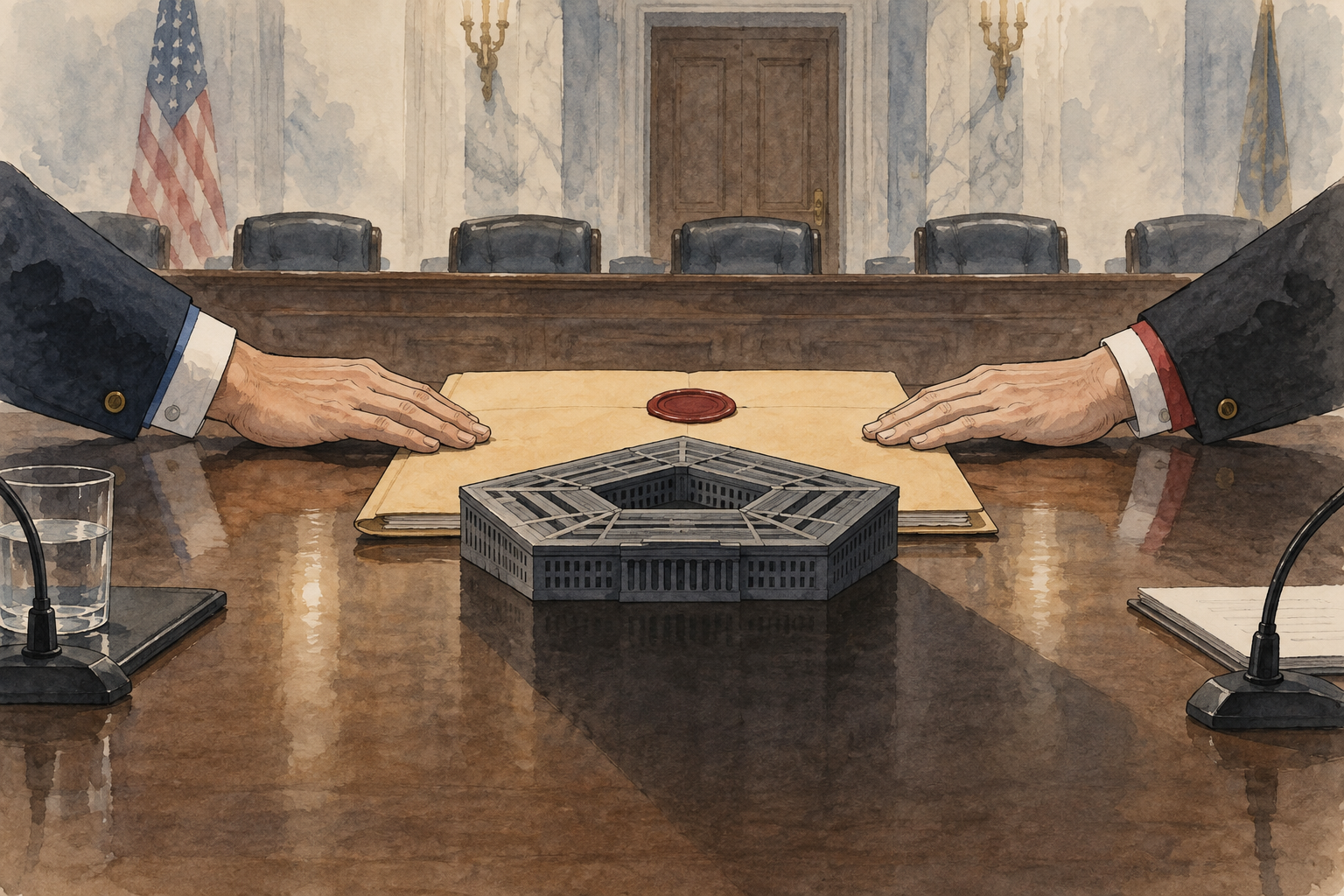
WASHINGTON — Senators from both parties criticized a classified Pentagon briefing Thursday after Defense Undersecretary Elbridge Colby reportedly failed to provide an expected update on the Trump administration’s National Defense Strategy.
The criticism sharpened a congressional oversight fight over whether the Defense Department is meeting a statutory requirement to explain its defense priorities.
The Senate Armed Services Committee session was scheduled as a closed full committee briefing on “the implementation of the National Defense Strategy and its impact on global defense posture,” with Colby, the undersecretary of defense for policy, listed as the witness.2 Under the annual National Defense Authorization Act, Colby was required to brief the committee on implementation of the strategy no later than Sept. 15, according to The Associated Press.1
Several senators said the Sept. 17 briefing did not satisfy that requirement. Sen. Kevin Cramer, R-N.D., described the session as “dodge and punt” and questioned why Colby arrived for a congressionally mandated update without an opening statement.1 Roll Call reported that Cramer called the lack of a prepared statement “contemptuous,” while Sen. Tim Kaine, D-Va., said Colby declined to answer consequential questions that senators believed he could answer directly.3
The dispute leaves Senate Armed Services Committee leaders to decide whether to treat the briefing as an incomplete response to Congress’s legal demand. They also must weigh whether to escalate through follow-up questions, written demands, another classified session, public hearings or pressure through the annual defense policy bill.
The immediate issue is not only whether senators liked Colby’s answers. It is whether the Pentagon met a requirement Congress wrote into law through the NDAA, the annual defense policy measure that authorizes Pentagon programs and often directs the department to provide reports, briefings and plans.
The National Defense Strategy is meant to guide military priorities, force posture and planning. AP reported that the Trump administration’s strategy, released in January, reinforced the president’s “America First” approach, including skepticism toward some overseas commitments and long-standing alliances.1
That made the classified briefing a key oversight venue. The official notice said the hearing would examine how the strategy is being implemented and how it affects global defense posture, indicating that senators expected more than a general discussion of current crises.2
Instead, lawmakers said the briefing focused heavily on the war in Iran and other questions, leaving members without the strategy update they expected. Sen. Mike Rounds, R-S.D., said the briefing was not what he expected and that the Pentagon owed the committee a report it did not receive.1 Sen. Mark Kelly, D-Ariz., said he left with more questions than he had going in, particularly about Iran strategy and munitions shortfalls.1
The criticism crossed party lines, though not every Republican joined it. Sen. Jacky Rosen, D-Nev., said Colby was not forthcoming and did not address lawmakers’ concerns.1 Cramer, a Republican member of the committee, faulted Colby’s handling of the briefing and said the absence of an opening statement was unusual for a mandated update.1
The Hill, in coverage published via AOL, reported that Sen. Joni Ernst, R-Iowa, said she was “very disappointed” and did not stay to ask questions because Colby was not giving clear responses.4 The same report said Kelly told reporters that Iran became the main focus even though the session had been scheduled around the National Defense Strategy.4
Some senators defended Colby. Sen. Jim Banks, R-Ind., called the briefing constructive and substantive, saying it answered his questions.1 The Hill reported that Banks said Colby was detailed and did not hide from questions.4
Committee Chairman Roger Wicker, R-Miss., and ranking member Jack Reed, D-R.I., declined to discuss details after the classified session, according to The Hill.4 AP reported that Wicker also declined to say whether he was satisfied with the briefing, citing the classified nature of the session.1
The strategy briefing dispute is unfolding alongside a separate Senate oversight push over the cost of the Iran war. On the same day as the Colby briefing, Sen. Elissa Slotkin, D-Mich., led 45 colleagues in a letter to Defense Secretary Pete Hegseth demanding a full accounting of war costs, supplemental funding needs and remaining Pentagon funding authorities.5
Slotkin’s office said the senators requested a detailed breakdown of direct and indirect costs, a full accounting of a $67 billion supplemental request and a plan for using $34 billion in remaining funds from the One Big Beautiful Bill Act.5 The letter argued that Congress needs that information to perform its oversight responsibilities.5
Budget-focused coverage in The Fiscal Times framed the Slotkin letter as part of the same fiscal oversight fight, with lawmakers seeking clearer Pentagon accounting for Iran war spending and the administration’s supplemental request.6
Together, the two tracks — the NDAA-mandated strategy briefing and the war-cost letter — point to a broader congressional concern: whether the Pentagon is providing enough information for lawmakers to judge strategy, authorize policy and scrutinize spending.
The next move rests largely with Armed Services Committee leaders and members who say the Pentagon has not complied with the law’s intent. Because the Sept. 17 session was classified, Wicker and Reed have limited ability to discuss the substance publicly. But the committee still has several oversight tools.
Leaders can ask the Pentagon to supplement the briefing in writing, schedule another classified session focused solely on the National Defense Strategy, call Colby or Hegseth to a public hearing, or use the next NDAA to tighten reporting language and deadlines. Individual senators can also submit questions for the record, demand documents, condition support for Pentagon requests or coordinate with appropriators overseeing defense spending.
The bipartisan nature of the complaints may matter. Oversight demands from the minority can be easier for an administration to dismiss as partisan. Criticism from Republicans and Democrats on the Armed Services Committee is harder to ignore, especially when the dispute centers on a statutory briefing requirement rather than a policy disagreement alone.
For now, the Pentagon faces questions on two fronts: whether it gave Congress the defense strategy update the NDAA required, and whether it is providing enough information about the costs and objectives of the Iran war. The answer will shape how aggressively Senate defense overseers press the department in the weeks ahead.
The House of Lords has appointed six peers to the joint committee examining the government’s draft Conversion Practices Bill, setting up pre-legislative scrutiny before ministers decide whether to bring forward a formal bill. The committee is due to report by 22 January 2027.

An 8th Circuit panel considered whether to revive Missouri’s Trump-backed congressional map for the November 3 midterms, even after state courts and the U.S. Supreme Court left a voter referendum process in place. The fight could determine whether Democratic Rep. Emanuel Cleaver’s Kansas City-area seat remains intact this fall.

Prime Minister Sanae Takaichi retained Foreign Minister Toshimitsu Motegi and Defense Minister Shinjiro Koizumi in a Sept. 17 Cabinet reshuffle, underscoring continuity in alliance management and regional deterrence. The lineup comes ahead of a planned year-end review of Japan’s core security and defense strategy documents.

New Delhi said the new Pakistan-China Boundary Joint Commission has no legal basis because it concerns territory India claims in Jammu and Kashmir and Ladakh. The exchange underscores how far India’s cautious outreach to Beijing can proceed while China-Pakistan border and CPEC arrangements remain tied to disputed territory.
National Defense Strategy
A Pentagon strategy document that sets broad defense priorities, military planning assumptions and force posture guidance.
NDAA
The National Defense Authorization Act, the annual law Congress uses to authorize defense programs and impose reporting or briefing requirements on the Pentagon.
Classified briefing
A closed session where lawmakers receive national security information that is not available to the public, limiting what members can say afterward.
Congressional oversight
Congress’s power to demand information, hold hearings and review executive branch decisions, especially when money, military operations or statutory requirements are involved.
Comments