Supreme Court opens term with voting, immigration and gun cases as election emergencies loom
Emergency docket
A Supreme Court process for urgent applications, often decided quickly and without full briefing or oral argument.
National Voter Registration Act
A federal law that sets rules for voter registration in federal elections and limits some voter-roll removals close to elections.
Third-country removals
A deportation practice in which the government sends a migrant to a country other than the person’s home country.
Merits docket
The Court’s regular track for cases that receive full briefing, oral argument and a written decision.
Untracked bias
ArcaMax
News briefs
Hawaii News Now
Supreme Court preview: New term brings Second Amendment, voting rights cases
NewsNation Online
US Supreme Court 2026 Term Opens With Immigration and Presidential Power in Focus
Bias and factuality ratings from Media Bias Fact Check. Outlets without a rating are marked “Untracked.”
Election timing
The Arizona proof-of-citizenship voting case is scheduled for December 8, after the November 3 midterms.
Emergency risk
Pre-election Supreme Court action is most likely through emergency litigation, not the regular merits docket.
Power tests
Trump immigration cases and the assault-weapons dispute could define limits on executive and congressional authority.
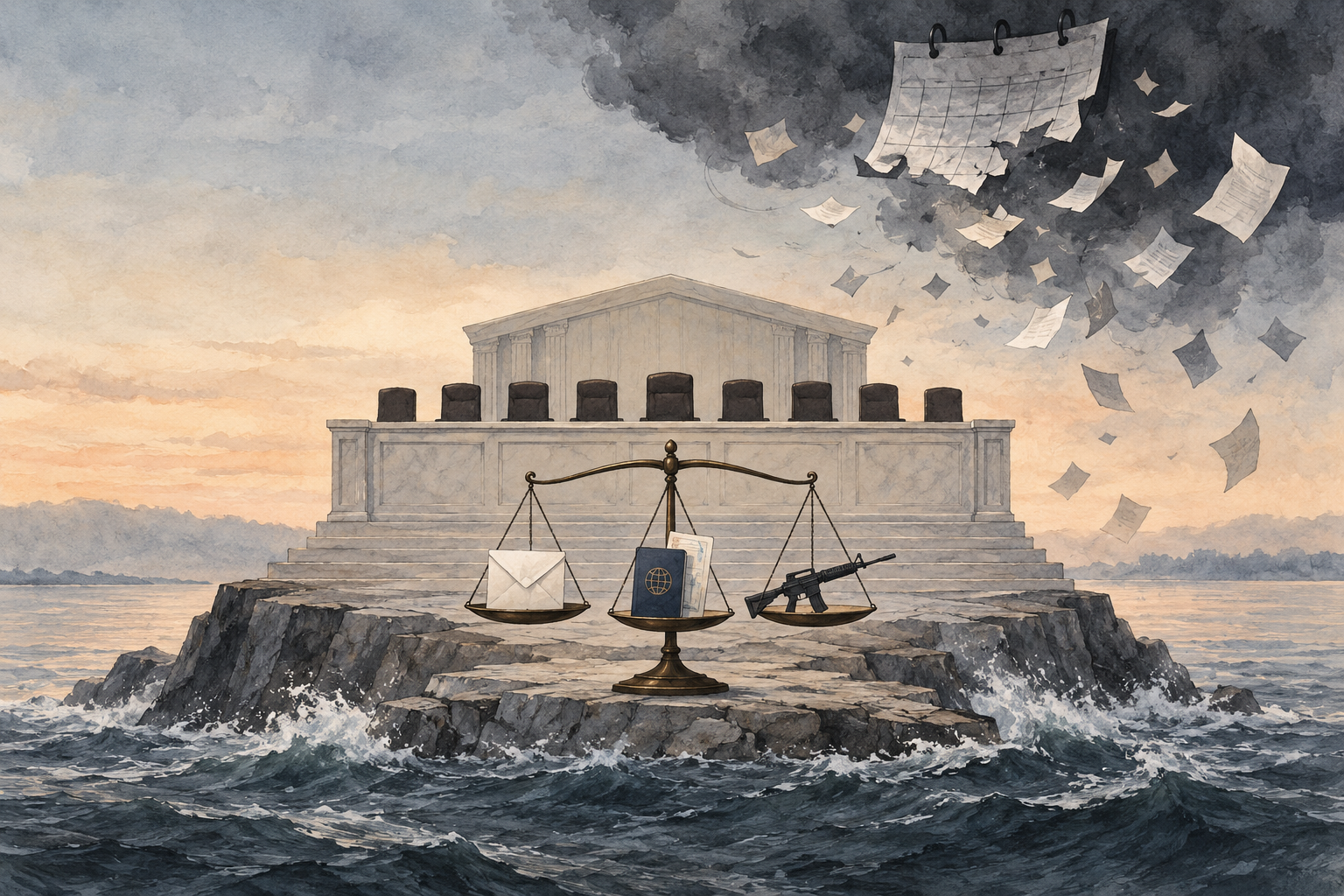
The Supreme Court opens its new term Monday, October 5, with a docket that is politically significant less for any single blockbuster case than for the Court’s growing role as a fast-moving referee on election rules and executive power.
Major scheduled disputes over Arizona proof-of-citizenship voting requirements, Trump administration immigration policies and assault-weapons restrictions are mostly set for after Election Day on November 3. But emergency litigation could still reach the justices before voters finish casting ballots.1
For election administrators, the central scheduled case is Republican National Committee v. Mi Familia Vota, part of a consolidated Arizona voting-law dispute. The justices are set to hear arguments on December 8, after the midterms, over whether Arizona can require more proof of citizenship than federal registration rules demand and whether federal law limits voter-roll removals close to an election.12
The case turns on the National Voter Registration Act, the federal statute that structures voter registration for federal elections and restricts some last-minute list maintenance.1
The more immediate pre-election question is not yet a merits case. It is whether late-breaking disputes — including challenges involving federal agents near polling places, mail voting or congressional maps — arrive on the Court’s emergency docket before November 3.
The Associated Press reported that the Department of Homeland Security says it has no plan to send immigration officers en masse to polling places. Election lawyers and voting-rights groups, however, are preparing for possible court action if federal officers appear at voting sites.6
The Court’s term begins October 5. The early calendar includes major cases outside the election-administration core, including climate litigation and other disputes that help define the term’s broader ideological stakes.24
But the marquee voting, immigration and guns cases identified in term previews are largely scheduled after November 3 or not yet scheduled for argument.12
That timing matters. A December argument in the Arizona case means any decision on proof-of-citizenship registration requirements is expected too late to set the rules for the November 3 midterms. The ruling could still reshape future federal election administration by clarifying how far states may go beyond the federal voter-registration form and how much room Congress has left under the National Voter Registration Act.12
The same is true for the assault-weapons case, Viramontes v. Cook County, which is set for December 2. The case does not directly govern election administration. But it could affect congressional and state authority to regulate firearms by testing how far the Second Amendment limits bans on particular categories of weapons, including AR-15-style rifles.12
The Arizona dispute is the docket’s clearest link to federal election administration. Arizona law requires documentary proof of citizenship for registration, and a 2022 law added citizenship-check procedures for registered voters. Civil-rights groups and voters challenged the system, arguing that parts of it conflict with the federal voter-registration regime and protections against improper roll purges close to elections.1
The Supreme Court docket identifies Republican National Committee v. Mi Familia Vota as a case from the Ninth Circuit, set for argument Tuesday, December 8.2 Advocacy groups tracking the case identify the consolidated disputes as including Republican National Committee v. Mi Familia Vota, Petersen v. Mi Familia Vota and Arizona v. Promise Arizona.7
The practical question is whether a state may demand additional citizenship documentation from voters seeking to participate in federal elections, and what counts as an “equivalent” registration form or “necessary” documentation under the National Voter Registration Act.1
A broad ruling for Arizona and Republican challengers could encourage more state-level proof-of-citizenship laws. A ruling for the challengers could reinforce federal limits on state registration requirements and on pre-election list removals.12
The Court’s regular merits docket moves slowly: briefing, argument and decisions often unfold over months. The emergency docket moves differently. It can produce consequential orders in days or weeks, often without full argument.1
That is the channel most likely to matter before November 3. Roll Call noted that the justices have already been pulled into last-minute election disputes, including fights over Missouri’s congressional map and Trump administration changes affecting mail voting.1
The AP’s reporting on fears about immigration enforcement near polling places shows another possible flashpoint. DHS says immigration agents will not be stationed at polling places, but officials have not entirely ruled out targeted enforcement responses. Voting-rights lawyers say federal law sharply limits armed officials at election sites.6
If such a conflict arises, the legal question could be immediate and operational: whether federal conduct at or near voting locations violates statutes barring armed personnel at election sites or voter-intimidation laws. That would put the Court in the position of deciding election conditions while voting is already underway or imminent.6
Two Trump immigration disputes already on the Court’s docket illustrate the broader executive-power theme.
In Department of Homeland Security v. D.V.D., the justices agreed to hear a challenge over third-country removals — deporting migrants to countries other than their own. The Court also allowed the administration to continue the policy while the case proceeds, with arguments planned for the December sitting.12
The docket questions include whether the district court had jurisdiction, whether it could issue classwide relief, and whether the government’s third-country removal guidance is unlawful under immigration statutes, due process or protections tied to torture claims.1
In Rhoney v. Barbosa da Cunha, the Court granted review on October 1 to consider mandatory immigration detention without bond hearings for certain noncitizens who entered without inspection and were later detained inside the United States.5
JURIST reported that the case concerns the government’s 2025 position that such noncitizens are subject to mandatory detention under one immigration-law provision, rather than a provision that permits release on bond while removal proceedings unfold.5
These immigration cases do not set voting rules. Their significance is institutional: they test how much room the executive branch has to reinterpret statutes and move quickly while lower courts review legality. Reuters described the new term as a continuation of the Court’s central role in assessing Trump’s aggressive uses of presidential power, with pending or potential cases involving immigration, asylum, grants and other executive actions.3
The assault-weapons case is scheduled for December 2, almost a month after Election Day. It asks whether bans on semiautomatic rifles such as AR-15-style weapons violate the Second Amendment.2
The case matters for Congress because a Supreme Court ruling could either preserve or narrow the space for federal and state regulation of particular weapons and accessories. Roll Call noted that experts see possible implications not only for local assault-weapons bans, but also for future congressional regulation of high-capacity magazines, bump stocks and other firearms or accessories.1
That does not make the case an election-administration dispute. It does make it a separation-of-powers and federalism case with consequences for what lawmakers can regulate after elections determine control of Congress and state governments.
Before November 3: The scheduled merits docket is not expected to decide the Arizona voting rules, Trump immigration policies or assault-weapons restrictions before the midterms. The key uncertainty is emergency litigation, especially if election procedures, federal enforcement activity near polling places, mail voting or redistricting disputes reach the justices.16
On November 3: The Court is scheduled to hear a religion and LGBTQ-rights dispute involving Colorado preschool funding and nondiscrimination requirements, according to Reuters. That case is politically salient but not a direct federal election-administration case.2
After November 3: The Court is set to hear the assault-weapons case on December 2, the third-country-removals case during the December sitting, and the Arizona proof-of-citizenship voting case on December 8. The mandatory-detention case has been granted, but its argument date had not been announced in the cited reporting.25
The term’s political importance lies in the Court’s dual posture. On the regular docket, the justices are preparing to decide disputes that could shape future voter-registration rules, immigration enforcement and gun regulation. On the emergency docket, they may be asked to intervene in election conditions before November 3.
That combination means the Court is not merely a final reviewer of laws passed by Congress and the states. It is increasingly a real-time arbiter when election rules, executive action and statutory authority collide during the final weeks of a national campaign.13





Comments