October talks test whether diplomacy can proceed as Russia keeps up attacks

The Kyiv Independent
news
Next Ukraine-US-Russia peace talks may take place in October, Budanov says
Interfax-Ukraine
news
Украина готовится к мирным переговорам в октябре – Буданов
Reuters via ThePrint
news
Kyiv preparing for talks to resume in October, senior Ukrainian official says
Untracked bias
100% of tracked sources are High factuality
The Kyiv Independent
Next Ukraine-US-Russia peace talks may take place in October, Budanov says
Bias and factuality ratings from Media Bias Fact Check. Outlets without a rating are marked “Untracked.”
October window
Ukraine says it is preparing for a possible trilateral Ukraine-U.S.-Russia negotiating round in October.
Ceasefire gap
Russia says it will not halt its invasion during talks, directly conflicting with Kyiv’s ceasefire-first position.
453 drones
Ukraine’s air force said Russia launched 453 drones overnight as strikes hit Odesa and western Ukraine.
A possible October round of Ukraine-U.S.-Russia talks looks less like a breakthrough than a test of whether diplomacy can begin while the war continues at full force. Ukraine’s presidential office says it is preparing for a trilateral format next month. But Russian Foreign Minister Sergey Lavrov has said Moscow will not stop its invasion during negotiations and has dismissed the prospect of a neutral-site meeting between Vladimir Putin and Volodymyr Zelensky.14
That leaves Washington with the hardest part of the emerging diplomatic track: reconciling Kyiv’s push for an unconditional ceasefire with Moscow’s position that talks can proceed only under continued military pressure.
The issue is not just procedural. Russia’s latest attacks on Odesa and western Ukraine, including areas near the Polish border, show that Moscow is still using strikes on civilian infrastructure, ports and logistics corridors as leverage while political signals circulate.7910
The firmest item on the diplomatic calendar is not a scheduled summit, but a preparation window. Kyrylo Budanov, head of Ukraine’s Presidential Office, said on Sept. 12 that Kyiv is preparing for a possible October round involving Ukraine, the United States and Russia. He confirmed the trilateral format but did not identify a venue.1
Interfax-Ukraine, reporting from the Yalta European Strategy meeting in Kyiv, also said Budanov framed the preparations around October and a three-party format.2
Reuters likewise described Kyiv as preparing for talks to resume in October, while noting that core issues remain unresolved, including territory and earlier contacts in Geneva.3 That suggests the diplomatic channel exists, but the agenda has not been reduced to a mutually acceptable package.
A negotiation date, if set, would not itself signal agreement on sequencing, ceasefire terms, territory, security guarantees or enforcement.
The U.S. role appears to be that of convenor and pressure manager. The Kyiv Independent reported that U.S. officials Steve Witkoff and Jared Kushner held recent contacts in Kyiv and Moscow, and that Secretary of State Marco Rubio described those exchanges as substantive.1
But public remarks from Kushner at the YES meeting point to the depth of the divide. He said Ukraine’s refusal to give up territory remains a sticking point in efforts to reach a peace deal.6
For Kyiv, that makes the negotiation framework politically and strategically risky. A ceasefire-first approach would freeze the battlefield before territorial bargaining. A negotiation-under-fire approach would allow Russia to keep hitting Ukraine while pressing for concessions. The difference is not semantic; it defines which side carries the immediate pressure cost.
The most visible signaling is around leaders and venues. Zelensky has said he is ready to meet Putin, including at the G20 summit in Miami in December, presenting Ukraine as willing to engage at the highest level outside Russia.5
Moscow’s response has been to portray itself as open to negotiations while rejecting the practical conditions Kyiv says would make talks meaningful.
Lavrov’s formulation is central. He said Russia remains ready for negotiations but that the war would not be stopped during that period.4 He also rejected the idea of a Putin-Zelensky meeting in a neutral or non-Russian venue, pushing back against the Miami option raised by Zelensky.45
The message is designed to separate Russia’s claimed willingness to talk from any obligation to de-escalate.
That posture serves several purposes. Internationally, it lets Moscow argue it is not blocking diplomacy. Militarily, it preserves Russia’s freedom to strike. Politically, it shifts debate toward venue, leadership optics and Ukrainian flexibility rather than the immediate question of whether civilians and infrastructure would be protected while negotiations unfold.
Kyiv’s public position does the reverse. By emphasizing readiness for trilateral talks and leader-level engagement, Ukrainian officials seek to show that they are not refusing diplomacy. But by insisting on an unconditional ceasefire, Ukraine is also trying to prevent a process in which Russian attacks continue while Kyiv is pressured to negotiate over territory.156
The timing of Lavrov’s remarks and Budanov’s October signal coincided with another Russian strike wave. The Associated Press reported that Russia hit Odesa, Ukraine’s main Black Sea port hub, and attacked western Ukraine, including near the Yahodyn-Dorohusk border crossing with Poland.7
Ukraine’s air force said Russia launched 453 drones overnight and that 409 were shot down or suppressed, according to AP.7
Odesa has particular strategic weight. It is a civilian city, a symbol of Ukraine’s maritime resilience and a key node for exports. AP reported at least nine injuries in a massive overnight attack on Odesa, after a Saturday drone strike hit a residential high-rise, killing two people and injuring 26.7
The Kyiv Independent reported that Russian attacks across Ukraine killed 11 and injured 96 during the Odesa-focused wave, citing Ukrainian authorities and air force figures.10 Ukrainska Pravda also reported that missiles struck Odesa, hitting a high-rise and injuring civilians.11
The western Ukraine strikes carry a separate message. Attacks near the Polish border threaten routes used for Western military and humanitarian assistance. AP reported a fire near the Yahodyn-Dorohusk crossing and a drone strike on a passenger train locomotive in Volyn region, about 2 kilometers from the Polish border.7
The Kyiv Independent described the wider assault as hitting Volyn, Rivne, Ivano-Frankivsk and Ternopil, and reported that a Russian drone struck the Kyiv-Warsaw train near Poland.9
These attacks frame the diplomacy more than any summit venue does. If Russia continues to strike Odesa, border infrastructure and transport links during talks, negotiations may function less as a pause before settlement than as another arena of pressure.
The United States now faces a sequencing problem. Ukraine wants an unconditional ceasefire before substantive bargaining. Russia says it will bargain only while continuing the war.
Between those positions, Washington can try to broker interim steps: humanitarian pauses, limits on long-range strikes, monitoring mechanisms, prisoner exchanges, or a preliminary political framework. But none would substitute for the central question of whether Russia is prepared to stop attacking without first extracting concessions.
Territory remains the hardest substantive issue. Kushner’s remarks that Ukraine’s refusal to give up territory is stalling a deal signal that some in Washington see territorial compromise as unavoidable.6
For Kyiv, accepting that premise under fire would risk turning Russian battlefield coercion into diplomatic terms. For Moscow, refusing a ceasefire keeps that coercion active.
The October window, if it materializes, is therefore best understood as an opening for process, not evidence of convergence. The parties may be closer to another meeting than to a settlement.
The test will be whether Washington can change the incentive structure enough to make talks more than a forum in which Ukraine negotiates while Russian drones and missiles continue to shape the battlefield.

An Israeli strike in Gaza City killed two people, according to AP, as Israel said it targeted Hamas operatives. The latest UN reporting points to a parallel civilian crisis, with severe water insecurity and stalled approvals for parts and fuel inputs threatening essential services.

A strike on an Iranian commercial vessel near Qeshm Island killed one person and wounded several others, Iranian media said, just before regional talks in Oman on managing shipping through the Strait of Hormuz. The incident adds pressure to Monday’s meeting as attribution remains unclear and U.S. interdiction of Iran-linked maritime traffic continues.

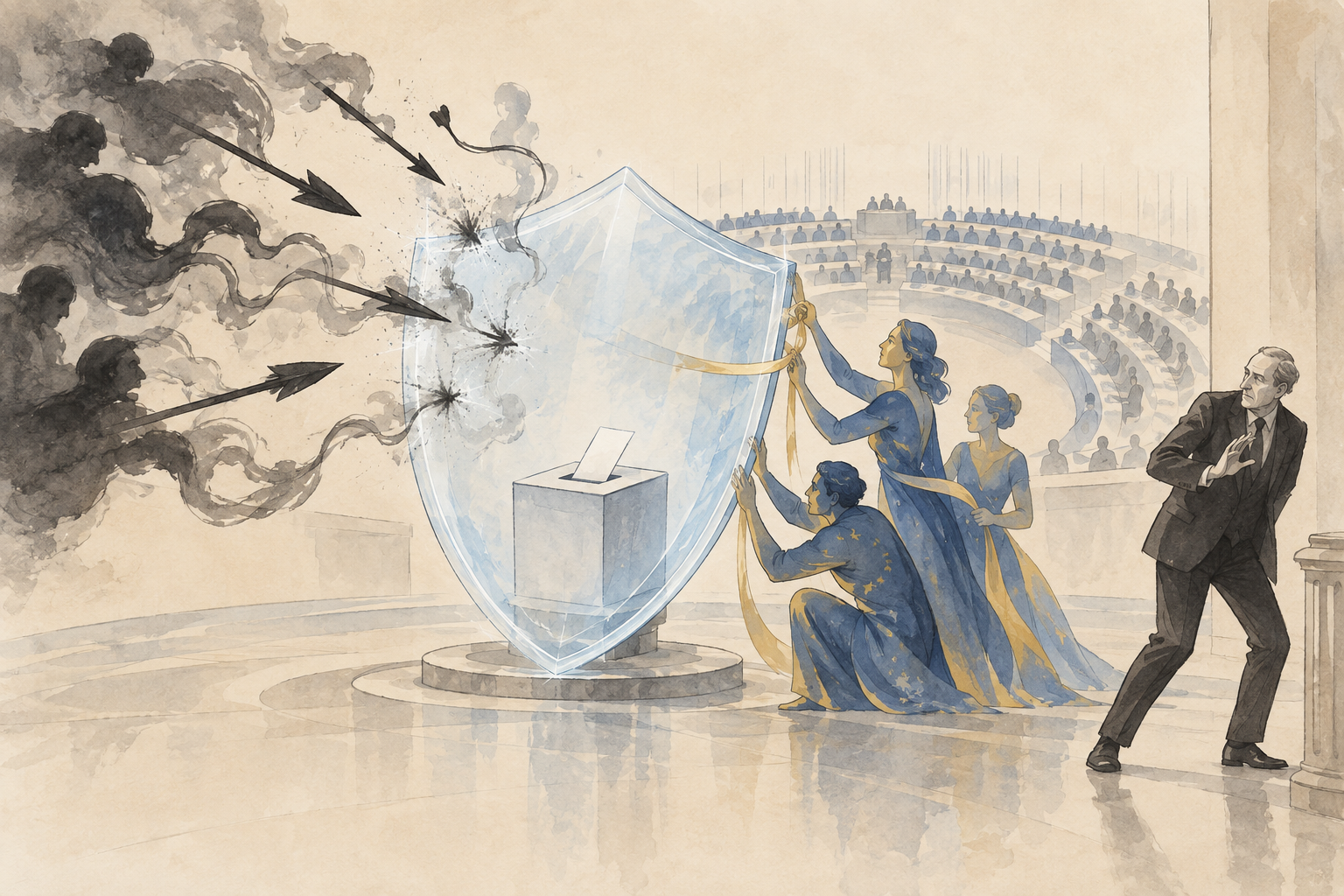
The European Parliament is due to vote on 15 September on recommendations for the European Democracy Shield, including support for an EU centre for democratic resilience with its own legal act and budget. The debate has exposed a fault line between groups seeking stronger EU-level monitoring and crisis response and conservatives warning against Brussels involvement in national electoral processes.

Ursula von der Leyen’s 16 September State of the Union address is set to function less as a ceremonial stocktake than as the first move in a crowded autumn negotiation with the European Parliament. MEPs are expected to test the Commission’s priorities on the 2028-2034 budget, defence readiness, enlargement, democracy protections and climate files.
Trilateral format
A negotiation format involving Ukraine, the United States and Russia, rather than direct Ukraine-Russia talks alone.
Unconditional ceasefire
A halt to fighting that is not tied to prior concessions, such as territorial withdrawals or political commitments.
Yahodyn-Dorohusk crossing
A key Ukraine-Poland border crossing used for civilian movement and Western military and humanitarian aid flows.
Negotiating under fire
A diplomatic process in which talks occur while active military attacks continue, often giving the attacking side added leverage.


Comments