White House seeks $810 million rescission, reviving fight over Congress’s spending power
Untracked bias
50% of tracked sources are Mixed factuality
Bias and factuality ratings from Media Bias Fact Check. Outlets without a rating are marked “Untracked.”
$810M package
The White House special message lists 11 proposed rescissions totaling $810 million across domestic and international accounts.
Year-end timing
The request was sent September 25, five days before the September 30 fiscal-year deadline, limiting Congress’s practical ability to use the 45-day review period.
GOP objection
Senate Appropriations Chair Susan Collins, a Republican, called rescinding appropriated funds without congressional approval illegal.
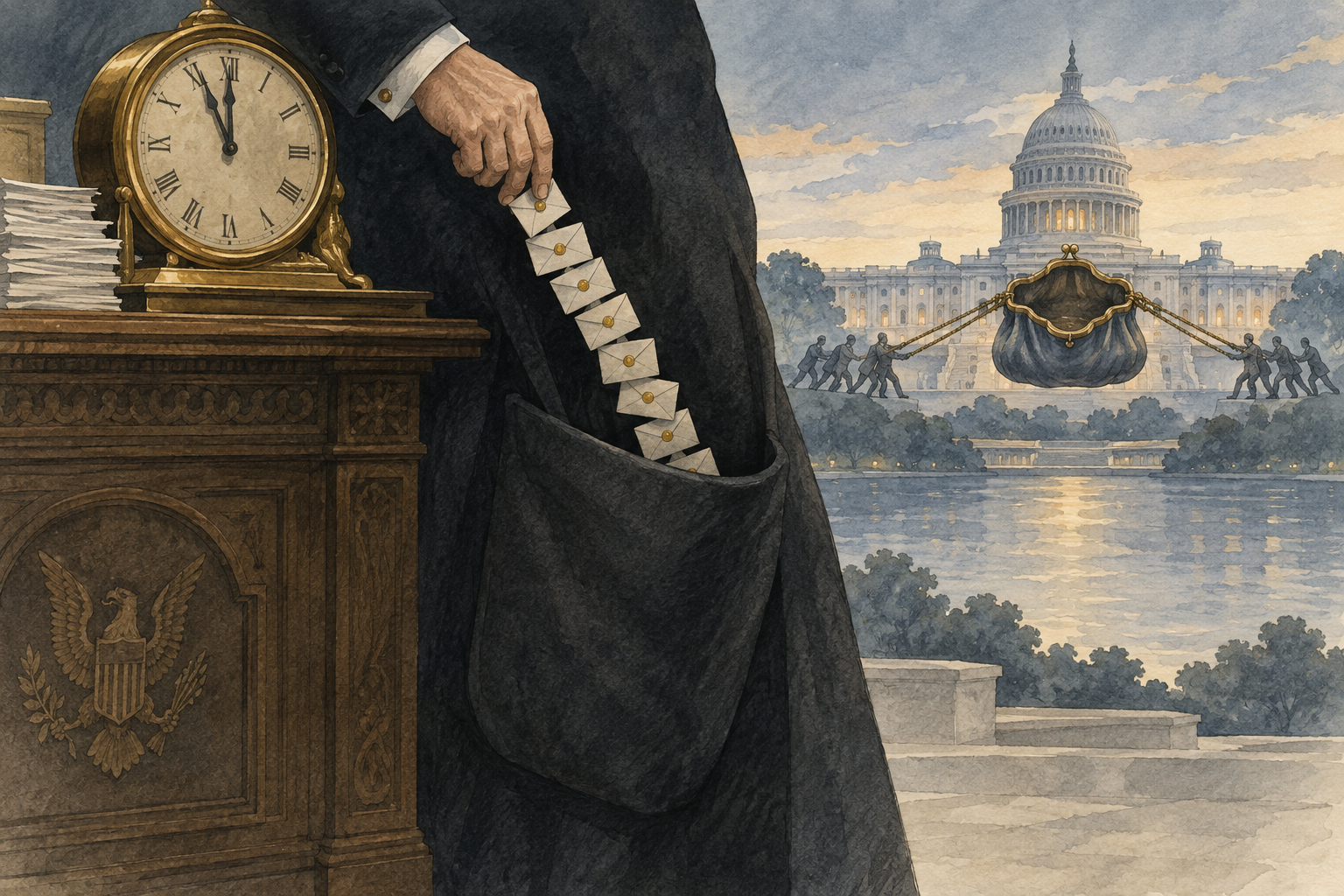
President Donald Trump is seeking to cancel $810 million in congressionally approved funding through a late-fiscal-year rescissions package that the White House and Office of Management and Budget are treating as a “pocket rescission.” The move revives a dispute over whether the executive branch can use year-end timing to bypass Congress’s appropriations authority.12
The September 25 special message to Speaker Mike Johnson cites section 1012(a) of the Congressional Budget and Impoundment Control Act of 1974. It identifies 11 proposed rescissions affecting accounts at the departments of Commerce, Education, Health and Human Services, Homeland Security, Housing and Urban Development, and Justice, as well as international assistance programs.1
The request arrived five days before the September 30 end of the fiscal year, compressing the statutory review window that ordinarily gives Congress 45 days to consider a president’s proposed rescissions.3
OMB’s position, according to Bloomberg Government, is that the funds will be rescinded regardless of whether Congress acts before the fiscal year closes.2 That is the core of the confrontation: appropriators say the Impoundment Control Act requires congressional approval before budget authority can be canceled. The administration argues that sending the request late in the year allows the money to lapse before Congress can complete its review.23
Senate Appropriations Chair Susan Collins, R-Maine, sharply rejected the maneuver, saying the package came without warning or consultation and that any effort to rescind appropriated funds without congressional approval violates the law.2 Collins also said OMB “does not get to decide which programs are worth funding,” framing the dispute as another attempt to undermine Congress’s constitutional power of the purse.3
The largest proposed cut is $567.4 million from HHS’s Refugee and Entrant Assistance account, which funds Office of Refugee Resettlement programs. The White House said the account is overfunded because of the administration’s border policies and argued that the rescission would reduce spending on services for refugees, asylees and other eligible noncitizens.14
The package also includes $15 million from FEMA’s Alternatives to Detention-Case Management Pilot Program and $10 million from U.S. Citizenship and Immigration Services’ Citizenship and Integration grant program, both within DHS-related accounts.1 A separate $24.9 million rescission would affect Education Department competitive grants within Special Programs for Migrant Students.1
Other proposed rescissions include $15 million from the Justice Department’s Community Relations Service; $8.7 million from international assistance debt restructuring funds used for the Tropical Forest and Coral Reef Conservation Act program; $10 million from Commerce Department Minority Business Development Agency programs; $69.6 million from Education Department international education and foreign language domestic programs; $27.7 million from the Agency for Healthcare Research and Quality; $56.1 million from HUD housing counseling assistance; and $5.1 million from HHS departmental management funds associated in the request with the Office of Minority Health.1
The White House public announcement described the package as targeting “wasteful and harmful” spending. It itemized programs the administration said focused on noncitizen services, race-conscious initiatives, climate-related debt relief, international education and certain health research grants.4 That framing echoed early public reports that characterized the package as aimed at immigrant-services and race-focused programs.5
Under the Impoundment Control Act, a president may propose rescissions, but Congress generally must approve them for the cancellations to become permanent. The administration’s pocket-rescission theory turns on timing: by sending the request near the end of the fiscal year, OMB can withhold the money during the review period until the budget authority expires.23
The Government Accountability Office has previously said pocket rescissions are illegal, according to the Associated Press, because they effectively deny Congress its full review period and allow the executive branch to cancel funding without enacted legislation.3 The administration, by contrast, points to the Impoundment Control Act authorities cited in Trump’s message and to prior use of late-year rescission tactics as support for its approach.14
The latest package follows an earlier Trump administration pocket-rescission effort involving foreign aid, which drew litigation and emergency Supreme Court action. The new request differs because it reaches domestic accounts as well as international assistance, increasing the stakes for appropriators responsible for annual discretionary spending bills.23
Collins’ opposition is notable because she chairs the Senate committee responsible for writing annual spending bills and is a Republican appropriator objecting to a Republican administration’s budget tactic. Her statement aligned with Democratic objections that the maneuver circumvents Congress rather than seeking an up-or-down vote on the cuts.23
Sen. Patty Murray, D-Wash., the ranking Democrat on Senate Appropriations, said Congress had provided the funds on a bipartisan basis and called for lawmakers to reassert their spending authority.3 Rep. Brendan Boyle, D-Pa., the ranking member on the House Budget Committee, also criticized the move as an attempt to achieve cuts through the back door.2
The procedural calendar limits Congress’s immediate options. Bloomberg Government reported that the Senate was scheduled to be in session during the final three days before the fiscal year ends, while the House was out until November.2 That schedule gives the package its practical force: absent rapid legislative action, OMB’s withholding could run through the expiration of the funds.
For congressional budget readers, the immediate question is whether appropriators can respond through legislation, oversight or litigation before the administration treats the accounts as canceled. The broader issue is whether pocket rescissions become a repeatable executive tool at the end of each fiscal year, shifting leverage away from the committees that write spending laws and toward OMB’s control of apportionment and execution.

Ministers have announced a £210m package to bring boarded-up high-street buildings back into use, but the money is being redirected from existing MHCLG regeneration budgets rather than created as a new spending line. The delivery test now falls on councils, mayors, strategic authorities and the Place Regeneration taskforce before a full high-streets strategy due later in 2026.

The Supreme Court on September 25 allowed the Trump administration to use an expanded DHS citizenship-verification system for voter checks while emphasizing that federal law restricts systematic roll removals close to Election Day. The emergency order gives the White House a partial election-administration win, but its immediate effect before the November 3 midterms may be limited to individualized inquiries.

Pakistan used UNGA-related forums to argue that the Indus Waters Treaty remains binding, while India’s defence leadership framed the treaty’s suspension as part of a broader response to terrorism after the Pahalgam attack. The dispute over water is increasingly being folded into the two countries’ wider confrontation over deterrence, diplomacy and international messaging.

Prime Minister Sanae Takaichi’s call to delete the UN Charter’s postwar “enemy state” language has reopened a long-running legal grievance for Tokyo. Beijing is treating the demand as evidence that Japan’s defense normalization and historical posture are challenging the postwar order.
Rescission
A proposed cancellation of previously enacted budget authority. Under the Impoundment Control Act, Congress generally must approve a rescission for it to become permanent.
Pocket rescission
A disputed tactic in which the president sends a rescission request near the end of a fiscal year and withholds funds until they expire, leaving Congress little or no time to act.
Impoundment Control Act
A 1974 law that governs when and how the executive branch may defer or propose canceling funds that Congress has appropriated.
Power of the purse
Congress’s constitutional authority to raise and spend federal money, exercised mainly through appropriations laws.
Comments