Yandex strikes put Russia’s digital backbone in Ukraine’s target set
Yandex
other
What is happening to our data centers, the iron heart of Yandex
Yandex Cloud
data
Yandex Cloud incident: Power disruption in availability zone ru-central1-b
Reuters via Investing.com
news
Ukraine expands drone strikes on data centres owned by Russia’s Yandex
Untracked bias
50% of tracked sources are High factuality
The Moscow Times
Ukrainian Drones Hit Yandex Data Center, Industrial Facilities Across Russia
Free Malaysia Today
Drones hit Yandex data centre in first major attack on Russian data hub
UNITED24 Media
Drone Strike on Yandex Data Center Triggers Widespread Internet Outages Across Russia
FACTUM.PRESS
Yandex Data Center Hit by Drones: Two Supercomputers and the Cost of Replacement
LeoDex News
Yandex says drones hit a second data center in two days, knocking Kaluga modules offline
SecurityLab.ru
Два дня, два удара. Теперь беспилотники добрались до серверов «Яндекса» в Калуге
Bias and factuality ratings from Media Bias Fact Check. Outlets without a rating are marked “Untracked.”
Cloud hit
Yandex said its Sasovo data center was seriously damaged and fully shut down after a drone attack.
Second strike
AP and Reuters reported Kaluga was the second Yandex data-center site hit in two days.
AI capacity
The affected Yandex infrastructure included cloud, database, artificial intelligence and other core digital services.
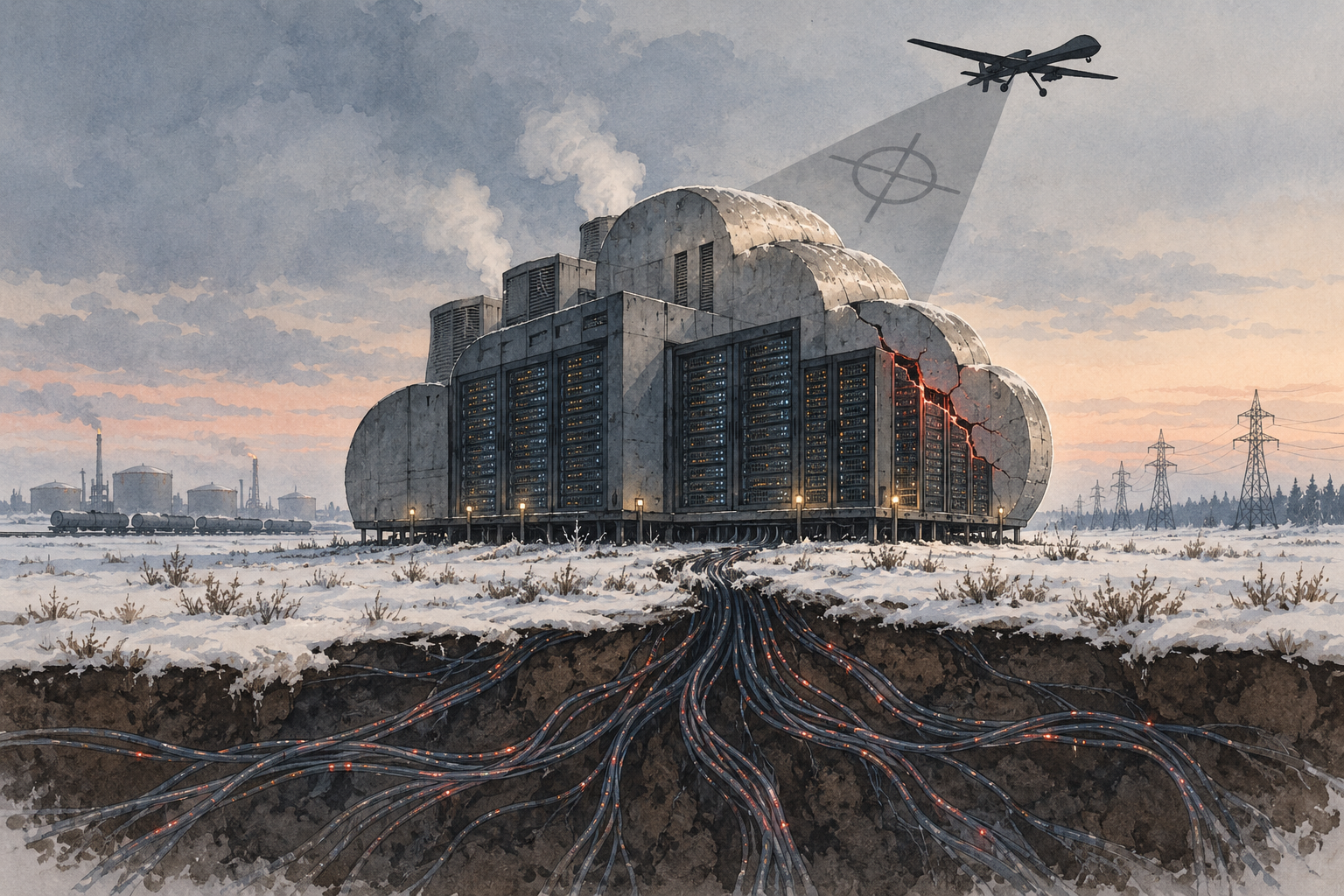
Drone strikes on Yandex data-center infrastructure in Russia on October 8 and 9 mark a potentially significant expansion of Ukraine’s long-range campaign: from energy, transport and logistics targets to the digital backbone that supports cloud computing, artificial intelligence workloads, business continuity and, indirectly, wartime command-and-control resilience.
Yandex confirmed that its Sasovo facility in Ryazan region was seriously damaged and fully shut down after a drone attack, leaving infrastructure out of service and restoration timelines uncertain.1 Its cloud status page separately identified a fire at the Sasovo data center after a UAV attack as the cause of an outage in the ru-central1-b availability zone, affecting cloud, database, artificial intelligence and infrastructure services.2 The next morning, Yandex said part of its Kaluga data-center infrastructure was also damaged by a UAV attack, with several modules fully out of service while the company assessed the damage.11
Reuters framed the Kaluga strike as a widening of Ukrainian attacks on Yandex-owned data centers after weeks of Russian strikes on Ukrainian data hubs and telecom infrastructure.3 A day earlier, Reuters described the Sasovo incident as the first confirmed major Ukrainian drone attack on a Russian data center.4 The Associated Press also reported that Kaluga was the second Yandex site hit in two days, placing the strikes within a broader pattern in which both sides are attacking infrastructure that sustains military logistics, civilian life and economic activity.5
The immediate military significance is less about one server hall going dark than about the category of target. Data centers are not ammunition depots, substations or bridges. But in modern war, they host cloud platforms, databases, routing and backup systems, analytics tools, enterprise services and artificial intelligence workloads. If Ukraine is now willing to hit those facilities inside Russia, it is testing whether Russia’s digital systems are as vulnerable to physical disruption as its refineries, rail nodes and power infrastructure.
Yandex is not just a consumer internet brand. Its infrastructure supports cloud services, machine-learning capacity and commercial digital systems used across Russia’s economy. The Sasovo incident affected the Yandex Cloud ru-central1-b availability zone, disrupting cloud, database, artificial intelligence and infrastructure products, according to the company’s status record.2 Reuters reported that the affected infrastructure was connected to Yandex services and artificial intelligence supercomputing capacity, raising questions about the resilience of systems built around a small number of major facilities.3
Meduza’s analysis emphasized the same vulnerability: large cloud platforms are designed with backups and redundant availability zones, but physical attacks on data centers can still degrade services, force failovers and expose weaknesses in backup architecture.8 Meduza also reported that service disruptions from Sasovo could affect Russian Railways, MegaFon and media sites relying on Yandex infrastructure, underscoring how a strike on a nominally private technology site can ripple through transport, telecommunications and information services.9
That blurring is central to the escalation risk. A data center may serve civilian customers, commercial platforms and state-linked functions at the same time. It may host routine business applications alongside services that support logistics, communications, mapping, analytics or artificial intelligence development. The same redundancy that protects consumers can also help military and government systems stay online.
Ukraine has spent much of 2025 and 2026 using long-range drones to pressure Russia’s war economy, especially oil refining, fuel storage, transport corridors and military-industrial supply chains. The Yandex strikes suggest a possible broadening of that approach. Instead of only hitting the infrastructure that moves fuel and materiel, Kyiv may be probing the infrastructure that moves data.
That shift did not occur in isolation. AP reported that Russia’s recent attacks on Ukraine have targeted telecom networks, energy systems, railways and other civilian and economic infrastructure.6 AFP likewise noted recent Russian attacks on Ukrainian data centers and logistics warehouses while confirming with Yandex that a drone attack caused a fire at Sasovo and halted the site.7 Data Center Dynamics, a specialist trade outlet, placed the Yandex attacks in the context of recent strikes on Ukrainian data-center and telecom operators including Parkovyi, MiroHost, Datagroup, Vodafone Ukraine, De Novo, Cosmonova, Omega Telecom and Ukrtelecom.12
That context makes the Yandex attacks look less like an isolated symbolic strike and more like reciprocal targeting of digital infrastructure. Ukraine may be signaling that Russian attacks on Ukrainian connectivity and hosting capacity will be answered not only with strikes on energy assets, but also with strikes on Russia’s cloud and data infrastructure.
For military planners, the value of striking a data center depends on what it hosts, how redundant it is and whether an outage forces an adversary to reroute sensitive systems through less secure or less efficient pathways. A hardened cloud architecture can absorb the loss of one availability zone; a poorly distributed architecture may not.
The Yandex Cloud incident shows why even partial disruption matters. The company’s status page linked the Sasovo fire to unavailability in a specific availability zone and listed affected service categories spanning cloud infrastructure, databases and artificial intelligence services.2 If customers had distributed workloads properly across regions and zones, disruption may have been limited. If not, the physical strike could have caused application outages, data-access problems or degraded services.
Kaluga may have had a different profile. Interfax-Ukraine cited Ukrainian defense-tech company Fire Point as saying FP-1 drones struck Yandex’s Kaluga facility in the Grabtsevo industrial park, identifying it as a 63-megawatt site and saying two of Yandex’s five major data centers had been attacked.10 If accurate, that would suggest an operation aimed not at a minor edge node but at core compute capacity.
Still, the direct military effect remains difficult to assess from public information. There is no public evidence that the strikes disabled a specific Russian military network. The more supportable conclusion is narrower: Ukraine appears to be testing a target class whose operational importance lies in resilience, redundancy and dependency rather than in a single visible battlefield effect.
The same traits that make data centers operationally attractive also make them legally and politically sensitive. Cloud facilities consolidate services for many users. A strike intended to disrupt state functions, military-adjacent analytics or strategic communications may also affect civilian companies, media outlets, transport operators or telecom services.
Yandex’s own statement on Sasovo described serious damage, a full shutdown and uncertain restoration timelines.1 Its Kaluga statement said several modules were fully out of service while damage was being assessed.11 Meduza reported that the disruption could affect commercial and public-facing services relying on Yandex infrastructure, including transport and telecom-linked users.9
That creates a familiar dilemma in infrastructure warfare. Russia’s attacks on Ukraine’s power grid, telecom networks and data facilities have already shown how quickly economic infrastructure becomes part of the battlefield.6 Ukraine’s apparent response now extends that logic into Russia’s technology sector. The distinction between civilian service provider and wartime support system becomes harder to maintain when the same cloud architecture underpins both.
For cloud operators and their customers, the Yandex incidents are a case study in physical risk to digital continuity. Cybersecurity planning often assumes that data centers are protected by redundancy, failover and geographic distribution. The war shows that those assumptions must be tested against drones, fires, power loss and simultaneous attacks on multiple sites.
The central question is not whether a cloud provider can keep one service running after one building is damaged. It is whether customers have designed their own systems to survive the loss of a zone, the degradation of a region, or the temporary unavailability of identity, database, storage or artificial intelligence services. Meduza’s explainer highlighted that backup architecture and service distribution across facilities determine how much disruption a physical strike can cause.8
Data Center Dynamics’ summary of recent attacks on Russian and Ukrainian data infrastructure points to a wider industry problem: data centers in a war zone can no longer be treated as neutral background utilities.12 They are high-value nodes in the economic and informational order, and their resilience depends on power supply, network routing, spare capacity, physical security and the ability to shift workloads quickly.
The escalation risk is not only that Russia may retaliate against Ukrainian data centers; according to AP, AFP and Data Center Dynamics, Russian strikes have already hit or threatened Ukraine’s telecom and data infrastructure.6712 The greater risk is that both sides normalize attacks on the digital systems that keep civilian economies functioning.
If data centers become routine targets, the effects could spread beyond the immediate belligerents. Cloud customers may include foreign companies, media platforms, financial services, logistics firms or telecom providers. Even when physical damage is local, service dependencies can be national or cross-border. A strike that knocks out a regional availability zone may force traffic rerouting, emergency migration or degraded performance across many sectors.
There is also a signaling dimension. Striking Yandex, one of Russia’s most important technology companies, communicates that Ukraine can reach not only traditional industrial assets but also high-value digital infrastructure. It also pressures Russian planners to divert air-defense, engineering and redundancy resources toward sites that may previously have been seen as lower priorities than refineries, depots or military bases.
The key indicator will be whether the Yandex attacks remain isolated or become part of a sustained campaign. Further Ukrainian strikes on Russian cloud, telecom, satellite ground, routing or data-hosting sites would suggest a deliberate expansion of the target set. If the attacks stop at Sasovo and Kaluga, they may be remembered as a warning shot rather than a strategic shift.
The second indicator is recovery time. If Yandex restores services quickly and customers experience limited disruption, the strikes may demonstrate resilience as much as vulnerability. If restoration takes longer, or if downstream customers report persistent problems, the attacks will strengthen the case that data centers are operationally valuable physical targets.
The third indicator is Russia’s response. Moscow may answer by hardening technology facilities, dispersing workloads, intensifying strikes on Ukrainian digital infrastructure or escalating against other civilian-economic systems. Any of those responses would reinforce the central lesson of the Yandex attacks: in a war fought with drones, cloud platforms and industrial-scale targeting, the digital backbone is no longer safely behind the front line.
Ukrainian commanders say some units are operating at roughly half strength, leaving exhausted infantry with fewer rotations as Russian pressure rises across the front. The strain is converging with intensified missile and drone attacks on cities and infrastructure, testing Kyiv’s ability to hold lines through winter.

A planned November 28 Palestinian legislative vote is set to be postponed for several months, Reuters reported, complicating international efforts to build a postwar governance and reconstruction framework for Gaza. The delay leaves diplomats trying to design security, aid and ceasefire arrangements through institutions whose electoral mandate is already widely contested.

The European Commission wants to extend two temporary VAT anti-fraud tools — the optional reverse charge mechanism and the Quick Reaction Mechanism — until 30 June 2030. The proposal now moves to the Council, where member states will test whether they can preserve national emergency powers while ViDA’s digital reporting regime is phased in.

The Council of the European Union has prolonged its Russia hybrid-activities sanctions regime until 9 October 2027, keeping restrictive measures on 80 individuals and 20 entities. The rollover comes one week before EU leaders discuss Russia’s hybrid attacks, defence readiness and critical capability gaps at the 15-16 October European Council.
Availability zone
A separate cluster of cloud infrastructure within a region, designed so customers can keep services running if one zone fails.
Digital backbone
The physical and network infrastructure that supports cloud services, databases, routing, storage and online platforms.
Failover
The process of shifting workloads from a failed system or site to a backup system so services can continue.
Dual-use infrastructure
Infrastructure that serves civilian users but may also support military, state or security functions.






Comments