Lawsuits challenge taxpayer-funded Trump TV ads as illegal propaganda
Axios
news
Americans don't want taxpayer dollars funding campaign ads: poll
Associated Press
news
Two lawsuits challenge Trump's taxpayer-funded ads, alleging they violate propaganda law
U.S. District Court for the District of Columbia / Democracy Docket
government
Democratic National Committee v. Trump — Complaint for Declaratory and Injunctive Relief
Untracked bias
83% of tracked sources are High factuality
ABC News
DNC sues Trump administration, alleging taxpayer-funded ads violate propaganda law
Los Angeles Times
DNC sues Trump administration, alleging taxpayer-funded ads violate propaganda law
Spectrum News
DNC sues Trump administration, alleging taxpayer-funded ads violate propaganda law
2 News
Two lawsuits challenge Trump's taxpayer-funded ads, alleging they violate propaganda law
Courthouse News Service
Democrats sue White House over taxpayer-funded pro-Trump political ads
Democracy Docket
Trump sued for using taxpayer money on campaign-style ads ahead of midterms
Fox News
DNC lawsuit accuses Trump admin of diverting $20M in federal funds for 'propaganda' ads
Primera Hora
Demócratas demandan a Trump por pagar anuncios electorales con fondos públicos
Bias and factuality ratings from Media Bias Fact Check. Outlets without a rating are marked “Untracked.”
Two lawsuits
The DNC and a Democracy Forward/Common Cause coalition filed separate October 7 challenges to federally funded Trump television ads.
$20 million
The DNC complaint alleges OMB shifted $20 million in Customs and Border Protection funds for the ad campaign.
Court timing
Plaintiffs are seeking an immediate halt to further taxpayer-funded ads before the November 3 midterm elections.
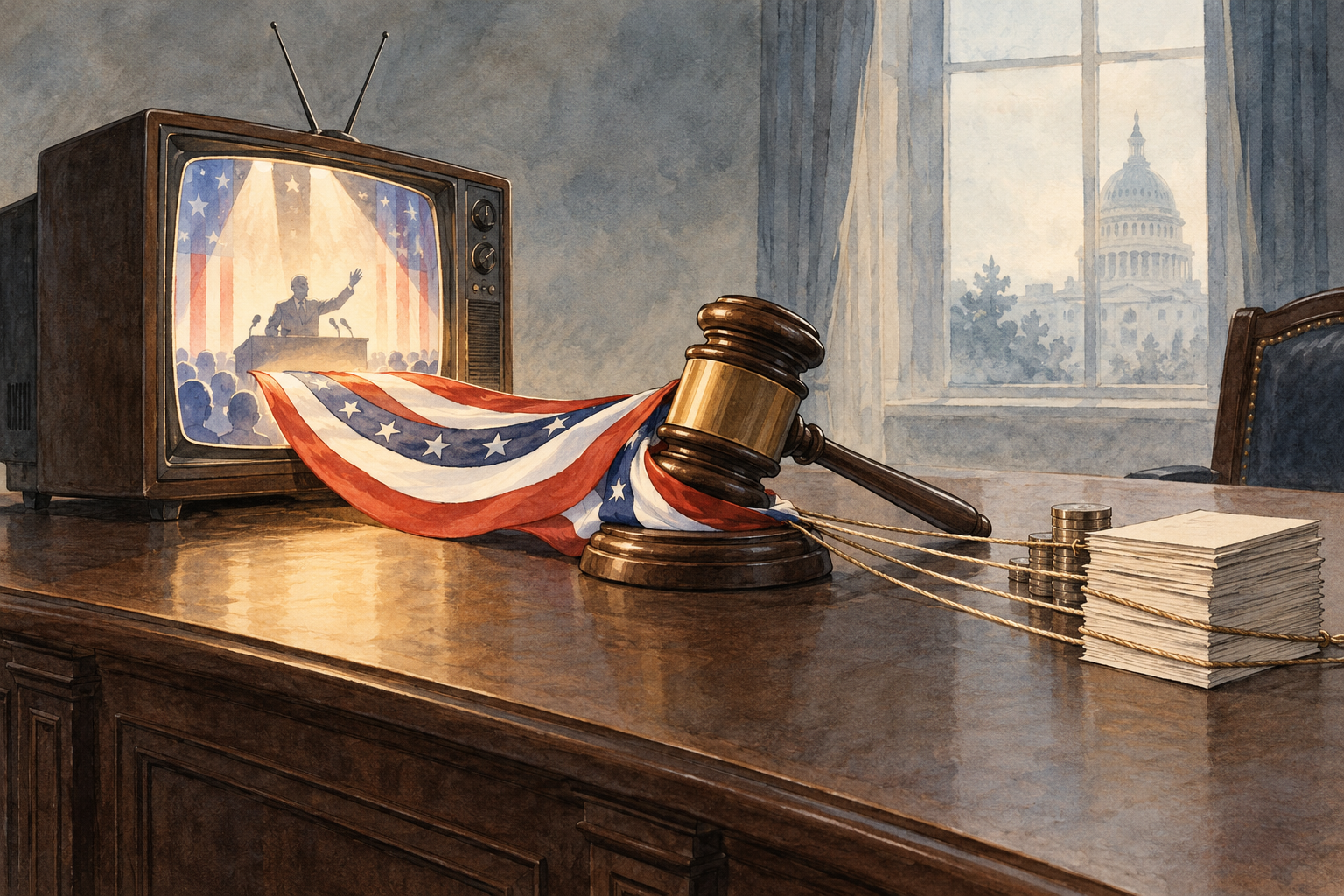
Two lawsuits filed Wednesday, October 7, ask federal courts to block further taxpayer funding for Trump administration television ads, alleging the spots crossed from public information into illegal government propaganda less than four weeks before the November 3 midterm elections.2
The Democratic National Committee filed the first case in U.S. District Court for the District of Columbia. Later Wednesday, Democracy Forward filed a separate lawsuit on behalf of Common Cause, a New York public employee union and a Democratic state legislative candidate in Alabama.2 Both complaints seek to stop additional federal spending on the ads, which have already cost more than $12 million to run, according to AdImpact figures cited by the Associated Press.2
The DNC complaint alleges that President Donald Trump personally directed the campaign; that the White House helped create the ads; that the Office of Management and Budget shifted $20 million in U.S. Customs and Border Protection funds to pay for them; and that the Department of Homeland Security carried out the spending.3 The suit seeks declaratory and injunctive relief against Trump, the White House Office, OMB and DHS. It asks the court to declare the spending unlawful and block further use of appropriated funds to develop or air what it calls propaganda ads.3
At issue is whether federal money appropriated for DHS and CBP could be used for television spots featuring or praising Trump in the closing weeks of an election season. The DNC complaint says OMB apportioned $20 million in CBP funds for “Commemorative Events,” a category Congress intended for purposes such as line-of-duty death memorials, agency anniversaries and commendation ceremonies.3 The Washington Post reported that the DNC cited prior Post reporting that the administration used money designated for CBP purposes, including memorials for officers killed in the line of duty.6
The complaint says DHS contracted with LMD Agency Inc. for a “National Media Campaign” and awarded the firm a $20 million contract to air the ads before the November elections, with LMO Advertising buying airtime.3 It alleges the funds moved through CBP’s mission support contracting division and Office of Public Affairs.3
The DNC argues that the spending violates the federal ban on using appropriations for “publicity or propaganda purposes” within the United States, as well as the Administrative Procedure Act, the Antideficiency Act and the Purpose Act.35 The complaint also describes the spending as a campaign injury, arguing that each taxpayer dollar used for the ads preserves money for MAGA Inc., a Trump-aligned super PAC, to spend in competitive races.3
The White House has defended the ads as public service announcements, saying past Republican and Democratic administrations have used taxpayer-funded advertising to promote government policies.5 Axios reported that the White House argued the spots are not political because Trump is not on the ballot and they include no call to action.5
Trump defended the ads earlier in the week as a “positive promotion” for the country but said his MAGA Inc. super PAC would pay for them going forward.2 The dispute did not end there. AP reported that a fifth ad began airing Tuesday with a “paid for by the U.S. government” notice, and that Trump had not committed to reimbursing money already spent.2 Reuters reported that the White House said Trump’s political action committee would not reimburse taxpayers for ads already run.8
A person familiar with the ad campaign told AP that government-funded ad buys placed before Trump’s pledge to switch to super PAC funding would end this week, with outside groups then taking over payment.2 The Washington Post similarly reported that government-funded ads would end this week and that ads already airing had been paid for.6
The DNC complaint describes a series of ads it says offer no public-information value and instead praise Trump, echo campaign themes or criticize political opponents. It says at least 13 campaign-style ads were in a Dropbox account controlled by LMD Agency, each ending with a “Paid for by the U.S. Government” disclosure.3
Examples cited in reports include ads using Trump’s campaign-style messaging, footage praising a “golden age of America,” and a spot about military actions involving Nicolás Maduro in Venezuela.28 AP reported that one ad was a near replica of a 2024 Trump campaign ad, a key point for plaintiffs who argue the content resembles campaign advocacy rather than neutral policy communication.2
The DNC complaint alleges that the ads aired nationally and in markets with competitive November 2026 contests. It says the campaign aims to influence the midterm elections even though Trump is not a candidate.3 The case tracker for the DNC suit says the committee alleges Trump ordered OMB Director Russ Vought to find a way to use taxpayer money to put the ads on television, and that not all of the $20 million had been spent when the lawsuit was filed.4
The lawsuits come amid broad public opposition to taxpayer-funded election-related advertising featuring senior officials. Axios reported that nearly nine in 10 voters in a Reuters/Ipsos poll said it was inappropriate to use taxpayer money for election-related ads featuring the president or Cabinet members, including 80% of Republicans.1 The same report said 9% of Americans viewed such spending as appropriate.1
That polling adds a political dimension to the legal fight, but the immediate question before the courts is statutory: whether the executive branch may use appropriated funds for communications that plaintiffs say glorify the president and aid his party. The plaintiffs argue it may not, particularly when an election is imminent and millions in federal funds remain unspent.38
The DNC asked the court to declare the administration’s actions illegal and immediately block further taxpayer-funded ads.5 The complaint asks the court to enjoin Trump, the White House Office, OMB and DHS from continuing to use appropriated funds to develop and air the ads.3
As of the October 7 filings and published reports, no injunction hearing date had been reported in the cited materials. That makes timing central. The lawsuits were filed 27 days before the November 3 midterms, and the practical effect of any court order will depend on whether a judge acts before voting concludes or before the administration and outside groups complete the planned shift away from federal funding.25
The cases could force courts to decide not only whether the specific Trump ads violated appropriations restrictions, but also how far judges may go in policing executive-branch communications during an active election period.

The UK-Germany counter-hybrid threat partnership gives ministers an international security frame for fast-tracked domestic powers to designate state-backed organisations and proxy groups. When Parliament returns on 12 October, scrutiny is likely to centre on evidence thresholds, oversight and whether the Home Secretary’s new powers are being normalised before safeguards have been fully tested.

The FCC is weighing a Club for Growth-backed request that could let political groups place prerecorded and AI-generated calls to cellphones without prior consent. Reply comments are due October 19, leaving open the possibility of a late-October decision that could affect campaign contact rules in the final stretch of the midterms.

Beijing said its military and coast guard acted lawfully after Manila accused Chinese forces of unsafe actions near disputed South China Sea features. The exchange followed a reported October 3 encounter in which the Philippine military said a Chinese J-16 fighter flew dangerously close to a Philippine C-208 patrol aircraft near Bajo de Masinloc.

Japan hosted an ASEAN-Japan AI focus session on October 6, framing artificial intelligence governance as a diplomatic and capacity-building agenda for Southeast Asia. The initiative positions Tokyo as a trusted standards partner for ASEAN as China, the United States and regional governments compete to shape AI rules and infrastructure.
Publicity or propaganda ban
A recurring appropriations restriction that bars federal funds from being used for unauthorized publicity or propaganda within the United States.
Antideficiency Act
A federal fiscal law that generally prohibits agencies from spending or obligating money beyond what Congress has authorized.
Injunctive relief
A court order requiring a party to stop or take an action; here, plaintiffs want judges to stop further taxpayer-funded ads.
Apportionment
An Office of Management and Budget process for making appropriated funds available to an agency for specified uses.





Comments