Trump ethics concession puts Senate crypto bill to test on presidential conflict rules
Associated Press
news
Trump agrees to new bipartisan ethics provision in massive crypto bill, Republican senators say
Associated Press
news
Trump agreed to new ethics rules to get a crypto bill across the line. But that might not be enough
Office of Sen. Cynthia Lummis
government
Lummis, Boozman, Scott Release Final Clarity Act Text
Untracked bias
67% of tracked sources are High factuality
Bias and factuality ratings from Media Bias Fact Check. Outlets without a rating are marked “Untracked.”
Ethics bargain
Trump agreed to key Senate crypto-bill ethics language, including a role for state attorneys general in enforcement.
Vote threshold
The procedural vote requires 60 senators, meaning Republicans need Democratic or independent support if the GOP conference is not enough alone.
State concern
A bipartisan group of 18 attorneys general warned the bill could weaken states’ ability to pursue cryptocurrency fraud.
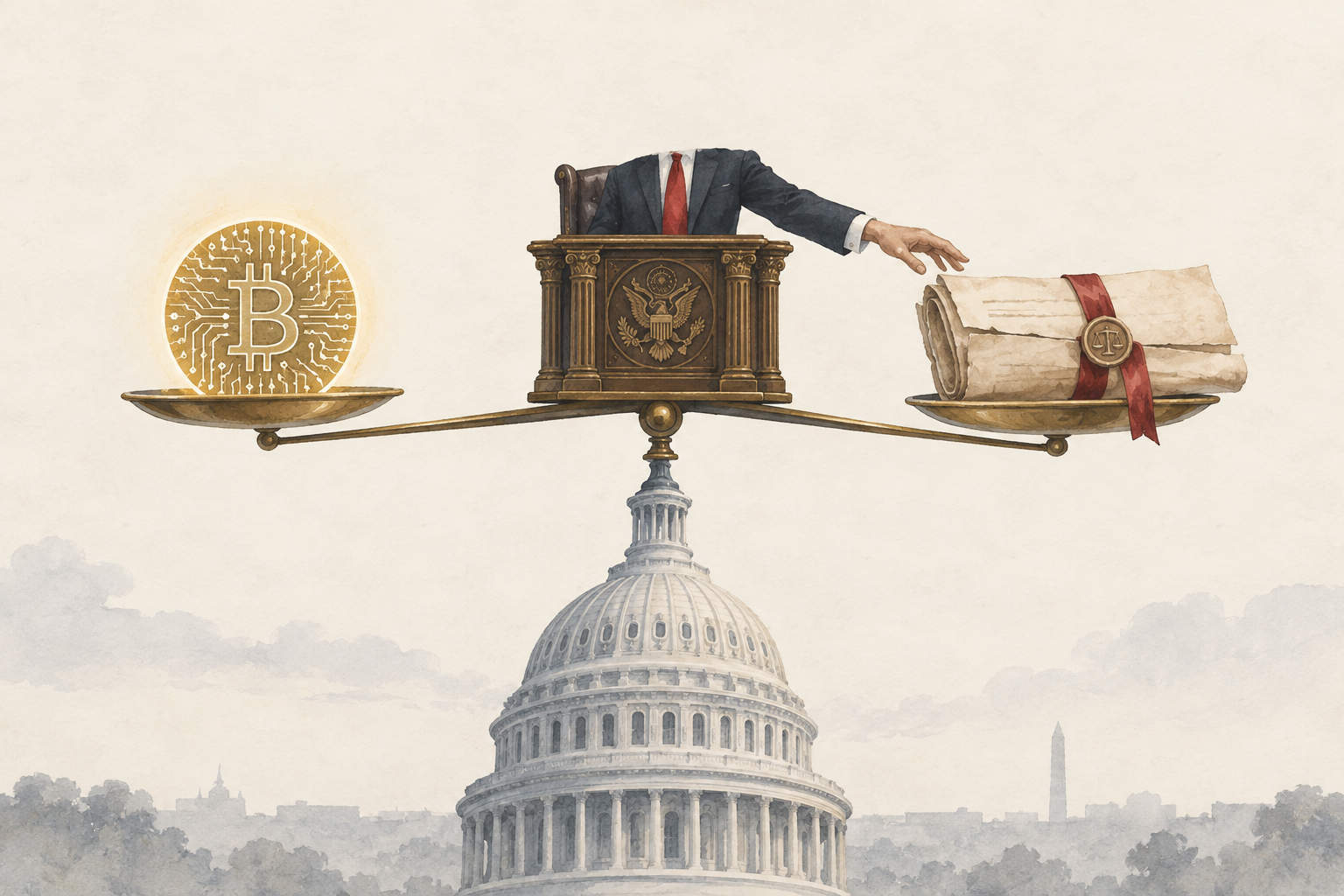
WASHINGTON — President Donald Trump’s agreement to accept major ethics restrictions in the Senate’s sweeping cryptocurrency bill has shifted the measure’s immediate test from crypto policy to political enforcement: whether Congress can bind a sitting president with conflict-of-interest rules and still assemble the 60 votes needed to advance a major economic package.
Republican authors of the Digital Asset Market Clarity Act say the latest Senate text incorporates a central demand from a bipartisan group led by Sen. Thom Tillis, R-N.C., and Sen. Ruben Gallego, D-Ariz.: giving state attorneys general a role in enforcing ethics rules, rather than leaving enforcement solely to the Justice Department.1 Senate Republicans released the final draft Monday, saying it reflects more than a year of negotiations and 126 substantive changes requested by Democrats.3
The concession is meant to unlock votes ahead of a planned Tuesday procedural vote. But it has not ended the dispute. Democrats who pressed for enforceable restrictions are still weighing whether the new text gives state attorneys general enough authority to act if a Trump-appointed Justice Department declined to pursue an alleged violation.2 Separately, a bipartisan group of state attorneys general led by New York Attorney General Letitia James warned Congress that the bill, as written, could weaken state enforcement against crypto fraud and scams.4
The Senate bill would create a comprehensive federal regulatory structure for digital assets, including clearer roles for financial regulators and new rules for crypto platforms. But the vote count has increasingly turned on Trump’s personal and family crypto interests, which Democrats have framed as an unavoidable conflict in any bill shaping the industry’s future.2
The original ethics provision would have barred federally elected officials, their spouses and federal judges from issuing digital assets. Democrats and Tillis argued that the language did not go far enough because it left enforcement to the Justice Department and did not adequately address Trump’s crypto wealth.1
According to the Associated Press, Trump agreed to much of the tougher Tillis-Gallego proposal, including language requiring officials to divest or place in a blind trust any significant financial interest in an entity that issues cryptocurrencies.1 Axios reported that the agreement would allow state attorneys general, not just DOJ, to take enforcement action for violations.5
The Republican authors — Sens. Cynthia Lummis of Wyoming, John Boozman of Arkansas and Tim Scott of South Carolina — cast the language as a major concession and a reason for Democrats to advance the bill. Their statement said the final text includes new ethics language reflecting substantially all of the Tillis-Gallego proposal, including a “meaningful role” for state attorneys general in enforcement.3
The enforcement fight matters because presidents have often been exempt from federal conflict-of-interest laws, and traditional remedies such as recusal are difficult for a president who oversees the executive branch as a whole.2 Democrats have argued that a statute aimed at presidential crypto conflicts would be ineffective if only the president’s own Justice Department could bring a case.
That argument made state attorneys general a pivotal part of the bargain. The AP reported that White House officials had privately raised concerns that Democratic state lawyers could use enforcement powers as a political weapon against Trump and other Republicans — and that Republican state attorneys general could do the same to Democrats.1 Still, Trump accepted language giving state attorneys general a role, a concession supporters hope will blunt Democratic objections.6
The question is whether that role is broad enough. The Block reported that some Democrats continued to question whether state attorneys general would have sufficient authority to bring cases directly against public officials, including the president, and whether DOJ would still effectively control enforcement.7
Gallego told reporters the new ethics language still “leaves a lot to be desired,” according to AP. Sen. Angela Alsobrooks, D-Md., said she would not support legislation that did not cover ethics and that state attorneys general needed power to act if DOJ refused.2
The White House’s concern over state attorneys general intersects with a separate objection from state law-enforcement officials: whether the Clarity Act would preserve or preempt their broader authority to police crypto fraud.
James said Monday that she led a bipartisan coalition of 17 other attorneys general opposing the bill as written, warning that it could prevent states from serving as the first line of defense against cryptocurrency fraud.4 Her office said the measure could allow the Securities and Exchange Commission to preempt state registration authorities and create ambiguity that would make it harder for state officials to bring fraud cases.4
The Block reported that state attorneys general from California, Illinois, Arizona, Kansas, Ohio, Wisconsin and other jurisdictions joined the letter, warning a day before the vote that the bill could “muddy the waters” for state prosecutors.8
That creates a two-sided political problem for bill authors. To win Democratic votes on presidential ethics, they need to empower state attorneys general. To win over state law-enforcement officials, they need to convince them the broader bill does not undercut existing state authority.
The Tuesday vote is expected to be a cloture vote on moving forward, not final passage. The Block reported that the first procedural test would require 60 votes. With Republicans holding 53 seats, at least seven Democrats or independents would need to join if all Republicans vote yes.6
Even if the Senate advances the measure, the bill would still face amendments, final Senate passage and House consideration of any Senate substitute. Axios noted that the vote comes during a narrow legislative window, with the House and Senate in session for only a limited period before the midterm elections.5
That compressed calendar gives the ethics dispute outsized importance. Republican authors argue the final text reflects Democratic demands and should be enough to begin debate.3 Democratic skeptics argue the enforcement structure remains too weak or too dependent on DOJ to meaningfully police a president’s financial interests.7
The result is that the Clarity Act’s near-term fate may depend less on crypto-market structure than on a constitutional and political question Congress rarely answers by statute: how to write enforceable ethics rules for a president who would be bound by them.

MPs have begun oral evidence on the Immigration and Asylum Bill, with UNHCR, the Independent Anti-Slavery Commissioner, the National Crime Agency and refugee-policy witnesses testing ministers’ case for tougher enforcement alongside safeguards. The provisions most likely to attract amendment pressure are those on modern-slavery credibility rules, removal-stage trafficking claims, asylum support payments and the new immigration appeals body.
The justices refused to let the Postal Service enforce new mail-ballot restrictions for the 2026 midterms, leaving election officials to proceed under existing procedures while lower-court injunctions remain in place. The dispute turns on whether USPS and the president can impose federal ballot-mail conditions over state election systems so close to Election Day.

Beijing rejected a report that Iranian forces obtained satellite imagery of a U.S. base in Jordan from Chinese entities before a deadly July attack. The allegation remains unverified by other outlets, but it highlights how commercial space imagery is becoming part of a wider technology-control dispute involving China, the United States and Middle East security.

The resignation of Chubu Electric’s top executives and withdrawal of Hamaoka reactor restart applications turn a utility governance failure into a political test for Tokyo’s push to normalize nuclear power. The case threatens to complicate Prime Minister Sanae Takaichi’s effort to accelerate restarts as Japan weighs energy costs, emissions targets and public trust.
Clarity Act
A sweeping digital-assets bill that would set federal rules for cryptocurrency markets and clarify oversight roles for agencies such as the SEC and CFTC.
Cloture
A Senate procedure used to advance debate; most legislation needs 60 votes to clear this step.
Blind trust
A legal arrangement in which an official’s assets are managed independently to reduce direct control and potential conflicts of interest.
State attorneys general
Top state legal officers who can bring enforcement actions under state or, when authorized, federal law.
Comments