China Frames Governance Agenda in UN Terms as Reform Contest Sharpens
Ministry of Foreign Affairs of the People's Republic of China
government
韩正出席第81届联合国大会一般性辩论并发表讲话
UN News via Global Issues
news
‘Safeguard the postwar order,’ China tells UN General Assembly
Xinhua
news
China to work with all countries to build a community with a shared future for humanity: VP
Untracked bias
100% of tracked sources are High factuality
Bias and factuality ratings from Media Bias Fact Check. Outlets without a rating are marked “Untracked.”
UN framing
Han Zheng presented China’s four global initiatives as aligned with UN authority rather than as alternatives to it.
Force opposed
China used the speech to criticize unilateral military action and actions that bypass the UN Security Council.
Development push
Beijing tied its Global Development Initiative to the UN 2030 Agenda and wider Global South priorities.
Chinese Vice President Han Zheng used his September 26 address to the 81st UN General Assembly to place Beijing’s four flagship global initiatives within the language of the United Nations. He argued that China’s proposals on development, security, civilization and governance offer a response to war, inequality and strains in the international order.1
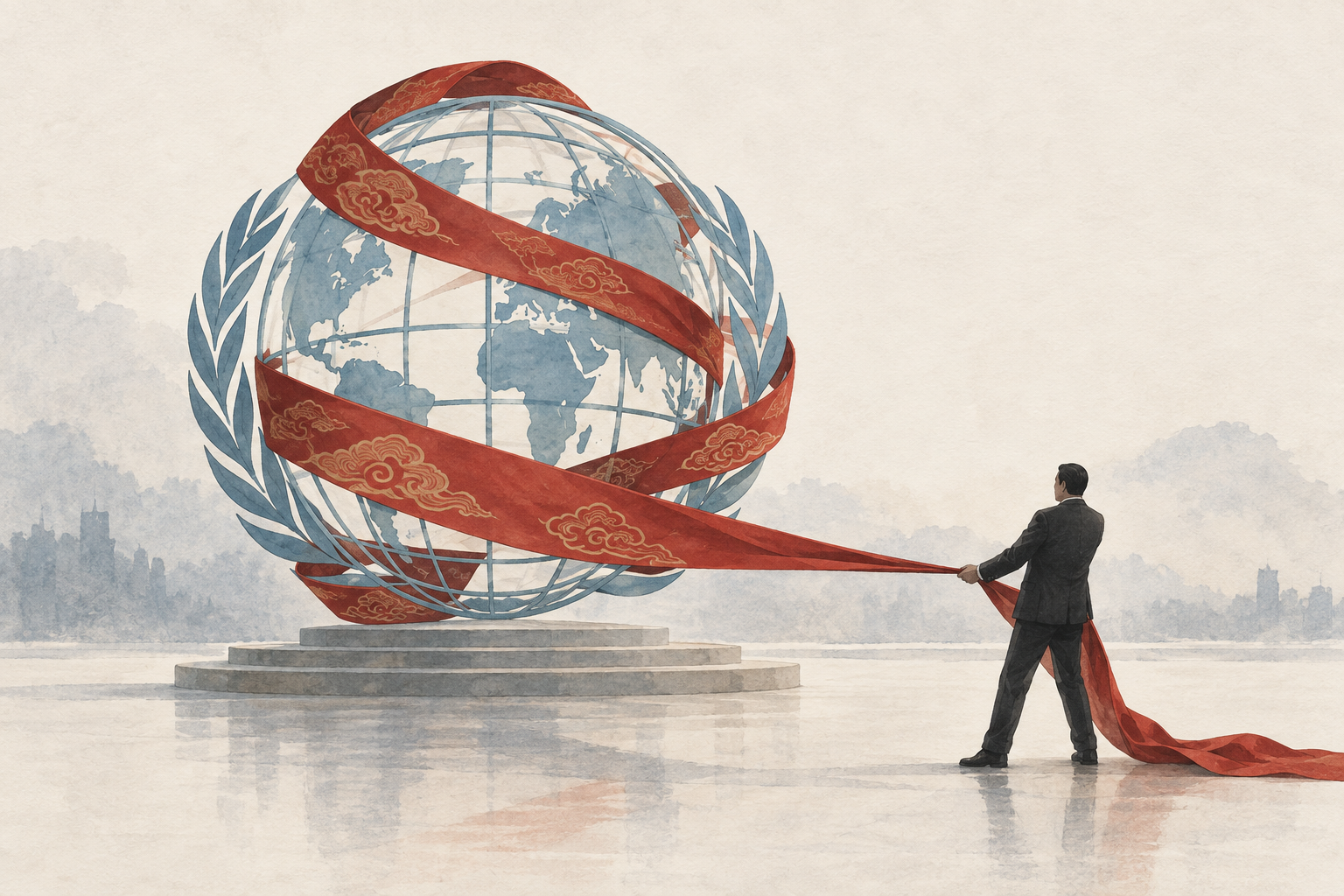
The speech was more than a defense of multilateralism. It was an effort to present China’s governance agenda as complementary to UN authority while sharpening a broader contest over who defines reform of the international system. Han framed the Global Development Initiative, Global Security Initiative, Global Civilization Initiative and Global Governance Initiative as practical paths to stability, fairness and cooperation, not as alternatives to the UN-centered order.13
That positioning matters for Asia-Pacific policy audiences. Beijing is increasingly using UN forums to argue that reform should strengthen state sovereignty, oppose bloc confrontation and give developing countries greater weight. In Han’s telling, the post-1945 order remains legitimate when anchored in the UN Charter, but it is under pressure from unilateral sanctions, military actions taken without Security Council authorization and unequal development.12
Han’s address centered on a familiar Chinese claim: the international system should be reformed, but in ways that protect the postwar order rather than remake it around new military coalitions or unilateral enforcement. According to China’s foreign ministry account, Han called for safeguarding the international system with the UN at its core, defending the international order based on international law and upholding basic norms of international relations founded on the UN Charter.1
UN News reported the same postwar-order framing, noting that China presented itself as a defender of the UN-centered system and called for a more equitable global governance structure that better reflects the interests of the Global South.2 Xinhua’s English-language account described Han’s remarks as a call to build “a community with a shared future for humanity,” linking that concept to China’s four initiatives and its stated support for UN-centered multilateralism.3
The distinction is important. Beijing is not rejecting the language of the current order; it is competing to define it. By invoking the UN Charter and the postwar settlement, China is trying to claim continuity and legitimacy for its agenda, even as it pushes back against Western-led coalitions, sanctions and intervention practices.
Han presented the four initiatives as interlocking responses to what Beijing sees as the central failures of global governance.
The Global Development Initiative is the economic pillar: a call to narrow development gaps, support poverty reduction and accelerate implementation of the UN 2030 Agenda.16 In separate September 25 remarks marking the fifth anniversary of the GDI, Han argued that development should remain central to the international agenda and described the initiative as aligned with the UN’s development mandate.6
The Global Security Initiative is the security pillar. In Beijing’s presentation, it emphasizes common security, opposition to bloc confrontation and resistance to unilateral military force. Han’s UNGA remarks criticized actions that bypass the Security Council and warned against uses of force that undermine sovereignty.12
The Global Civilization Initiative is the normative pillar. It promotes respect for different political systems and cultural models, an idea Beijing uses to counter liberal-democratic conditionality and criticism of its domestic governance model.13
The Global Governance Initiative is the newest and most explicitly institutional pillar. Han linked it to calls for making global governance more just and equitable, giving Beijing a platform to argue for changes in representation, agenda-setting and rule interpretation inside existing institutions rather than outside them.17
In a September 26 meeting with UNGA President Khalil, Han also cast the Global Governance Initiative as consistent with UN priorities. The message reinforced China’s effort to present its reform agenda as supportive of UN authority rather than disruptive to it.7
Although Han’s language was broad, the political targets were clear. Reuters reported that the speech pushed back against the United States on Iran and Cuba, including criticism related to sovereignty in the Gulf and sanctions on Cuba.5 The Associated Press similarly noted that China used the UN platform to promote development as the answer to global challenges while criticizing unilateral military action.4
This is where Beijing’s UN strategy carries both institutional and geopolitical weight. By opposing military action without Security Council approval, China is defending a legal principle while reinforcing the centrality of a body where it holds veto power. The same logic applies to sanctions. China’s criticism of unilateral sanctions allows it to present itself as a defender of developing countries while challenging a tool heavily used by Washington and its partners.5
For many governments in the Asia-Pacific, the argument has both appeal and risk. The appeal lies in the emphasis on sovereignty, development finance and non-interference. The risk is that China’s version of multilateral reform may reduce space for rights-based scrutiny, alliance coordination and responses to coercion that fall outside Security Council consensus.
Han’s development message fits a longer pattern. The AP described China’s UN speech as consistent with Beijing’s usual emphasis on global development as a solution to international problems.4 That continuity reflects a strategic choice: development is one of China’s most effective ways to speak to the Global South while avoiding a purely great-power framing of its rivalry with the United States.
The GDI gives Beijing a bridge between UN development priorities and China’s broader diplomatic network. By tying the initiative to the 2030 Agenda, China can present its programs as implementation tools rather than parallel institutions.6 That helps Beijing reduce concerns that its initiatives compete with the UN, while still allowing China to set priorities and vocabulary around development cooperation.
The same pattern is visible across the four initiatives. Each is broad enough to attract general support, but each also advances Chinese preferences: sovereignty over intervention, development over conditionality, pluralism over universal values, and institutional reform that elevates developing-country representation while limiting Western agenda-setting power.
Han’s speech shows that the battle over multilateralism is not between support for the UN and rejection of the UN. It is increasingly a contest inside the UN system itself.
China’s argument is that its initiatives defend the postwar order by returning global politics to the UN Charter, sovereign equality and development-first cooperation.12 Critics and competitors are likely to see a different project: an effort to reshape the system’s operating norms so Beijing’s preferences carry more weight and Western-led coalitions face higher legitimacy costs.
For Asia-Pacific governments, the practical question is not whether China supports multilateralism. It is what kind of multilateralism China is asking others to endorse. Han’s UNGA address made Beijing’s answer clearer: a UN-centered order in form, a sovereignty-first order in substance, and a reform agenda in which China’s initiatives are presented as the vocabulary of the future.

Mongolian Prime Minister Nyam-Osor Uchral began a Sept. 27–30 working visit to Japan, where talks with Prime Minister Sanae Takaichi are expected to deepen a partnership Tokyo frames around democracy, rule of law and strategic resilience. The visit highlights Japan’s effort to strengthen ties with inland partners positioned between China, Russia and the wider Indo-Pacific order.

External Affairs Minister S. Jaishankar’s September 26 remarks framed BRICS as supportive of the United Nations and as a source of bottom-up pressure for reform. The message fits India’s effort to pair Global South leadership with continued investment in the UN-centred multilateral system.

Israeli strikes on Sojod and the Jezzine heights on Sept. 26 suggest Israel is pairing reduced troop deployments in parts of its south Lebanon buffer zone with longer-reach pressure on suspected Hezbollah relocation routes. The pattern indicates a post-Ali Taher recalibration: less visible ground mass in some areas, but continued airstrikes, artillery, drones and demolitions across a broader belt.

Hamas criticized the US-created Board of Peace after it said it would not work with UNRWA in Gaza, turning aid delivery and postwar administration into a new flashpoint under the ceasefire. The dispute raises a practical question for Gaza’s recovery: who can move relief and rebuild services if the territory’s long-standing refugee agency is sidelined?
Global Development Initiative
A Chinese proposal that frames development, poverty reduction and implementation of the UN 2030 Agenda as central global priorities.
Global Security Initiative
Beijing’s security concept emphasizing common security, sovereignty, opposition to bloc confrontation and resistance to unilateral force.
Global Governance Initiative
China’s recent framework for reforming global governance, presented as a way to make international institutions more representative and equitable.
UN-centered order
A phrase used by China to describe an international system anchored in the United Nations, the UN Charter and state sovereignty.
Comments