Jaishankar frames BRICS expansion as a push for UN reform, not a rival order
BRICS
A grouping originally formed by Brazil, Russia, India, China and South Africa that has expanded to include additional emerging and non-Western powers.
UN Security Council reform
A long-running effort to change the membership and structure of the UN’s most powerful body, including demands for more representation from developing countries.
Global South
A broad political term for developing and emerging economies, many of which argue that global institutions underrepresent their interests.
Inverted pyramid
A news-writing structure that puts the most important information first, followed by context, analysis and background.
Business Standard
news
Brics or UN is a 'false choice', group supports UN reform: Jaishankar
The Economic Times
news
It's not BRICS or the UN, BRICS is supportive of the UN: EAM Jaishankar
Akashvani News / News On AIR
government
EAM Jaishankar meets Russian, Iranian counterparts on sidelines of UNGA in New York
Untracked bias
Bias and factuality ratings from Media Bias Fact Check. Outlets without a rating are marked “Untracked.”
False choice
Jaishankar said choosing between BRICS and the UN is a false framing because BRICS supports the UN and its reform.
Reform push
India is using BRICS expansion to amplify its case that global institutions, including the UN Security Council, must reflect current realities.
Balancing act
Jaishankar’s UNGA-side meetings with Russian and Iranian counterparts showed India’s continued use of multiple diplomatic forums at once.
External Affairs Minister S. Jaishankar has rejected the idea that India or other countries must choose between BRICS and the United Nations, calling it a “false choice” and arguing that smaller groupings can reinforce, rather than replace, the UN system.1
Speaking on the margins of the 81st session of the UN General Assembly in New York, Jaishankar said BRICS is “supportive of the UN” and that many members want the world body reformed, though with varying degrees of emphasis.2 His remarks placed India’s recent hosting of a BRICS Leaders’ Summit on September 12-13 within a broader diplomatic argument: BRICS expansion and UN reform are mutually reinforcing, not evidence of a break from the existing multilateral order.1
For India, the message is aimed at two audiences. To the Global South, New Delhi is presenting BRICS as a platform for non-Western concerns, representation and agenda-setting. To partners invested in the UN-centred order, including Western capitals, it is signalling that India’s use of BRICS is not an attempt to discard universal institutions but to reshape them.
Jaishankar’s remarks turned on a distinction central to Indian diplomacy: the UN remains indispensable, but its structure no longer reflects contemporary power, demography or development concerns. He acknowledged the UN’s shortcomings but cautioned against dismissing an institution that, in his words, the world would have to invent if it did not already exist.1
That formulation allows India to criticise the UN’s representational deficit while avoiding the charge that it is joining a parallel, anti-UN bloc. Jaishankar linked the BRICS agenda — resilience, sustainability, innovation and cooperation — to issues already before the UN, arguing that the grouping can strengthen the case for reform from below.2
This is the diplomatic logic behind India’s framing of BRICS expansion. The grouping now brings together Brazil, China, Egypt, Ethiopia, India, Indonesia, Iran, Russia, Saudi Arabia, South Africa and the United Arab Emirates, according to reports of Jaishankar’s remarks.1 Its larger and more diverse membership gives New Delhi a way to argue that demands for institutional reform are not confined to a few aspirant powers but reflect a wider shift in global politics.
India has long sought permanent membership of a reformed UN Security Council. Jaishankar’s comments were therefore less a defence of BRICS for its own sake than an effort to align the grouping with India’s reform campaign.
At the UNGA, he argued that the post-1945 international order is confronting new realities and that a large part of humanity cannot be excluded from decision-making.8 That line tracks India’s broader case for Security Council reform: institutions designed after the Second World War must adapt to a multipolar world in which developing economies, populous countries and non-Western regions carry greater weight.
BRICS helps India make that point politically. The grouping is not universal, and it contains internal contradictions, including sharp differences among members on strategic issues. But its expansion gives India a visible forum through which to argue that reform demands are collective, not merely national.
Jaishankar described BRICS as a non-Western platform that reflects viewpoints and contributions that need to be taken into account.1 That language is consistent with India’s recent emphasis on the Global South, including concerns over development finance, food and energy security, supply chains and the spillover costs of wars.
In his UNGA address, Jaishankar said countries far from conflicts were paying the price for wars not of their making. He warned that crises involving food, fuel, fertilisers and financing had made conditions especially difficult for the Global South.8 That context helps explain why India wants BRICS to be seen as a reformist pressure group rather than a spoiler: the practical issues it raises are already UN issues.
Still, the platform is complicated for India. BRICS includes China, with which India has a competitive and often tense relationship. It also includes Russia and Iran, both central to current geopolitical disputes involving the West. Jaishankar’s UNGA-side meetings with Russian Foreign Minister Sergey Lavrov and Iranian Foreign Minister Abbas Araghchi covered bilateral issues, BRICS cooperation and conflict-related developments, underscoring how India uses overlapping forums to preserve multiple channels of influence.7
A later report on the Jaishankar-Lavrov meeting said the two sides discussed coordination at the UN, G20, BRICS and other venues, as well as the annual India-Russia summit and the expected BRICS Parliamentary Forum in India.9 That is a practical example of India’s forum-by-forum balancing: maintaining legacy strategic ties, engaging Global South coalitions and keeping its diplomacy anchored to major multilateral institutions.
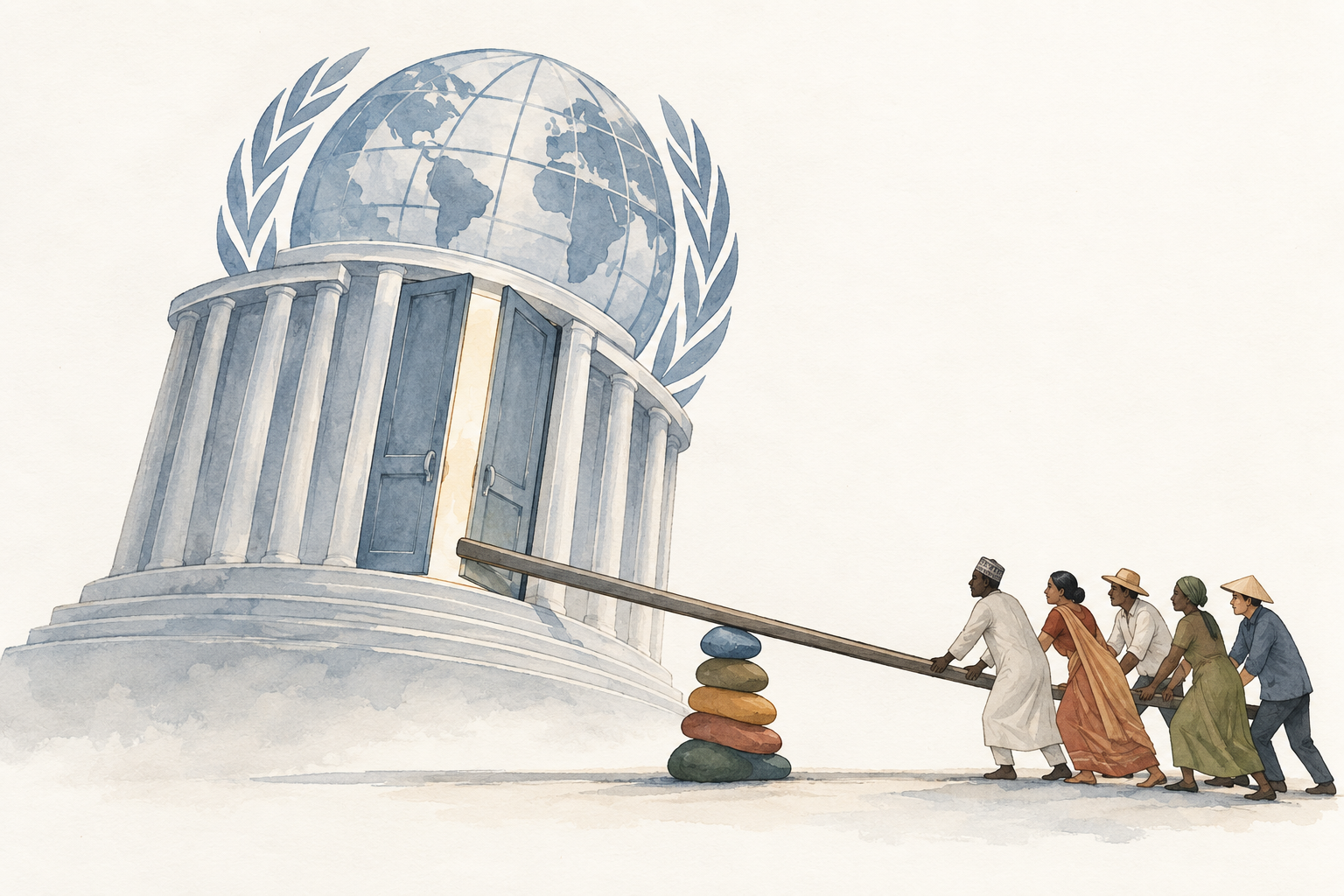
The phrase matters because India is trying to avoid being boxed into a binary foreign-policy narrative. If BRICS is portrayed as an alternative to the UN, India’s participation could be read as support for a rival order led by powers dissatisfied with Western influence. If BRICS is presented as a complement to the UN, India can use it to press reform while retaining credibility as a stakeholder in existing institutions.
That distinction is especially important as India deepens ties with Western partners in technology, defence, trade and supply-chain resilience while also working through non-Western forums. New Delhi’s preferred posture is not alignment with a single bloc but issue-based positioning across multiple coalitions.
Jaishankar’s argument therefore serves a wider strategic purpose. It tells BRICS members that India supports a stronger non-Western voice in global governance. It tells the UN system that India wants reform, not abandonment. And it tells outside observers that India’s diplomacy is best understood as an effort to redistribute influence within multilateralism, not to walk away from it.
India is presenting BRICS expansion as a source of legitimacy for UN reform, not as a substitute for the United Nations. Jaishankar’s September 26 remarks make clear that New Delhi sees smaller groupings as instruments for agenda-setting and pressure-building, while the UN remains the central arena where global legitimacy is conferred.1
For India foreign-policy watchers, the signal is that New Delhi will continue to work both tracks: using BRICS and other Global South platforms to challenge the distribution of power, while insisting that the objective is a reformed multilateral order rather than a rival one.


Comments